
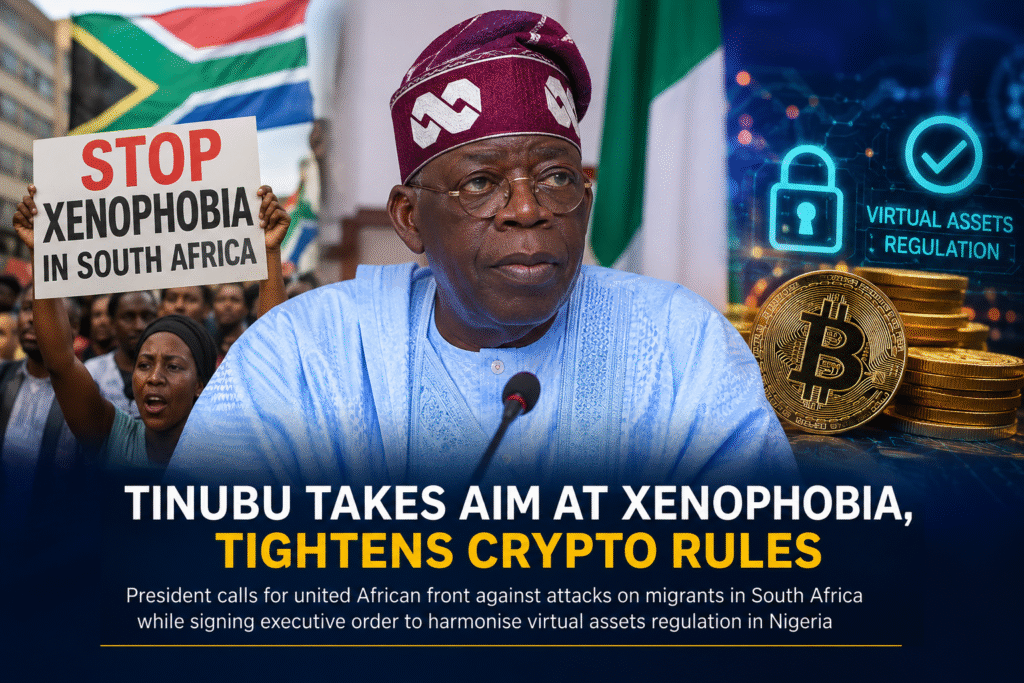
President combines pressure over attacks on African migrants with a new framework for coordinated regulation of Nigeria’s digital-asset sector
ABUJA — President Bola Ahmed Tinubu has called for a united African response to the renewed xenophobic attacks targeting Nigerians and other African nationals in South Africa, while simultaneously moving to strengthen Nigeria’s regulatory framework for virtual assets.
The twin developments highlight the administration’s growing focus on Nigeria’s role in shaping continental policy while modernising its domestic financial system.
Tinubu Seeks Continental Response
Tinubu has urged African countries to unanimously condemn the ongoing attacks against African migrants in South Africa, arguing that a united continental position would send a clear message that xenophobia and intolerance have no place in Africa.
The President’s intervention comes as Nigeria continues to respond to attacks affecting its citizens in South Africa, including through the evacuation of nationals exposed to violence.
For Abuja, however, the issue goes beyond the immediate protection of Nigerian citizens. Nigeria has traditionally regarded itself as a leading voice in African affairs, and the attacks have revived questions about the continent’s capacity to protect Africans living and working in other African countries.
Tinubu’s call for a common African position therefore places the issue within the broader framework of African solidarity and regional diplomacy.
The challenge now is whether condemnation will translate into concrete continental action.
A coordinated position through ECOWAS and the African Union could give Nigeria’s concerns greater diplomatic weight, particularly if it is accompanied by practical measures to prevent further attacks and strengthen accountability.
A Difficult Relationship
The issue is particularly sensitive because Nigeria and South Africa remain two of Africa’s most influential economies, with extensive commercial, diplomatic and people-to-people ties.
Repeated attacks against Nigerians and other African migrants risk placing additional strain on that relationship.
Nigeria’s response must therefore balance the protection of its citizens with the preservation of an important bilateral relationship.
For the Tinubu administration, the immediate test is whether diplomatic pressure can persuade Pretoria to provide stronger protection for foreign nationals and address the organisations and individuals responsible for inciting or participating in violence.
Virtual Assets Get New Regulatory Framework
On the domestic front, Tinubu has signed the Presidential Executive Order on Virtual Assets Coordination, 2026, aimed at improving coordination among Nigeria’s financial, revenue and capital-market regulatory institutions.
The order is intended to strengthen inter-agency cooperation, protect citizens from fraud, safeguard financial-system integrity and provide a more coherent framework for the responsible development of the country’s rapidly expanding digital-asset ecosystem.
The move reflects the growing importance of cryptocurrencies and other virtual assets within Nigeria’s financial landscape, while acknowledging the risks associated with an industry that has developed faster than traditional regulatory structures.
Rather than allowing multiple agencies to operate in isolation, the new framework seeks to bring greater coordination to oversight, taxation, consumer protection and financial-market supervision.
Regulation Without Killing Innovation
The central policy challenge will be finding the right balance.
Excessive regulation could discourage investment and innovation in Nigeria’s emerging digital economy. Weak regulation, on the other hand, could expose consumers to fraud, money laundering, market manipulation and other financial crimes.
The administration will therefore be judged not simply by the existence of the executive order, but by how effectively the new framework protects the public while allowing legitimate digital businesses to grow.
Two Fronts, One Strategic Message
The President’s intervention on South Africa and the new virtual-assets order address very different problems, but they point to a broader ambition: positioning Nigeria as both a stronger continental voice and a more modern regulatory state.
On xenophobia, the measure of success will be whether African diplomacy produces greater protection for migrants and meaningful accountability for perpetrators.
On virtual assets, success will depend on whether Nigeria can regulate a rapidly evolving sector without driving innovation elsewhere.
In both cases, the real test begins after the presidential announcement.
The credibility of policy is ultimately measured not by what governments declare, but by what citizens experience.