
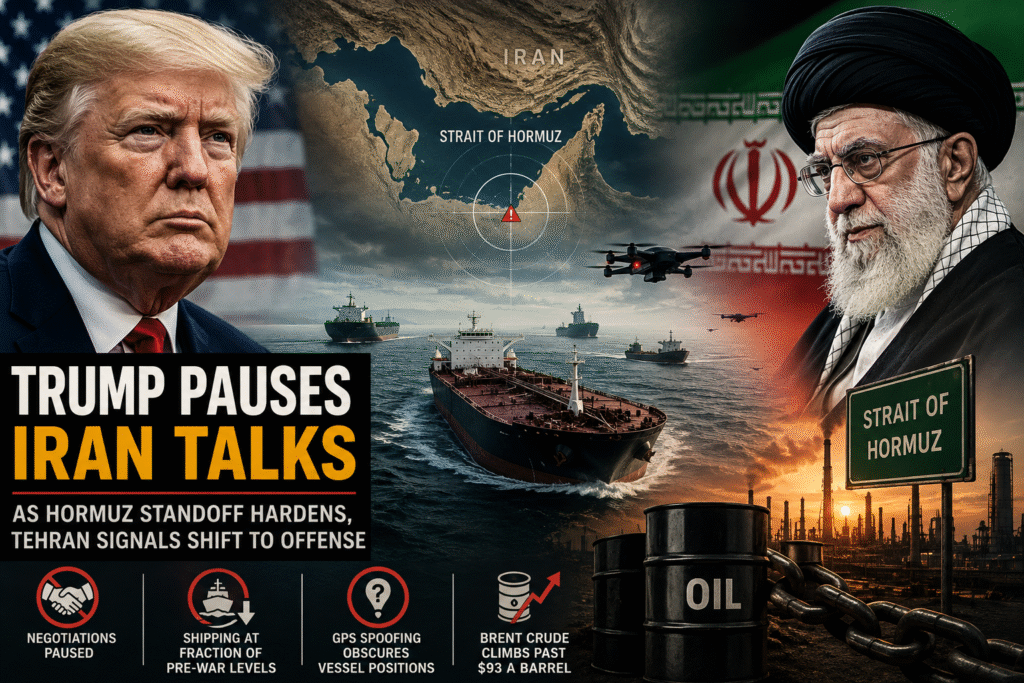
Washington and Tehran dig in as shipping collapses through the strategic waterway and Iran signals readiness for a prolonged confrontation
WASHINGTON/TEHRAN — Prospects for a diplomatic breakthrough between the United States and Iran have dimmed further after President Donald Trump said Washington had paused negotiations with Tehran, while Iranian officials signalled that the country could adopt a more aggressive military posture if diplomacy fails.
Trump said the situation with Iran was currently “so good” and suggested that negotiations could resume “at some point.” He also reiterated his claim that the United States has “complete control” of the Strait of Hormuz, describing Iranian drone activity as sporadic.
The reality on the water, however, remains considerably more complicated.
Hormuz Remains Effectively Choked
Commercial traffic through the Strait of Hormuz has fallen to exceptionally low levels. Shipping movements remain a fraction of their pre-war levels, while GPS and maritime tracking disruptions have made it increasingly difficult for vessels to navigate and establish reliable positions.
Before the conflict, roughly 110 vessels crossed the strategic waterway each day. That volume has not recovered.
The result is a maritime chokepoint that may not be formally closed in every legal or operational sense, but is functioning far below normal capacity.
Tehran Signals a Harder Line
Iran’s position is also hardening.
Iranian officials have indicated that Tehran could shift towards a more offensive military posture if diplomacy fails, including actions aimed at challenging the U.S. presence and reopening the Strait on terms favourable to Iran.
The message is clear: Tehran appears increasingly prepared to use the strategic waterway as leverage while betting that prolonged confrontation could eventually strengthen its bargaining position.
That raises the risk that the dispute will evolve from a struggle over reopening Hormuz into a wider contest over deterrence, economic endurance and regional military dominance.
The Economic Shock Is Global
The consequences extend well beyond the Gulf.
The disruption of one of the world’s most important energy corridors has pushed crude prices higher and increased uncertainty across global shipping and energy markets.
Nigeria is already feeling the effect.
The recent increase in Dangote Petroleum Refinery’s petrol price to ₦1,185 per litre has coincided with Brent crude climbing above $93 a barrel, illustrating how developments thousands of kilometres away can quickly translate into higher costs for Nigerian motorists and households.
Domestic refining has reduced Nigeria’s dependence on imported petroleum products, but it cannot completely insulate the country from movements in global crude prices.
A War Becoming Harder to End
The danger now is that Washington and Tehran may be settling into competing calculations of endurance.
Washington appears confident that sustained economic and military pressure will eventually force Iran back to the negotiating table. Tehran, meanwhile, appears increasingly willing to absorb economic pain if it believes prolonged confrontation can improve its bargaining position.
That creates a dangerous stalemate.
The longer Hormuz remains effectively crippled, the greater the pressure on global energy markets. The longer diplomacy remains frozen, the greater the risk that a maritime confrontation develops into a wider regional escalation.
For now, the Strait of Hormuz has become more than a shipping problem.
It is the pressure point where military strategy, diplomacy and the global economy are colliding.