
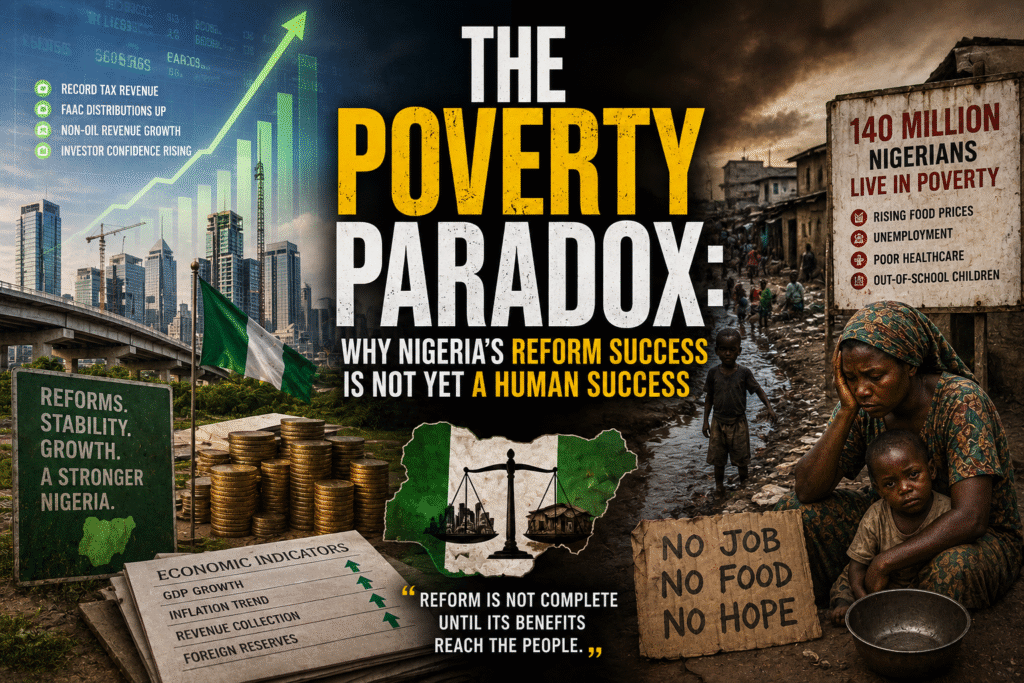
There is a number that should dominate every cabinet meeting, every budget review, every FAAC celebration, and every assessment of Nigeria’s economic trajectory.
That number is 140 million.
One hundred and forty million Nigerians now live in poverty.
Not the poverty of statistical abstraction. Not the poverty of economic modelling. But the poverty of empty kitchens, abandoned classrooms, untreated illnesses, and dreams deferred by circumstances beyond individual control.
It is a figure so large that it is easy to become numb to its significance. Yet behind that number are real people making impossible choices every day: parents choosing between food and school fees, farmers unable to afford inputs, graduates unable to find meaningful work, and families watching inflation consume whatever income they have left.
The World Bank’s latest assessment presents a troubling paradox. The institution has broadly endorsed many of the reforms undertaken by the administration of President Bola Ahmed Tinubu while simultaneously reporting a rise in poverty levels across the country.
That contradiction should concern everyone.
Because while economic reforms may be necessary, their ultimate purpose is not to improve indicators. Their purpose is to improve lives.
The Case for Reform Was Real
It is important to begin with honesty.
The economic model inherited by the current administration was unsustainable.
Fuel subsidies had become a fiscal black hole, consuming resources that could have been directed toward infrastructure, healthcare, education, and productive investment. Exchange-rate distortions encouraged speculation, discouraged investment, and created multiple opportunities for arbitrage. Debt-service obligations had reached alarming levels relative to government revenue.
Maintaining the status quo was not an option.
The decision to remove the fuel subsidy and liberalise the foreign exchange market was politically costly, but the underlying structural problems were real. Few serious economists dispute that reforms were needed.
The question today is not whether reforms were necessary.
The question is whether the benefits of those reforms are reaching ordinary Nigerians.
The Revenue Revolution
On paper, there are reasons for optimism.
Government revenues have improved significantly. Tax collections have reached record levels. FAAC distributions to states and local governments have increased substantially. Non-oil revenues now constitute a larger share of public income than at any point in decades.
These developments matter.
For years, Nigeria suffered from a chronic inability to generate sufficient domestic revenue. The result was dependence on borrowing, vulnerability to oil-price shocks, and limited fiscal capacity.
The current administration deserves credit for addressing some of those structural weaknesses.
The numbers suggest that the state’s ability to raise revenue has improved.
Yet the lived reality of many Nigerians tells a different story.
Food remains expensive.
Transport remains expensive.
Housing remains expensive.
Healthcare remains increasingly unaffordable.
For millions of households, the macroeconomic gains celebrated in Abuja have not translated into tangible improvements in daily life.
The Distribution Problem
This is the central challenge confronting the administration.
The reform dividend exists.
But it has a distribution problem.
The gains are visible in government accounts, investor reports, and international assessments. They are evident in improved revenue mobilisation and growing confidence among external observers.
What remains less visible is their impact on the average Nigerian household.
Economic reform is not merely about stabilising fiscal balances.
It is about ensuring that increased state capacity ultimately produces better public outcomes.
Citizens do not experience economic policy through debt-service ratios or foreign-reserve figures.
They experience it through schools.
Through hospitals.
Through roads.
Through jobs.
Through food prices.
If those indicators remain weak, then the political and social legitimacy of reform inevitably comes under strain.
No government can indefinitely ask citizens to endure hardship on the promise of future prosperity without demonstrating that the promised future is beginning to arrive.
Debt Still Casts a Long Shadow
The debt challenge remains another source of concern.
While improvements have been recorded in the debt-service-to-revenue ratio, Nigeria’s overall debt burden continues to rise.
Revenue growth has provided breathing space, but debt obligations still consume resources that could otherwise support productive investment and social development.
This is not merely an accounting issue.
It is a developmental issue.
Every naira devoted to servicing debt is a naira unavailable for classrooms, healthcare facilities, agricultural support programmes, power infrastructure, and job creation.
Fiscal sustainability matters. But so does developmental sustainability.
A nation cannot achieve long-term stability if its citizens remain trapped in worsening conditions while macroeconomic indicators improve around them.
The Political Test Ahead
As political attention gradually shifts toward 2027, the administration faces a critical temptation.
It can focus on managing perceptions.
Or it can focus on transforming realities.
Those are not always the same thing.
Nigeria does not need more announcements of revenue milestones.
It needs visible evidence that those revenues are changing lives.
The true measure of economic success is not whether international institutions approve of reforms.
Nor is it whether investors express confidence.
Those are important signals, but they are not the final verdict.
The final verdict belongs to the citizens who experience the consequences of policy every day.
What Must Happen Next
The administration’s fourth year must be different from its first three.
The emphasis must now shift from stabilisation to delivery.
First, government must establish a transparent framework that directly links rising public revenues to measurable improvements in education, healthcare, food security, and social protection.
Second, debt accumulation must be approached with greater caution and accompanied by clear public accountability regarding how borrowed funds are utilised.
Third, budget implementation must receive the same level of attention as budget announcements. Citizens deserve to know not only what government intends to spend, but what is actually spent and what outcomes are achieved.
Fourth, poverty reduction must become the primary metric through which reform success is judged.
A reform programme that strengthens the state while leaving millions behind cannot be regarded as complete.
A Final Word
History will likely record that President Bola Tinubu inherited a deeply distorted economy and took politically difficult decisions that many before him avoided.
The fuel subsidy is gone.
The exchange rate has been liberalised.
Government revenues have risen sharply.
International financial institutions are increasingly optimistic about Nigeria’s macroeconomic trajectory.
Those achievements matter.
But history is unlikely to remember revenue collections, debt ratios, or sovereign ratings with the same intensity that Nigerians remember whether they could afford food, whether their children stayed in school, whether hospitals functioned, and whether work provided dignity rather than mere survival.
That is the administration’s unresolved contradiction.
A government cannot celebrate record revenues while presiding over record levels of poverty. It cannot point to improving fiscal indicators while millions experience declining living standards.
The ultimate test of reform is not whether markets approve.
It is whether people prosper.
The arithmetic is straightforward. If economic reforms generate growth but leave 140 million Nigerians trapped in poverty, then the work remains unfinished.
The reforms may have stabilised the state.
They have not yet transformed society.
Nigeria’s citizens have borne the cost of adjustment.
The time has come for them to receive its benefits.
Not in speeches.
Not in projections.
Not in international commendations.
But in jobs, schools, hospitals, food security, and a tangible improvement in the quality of everyday life.
That is the dividend Nigerians were promised.
And that is the dividend they are still waiting for.