
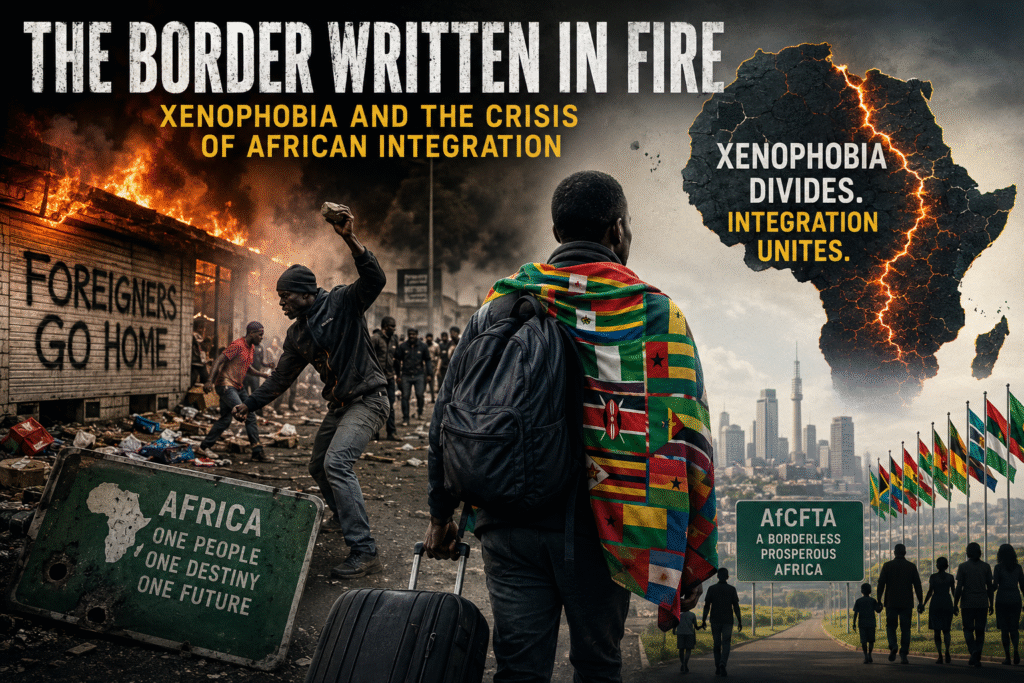
South Africa’s xenophobia is no longer a domestic crisis. It is a direct threat to African integration, continental mobility, and the future of AfCFTA.
By TMN Editorial Board
When African migrants are hunted through the streets of Johannesburg, when Somali shopkeepers are burned out of townships, when Nigerian-owned businesses are looted in Durban, or when Zimbabwean workers are beaten by mobs chanting nationalist slogans, the violence is often described as criminal unrest.
It is not.
It is political violence with continental consequences.
And after three decades of recurring attacks, the time has come to say clearly what African governments and multilateral institutions have too often avoided saying plainly: South Africa’s xenophobia is now one of the greatest internal threats to the African integration project.
This is no longer merely about immigration. It is about whether Pan-Africanism itself has meaning beyond speeches and summit communiqués.
South Africa occupies a paradoxical place in modern Africa.
It is the continent’s most industrialised economy. One of the largest beneficiaries of intra-African trade. A diplomatic heavyweight within the African Union. And a critical anchor of the African Continental Free Trade Area (AfCFTA).
Yet it is also, by any measurable standard, the most dangerous country in Africa for fellow Africans attempting to live, work, or trade across borders.
That contradiction is unsustainable.
AfCFTA envisions a continent where Africans move freely, trade freely, invest freely, and build integrated value chains across national boundaries. But every xenophobic attack in South Africa tears directly at that vision.
A continental market cannot function where African mobility is criminalised socially, even if it is protected legally on paper.
Too much discussion around AfCFTA focuses narrowly on tariffs, customs procedures, and trade protocols.
But trade agreements do not function independently of people.
The Nigerian entrepreneur operating in Johannesburg, the Malawian trader supplying township markets, the Somali retailer running informal distribution chains, the Zimbabwean technician working in Gauteng — these are not peripheral actors in the African integration project.
They are its human infrastructure.
They do, often informally and at personal risk, what African institutions formally aspire to achieve.
When their businesses are destroyed, the damage extends beyond individual suffering. Supply chains collapse. Commercial trust erodes. Informal regional markets weaken. Cross-border entrepreneurial confidence disappears.
Every pogrom against African migrants in South Africa is therefore simultaneously:
a humanitarian crisis,
a governance failure,
and an economic attack on continental integration itself.
The most disturbing dimension of the crisis is not only the violence.
It is the institutional silence surrounding it.
The African Union issues statements heavy with diplomatic caution and light on consequence. The AfCFTA Secretariat — whose mandate is directly threatened by anti-African violence — remains conspicuously restrained. SADC, despite possessing direct regional jurisdiction, has repeatedly approached the issue as episodic unrest rather than a structural regional security problem.
This passivity has created a dangerous perception: that xenophobic violence in South Africa carries no meaningful continental cost.
That calculation must change.
The Airlift Fallacy
Each time xenophobic violence erupts, African governments face domestic pressure to “bring their citizens home.”
Politically, the instinct is understandable. Strategically, it is profoundly flawed.
Airlifting nationals out of South Africa may appear decisive, but it ultimately validates the very logic xenophobic violence seeks to impose: that African migrants do not belong and can be violently removed from South African space.
Every evacuation unintentionally communicates three dangerous messages:
- Violence works.
- African states will retreat rather than insist on rights.
- South Africa can resolve diplomatic crises through displacement rather than accountability.
The continent cannot build Pan-Africanism by evacuating Pan-Africans from African countries.
Equally important, every retaliatory or tit-for-tat diplomatic response risks becoming strategically self-defeating. Reciprocal hostility — whether through economic retaliation, symbolic reprisals against South African businesses, or escalating nationalist rhetoric — may satisfy domestic political anger in the short term, but it ultimately deepens the very fragmentation AfCFTA was designed to overcome.
Africa cannot answer xenophobic nationalism by reproducing competing nationalisms across the continent.
The challenge is therefore larger than evacuation logistics or diplomatic outrage. The real question is whether Africa can construct a rules-based continental order where the protection of African nationals does not depend on reciprocal coercion, emotional retaliation, or periodic evacuation flights.
Durable integration requires institutional enforcement, legal accountability, and coordinated multilateral pressure — not cycles of retaliatory diplomacy between economically interdependent states.
What Accountability Should Look Like
The African Union already possesses mechanisms capable of intervention.
Article 4(h) of the AU Constitutive Act grants authority to intervene in grave circumstances, including crimes against humanity. Recurrent mass violence targeting African nationals across decades demands at minimum a formal continental inquiry framework.
The African Commission on Human and Peoples’ Rights should conduct country investigations into xenophobic violence with binding recommendations.
The AfCFTA Secretariat must formally classify anti-African business destruction and mobility insecurity as non-tariff barriers to trade and continental integration.
SADC should activate its Organ on Politics, Defence and Security Cooperation to treat xenophobic violence as a regional security issue rather than a domestic public-order inconvenience.
The United Nations Special Rapporteur on Xenophobia and Related Intolerance should be formally invited by African member states collectively to conduct a sustained country examination of South Africa.
Most importantly, continental institutions must move beyond symbolic condemnation toward enforceable consequence frameworks.
Without consequence, every future statement becomes theatre.
The Need for Criminalisation
South Africa’s current legal architecture remains fundamentally inadequate.
While general hate-crime provisions exist, xenophobia itself is still not treated with the seriousness demanded by its scale and recurrence.
This matters because law does more than punish. Law names. Law classifies. Law signals moral seriousness.
When anti-African violence is prosecuted merely as ordinary assault, looting, or vandalism, the systematic and identity-based nature of the attacks disappears from the legal record.
Specific criminalisation would:
establish aggravated sentencing standards,
create clearer civil liability pathways,
enable institutional monitoring,
and force the state itself to confront xenophobia as a coherent political phenomenon rather than isolated criminal disorder.
Without legal recognition, the cycle simply resets after each outbreak.
The Structural Reality Cannot Be Ignored
None of this means South Africa’s internal socioeconomic conditions should be ignored.
Unemployment above thirty percent. Failing service delivery. Entrenched inequality. Urban overcrowding. Political frustration. And years of governance erosion under the ANC.
These realities create the combustible conditions xenophobic politics exploits.
But structural explanation must never become structural excuse.
For too long, the complexity of South Africa’s domestic crisis has functioned as a diplomatic shield against accountability. The result has been a recurring pattern:
violence erupts,
outrage spreads,
governments protest,
statements are issued,
tensions subside,
and nothing fundamentally changes.
Until the next cycle begins.
The Future of Pan-Africanism
The stakes now extend beyond South Africa itself.
AfCFTA represents the most ambitious economic integration project in modern African history — a continental market built on the assumption that Africans can move, trade, work, and build across borders safely.
If that assumption collapses in Africa’s most industrialised economy, the political credibility of the entire integration project weakens with it.
This is why South Africa’s xenophobia is not a local crisis. It is a continental stress test.
Can African institutions defend African mobility? Can Pan-Africanism survive nationalist violence? Can integration exist where Africans fear other Africans?
Those are now the real questions.
The right of Africans to live and work freely across their continent is not a favour to be negotiated during moments of crisis. It is supposed to be the foundational premise of the African project itself.
If Africa cannot defend that principle inside its own borders, then AfCFTA risks becoming exactly what xenophobic politics has always threatened to reduce it to:
a document, rather than a reality.