
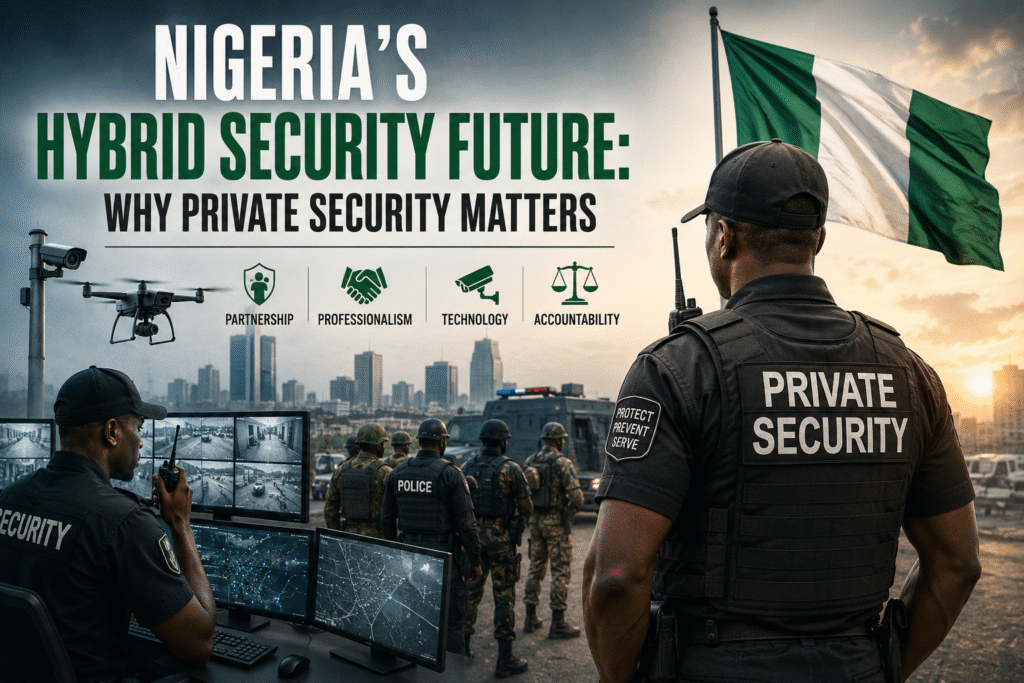
Nigeria’s security crisis has outgrown the capacity of conventional state institutions. From insurgency in the North-East to banditry in the North-West, kidnapping across the South-East and Middle Belt, oil theft in the Niger Delta, and urban criminality in major cities, the Nigerian state is confronted by a multidimensional threat environment that has stretched the Police, military, Department of State Services (DSS), and Nigeria Security and Civil Defence Corps (NSCDC) to their operational limits.
In this expanding vacuum, private security has emerged not merely as a commercial service industry, but as a strategic necessity within Nigeria’s evolving security architecture.
Today, thousands of private security companies operate across the country, employing hundreds of thousands — perhaps over a million — personnel in guarding residential estates, banks, schools, telecommunications infrastructure, oil installations, shopping complexes, hospitals, industrial facilities, and government assets. In many urban and semi-urban spaces, the visible face of everyday security is no longer the state policeman, but the private guard.
This transformation raises an important national question: Can private security help address the inadequacies of Nigeria’s security sector?
The answer is yes — but only if Nigeria avoids the dangerous mistake of confusing expansion with effectiveness.
At present, the private security industry in Nigeria occupies a paradoxical position. It is simultaneously indispensable and underdeveloped; strategically valuable yet structurally weak; increasingly influential but poorly integrated into the broader national security framework.
There is little doubt that private security companies now fill critical operational gaps left by overstretched public institutions. Their contribution is particularly significant in intelligence gathering, surveillance, infrastructure protection, and rapid local response. Because many private security personnel work directly within communities, facilities, and neighbourhoods, they often possess real-time situational awareness unavailable to centralized state agencies.
This local proximity is an underutilised strategic asset.
Modern security threats thrive on intelligence failure. Terrorism, kidnapping, and organized criminality are rarely spontaneous phenomena; they evolve through planning, reconnaissance, and local collaboration. A properly coordinated private security network could therefore serve as an extensive early-warning system capable of feeding actionable intelligence to the Police, DSS, NSCDC, and military formations.
Yet Nigeria has not fully institutionalised this possibility.
Instead, collaboration between public and private security actors remains largely informal, personality-driven, and inconsistent. Intelligence sharing is often ad hoc rather than systematic. Operational coordination is weak. In many instances, private guards remain little more than observers without formal channels through which threat intelligence can be escalated quickly and securely.
This represents a major structural failure.
What Nigeria requires is not merely more private security companies, but an integrated public-private security coordination architecture. There must be formal mechanisms through which licensed private security operators can interface with state security agencies under clearly defined legal and operational frameworks. Without institutional integration, the sector’s potential will remain fragmented and underutilised.
Technology further strengthens the case for strategic integration.
The security landscape is changing rapidly. Criminal organizations now employ sophisticated communication systems, surveillance evasion tactics, drones, cyber tools, and coordinated mobility networks. Conventional security responses alone are no longer sufficient.
Interestingly, many private security firms are adapting faster than public institutions in deploying technology-driven security systems. AI-assisted surveillance, drone monitoring, biometric access control, smart sensors, and advanced detection systems are increasingly becoming part of private security operations protecting critical infrastructure.
This evolution is important because modern security effectiveness is increasingly determined not only by manpower, but by technological superiority and information dominance.
However, technology without accountability creates another danger.
A poorly regulated private security environment equipped with sophisticated surveillance tools could easily produce privacy violations, intelligence abuse, extortion, illegal detention, and human rights violations. Around the world, the privatization of security has often generated serious concerns regarding oversight, transparency, and the legitimate use of force.
Nigeria must avoid that path.
This is why current discussions surrounding reform of the Private Guards Companies Act of 1986 are critically important. The existing law is outdated and incapable of regulating the realities of twenty-first century private security operations. A modern regulatory framework must establish:
- enforceable professional standards,
- graded licensing systems,
- mandatory training requirements,
- technology compliance standards,
- oversight and accountability mechanisms,
- intelligence-sharing protocols,
- human rights safeguards,
- and strict penalties for unlicensed operations.
Licensing without enforcement is meaningless.
One of the greatest weaknesses of Nigeria’s private security sector remains the proliferation of poorly regulated and sometimes unregistered operators. Many guards are inadequately trained, poorly paid, weakly supervised, and vulnerable to compromise. Low remuneration has created a dangerous cycle of low morale, poor professionalism, insider collaboration, and operational inefficiency.
An underpaid guard protecting a bank, estate, or critical facility is not merely a labour concern; he may become a national security vulnerability.
This is why welfare reform must become part of security reform. Security personnel who operate under exploitative conditions cannot consistently deliver professional security outcomes. Improved salaries, insurance coverage, career pathways, certification systems, and continuous professional training are necessary if the industry is to mature into a credible national security partner.
Equally significant is the issue of oversight.
The emerging engagement between Nigeria and international accountability frameworks such as the International Code of Conduct Association (ICoCA) and the Montreux Document reflects growing recognition that private security governance must align with global standards. These frameworks are important because they introduce ethical conduct principles, complaints mechanisms, and human rights benchmarks into an industry that can easily become abusive if left unchecked.
But reforms alone will not solve Nigeria’s security crisis.
Private security companies cannot replace the constitutional responsibilities of the Nigerian state. They cannot substitute for national defense, criminal prosecution, border management, counterterrorism strategy, or sovereign law enforcement. The state must retain monopoly over legitimate coercive authority.
What private security can provide is strategic support.
Its most realistic and valuable roles lie in:
- intelligence support,
- infrastructure protection,
- surveillance,
- access control,
- technological monitoring,
- local threat detection,
- and manpower supplementation.
In essence, private security should function as a force multiplier — not as a parallel state.
Nigeria is gradually moving toward what security scholars describe as “hybrid security governance,” where state and non-state actors jointly contribute to national security management. This transition is not unique to Nigeria. Across the world, governments increasingly collaborate with private actors to manage critical infrastructure protection, cybersecurity, logistics security, and surveillance systems.
The challenge, however, is ensuring that such collaboration strengthens the state rather than weakens it.
A fragmented private security environment operating without effective regulation could deepen insecurity instead of reducing it. Unregulated growth may produce competing security interests, weak accountability, and commercialization of coercive power. The consequences of such institutional disorder would be severe.
The true test, therefore, is implementation.
Nigeria has never suffered from a shortage of policy recommendations. What has historically undermined security reform is the persistent gap between legislation and enforcement, between institutional rhetoric and operational reality.
If the Federal Government genuinely intends to reposition private security as a meaningful component of national security strategy, then reforms must move beyond conferences, communiqués, and policy declarations. Enforcement must be visible. Oversight must be independent. Licensing standards must be credible. Intelligence coordination must be operational. Professionalism must be measurable.
Most importantly, political will must be sustained.
Private security is no longer peripheral to Nigeria’s security reality. It has become an essential layer within the country’s broader security ecosystem. But whether it becomes a transformative national asset or remains a loosely regulated supplementary industry depends entirely on the seriousness with which Nigeria approaches reform.
The country stands at a critical crossroads.
Handled properly, private security can strengthen national resilience, improve intelligence gathering, protect critical infrastructure, support overwhelmed public agencies, and modernize aspects of Nigeria’s security architecture.
Handled poorly, it risks becoming another fragmented sector overwhelmed by corruption, weak oversight, and institutional failure.
Nigeria cannot afford the latter.