
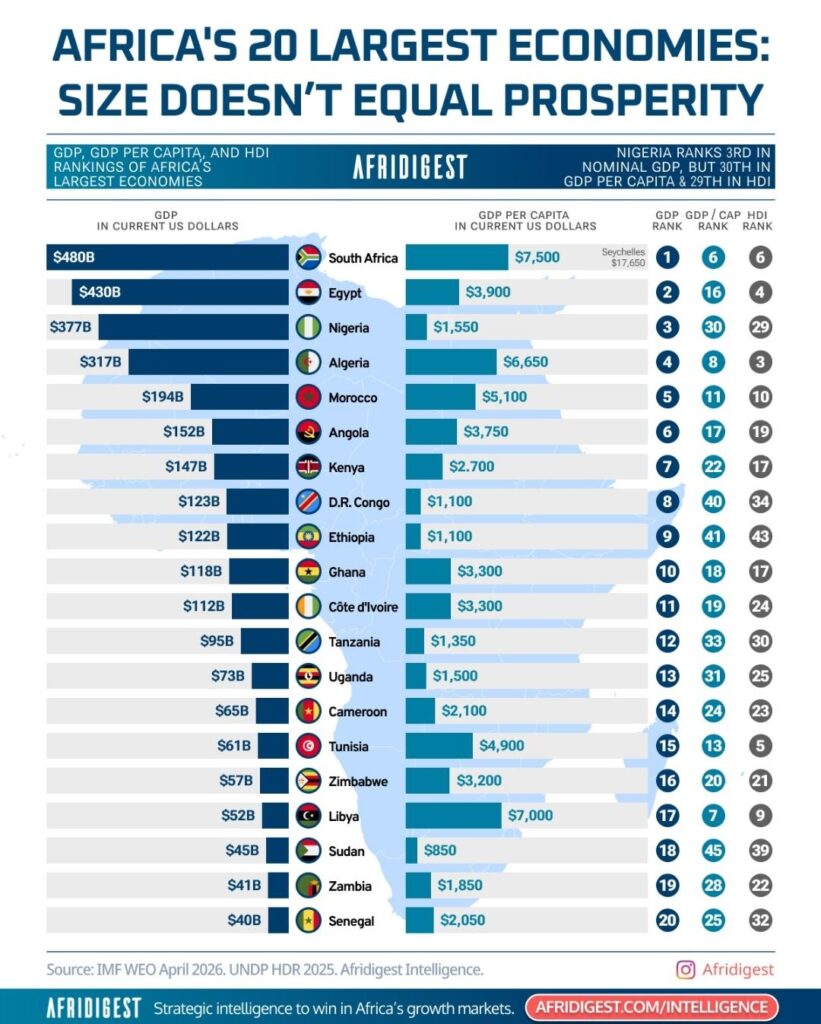
Third on the continent by GDP, thirtieth by per capita income, twenty-ninth by human development — Nigeria’s economic story is a monument to extraction dressed as progress.
TMN Editorial Board | May 2026
Nigeria has long worn the title “Giant of Africa” with ceremonial confidence. The numbers increasingly suggest something far less triumphant: a giant hollowed out from within.
The latest International Monetary Fund projections place Nigeria as Africa’s third-largest economy, with nominal GDP estimated at approximately $377 billion. On paper, the figure is formidable. It confers diplomatic prestige, attracts investor attention, and sustains the mythology of continental leadership.
But aggregate size is not prosperity. It is possible for an economy to grow large while the people inside it grow poorer.
Strip away the headline GDP figure and the Nigerian story changes almost immediately. At roughly $1,550 GDP per capita, Nigeria ranks around thirtieth in Africa — a collapse of twenty-seven positions from its GDP standing. Its Human Development Index ranking is similarly dismal. Measured not by extraction but by lived human outcomes — education, health, life expectancy, purchasing power — Africa’s so-called giant begins to resemble a state structurally disconnected from the welfare of its own population.
That gap is not statistical noise. It is the defining fact of the Nigerian political economy.
THE GOVERNANCE DIVIDE
Comparisons with Nigeria’s continental peers reveal the scale of the distortion.
South Africa, despite profound inequality and social fragmentation, maintains a far closer relationship between economic scale and citizen welfare. Egypt’s gap is substantial but narrower. Algeria’s is narrower still, suggesting at least partial conversion of hydrocarbon wealth into social infrastructure and public welfare systems.
Nigeria stands apart for a darker reason: the economy produces wealth without broadly distributing it.
This is the central paradox of the Nigerian state. The country generates enough aggregate value to appear powerful internationally while remaining unable — or unwilling — to translate that value into measurable improvements in human development.
A large economy with mass poverty is not an emerging power. It is a structural warning sign.
THE POPULATION EXCUSE
The most common defence is demographic: Nigeria’s population, now estimated above 220 million, dilutes per capita outcomes.
The argument is mathematically correct and politically evasive.
Population is not a natural disaster. It is a governance variable.
A functioning state converts demographic scale into labour productivity, industrial capacity, domestic consumption, innovation, and long-term economic expansion. Countries that successfully industrialise do not fear population size; they harness it.
Nigeria has struggled to do so because economic growth has remained excessively extractive rather than productive.
Oil dominates exports but employs relatively few citizens. Public revenues circulate through elite political networks faster than through productive investment systems. Manufacturing remains weak. Electricity supply remains unreliable. Technical education remains underfunded. Infrastructure gaps suppress industrial competitiveness. The economy consumes imports it does not competitively replace.
The result is a growth model that enlarges GDP without structurally expanding prosperity.
THE HUMAN DEVELOPMENT INDICTMENT
GDP figures can be manipulated by exchange rates, oil cycles, and statistical rebasing. Human development indicators are more difficult to disguise.
Nigeria’s low HDI ranking reflects cumulative institutional failure across sectors that directly shape human life:
- education,
- healthcare,
- nutrition,
- sanitation,
- public infrastructure,
- and social protection.
Countries with smaller economies and fewer natural resources consistently outperform Nigeria on these measures.
That reality is devastating because it undermines the entire mythology of Nigerian exceptionalism. A country cannot credibly claim continental leadership while millions remain trapped in multidimensional poverty amid immense national wealth.
The contradiction is no longer abstract. It is visible in collapsing public schools, overstretched hospitals, youth unemployment, mass emigration, food inflation, and declining purchasing power.
THE EXTRACTIVE STATE
Three structural pathologies continue to define the Nigerian system.
The first is rent concentration. Oil revenue generates enormous state income without generating broad-based productivity. Wealth flows upward through political and commercial patronage systems rather than outward through industrial expansion.
The second is fiscal dysfunction. Revenue allocation mechanisms across federal, state, and local governments have too often prioritised elite preservation over service delivery. Health and education spending remain persistently inadequate relative to developmental need.
The third is monetary distortion. Years of exchange-rate management preserved artificial macroeconomic optics while steadily weakening real purchasing power and discouraging productive investment.
Together, these distortions created an economy that looked larger internationally than it felt domestically.
THE TINUBU MOMENT
President Bola Tinubu’s administration inherited many of these structural weaknesses and, to its credit, has attempted to confront some of them directly.
Fuel subsidy removal and exchange-rate liberalisation were economically rational decisions delayed by successive administrations. But structural correctness does not automatically produce social legitimacy.
The reforms have carried immense social costs:
- inflationary acceleration,
- rising transport costs,
- declining real wages,
- and deepening household pressure.
Without parallel investment in social infrastructure, industrial policy, and income protection, reform risks becoming macroeconomic surgery performed without anaesthesia.
Markets may applaud adjustment. Citizens live inside its consequences.
That distinction matters politically.
A reform programme that stabilises fiscal indicators while worsening everyday life eventually loses democratic credibility, regardless of how positively ratings agencies respond.
THE REAL QUESTION
Nigeria’s problem is no longer whether it possesses resources, talent, or scale. It possesses all three in abundance.
The real question is whether the Nigerian state can finally evolve from an extractive political arrangement into a developmental one.
Can economic policy become genuinely productive rather than distributive?
Can institutions outgrow patronage?
Can public investment begin serving citizens before political networks?
Can growth become visible in ordinary life rather than statistical briefings?
Those are now the central tests of Nigerian governance.
THE VERDICT
Africa’s third-largest economy cannot continue functioning as its thirtieth in per capita welfare.
That is not merely a development gap. It is a legitimacy crisis.
For too long, aggregate GDP has functioned as political camouflage — flattering the state while concealing the lived realities beneath it. The danger is that nations can survive poor headlines longer than they can survive prolonged structural disappointment among their citizens.
Nigeria remains a giant by size. Whether it can become one by human development, institutional credibility, and productive prosperity remains the unanswered question upon which its future — and much of Africa’s — now depends.