
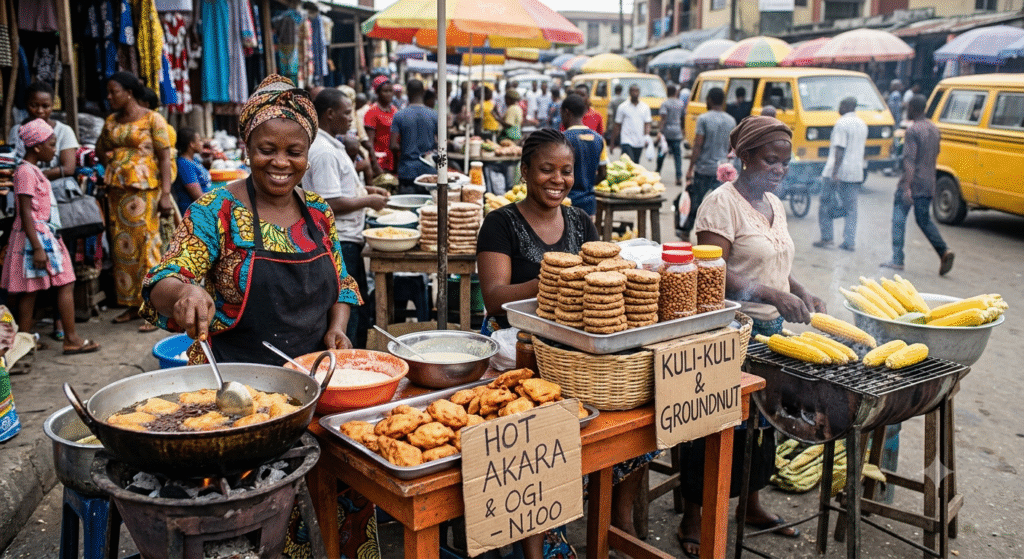
When Nigeria’s First Lady suggested that young people could begin by selling akara, roasted corn or kulikuli, the backlash was immediate. Social media erupted with ridicule. Critics saw the remarks as proof that the country’s leadership had become detached from the realities confronting educated youths. Supporters countered that every successful entrepreneur starts somewhere, and that honest trade should never be demeaned.
Both sides were arguing about the wrong thing.
The real issue was never akara. It was whether Nigeria has built an economy in which a small business has a realistic chance of becoming a medium-sized enterprise, an employer of labour, or even a national brand. Judged by that standard, the controversy exposed not simply a communications problem but a structural failure.
The instinct to mock informal trade reflects a misconception that has persisted for decades. Nigeria’s informal economy is often portrayed as evidence of national failure, a temporary refuge for people excluded from the formal labour market. Yet this ignores an uncomfortable reality: the informal sector is the country’s largest employer. It keeps millions of households afloat where neither government nor the private sector has created enough formal jobs.
The problem, therefore, is not that Nigerians sell akara, repair vehicles, tailor clothes, process food or trade in neighbourhood markets. The problem is that too many of these enterprises remain trapped at the level of subsistence.
This distinction matters.
An economy can absorb millions of workers without becoming productive. It can generate activity without creating prosperity. It can produce entrepreneurs who work tirelessly every day yet never accumulate enough capital to expand, employ others or innovate. That is precisely the dilemma confronting much of Nigeria’s informal sector.
It also explains why many university graduates continue to describe themselves as unemployed even when opportunities for self-employment exist. Their reluctance is not simply a matter of pride or unrealistic expectations. It reflects a rational assessment of risk. Most informal enterprises operate under extraordinarily difficult conditions—unreliable electricity, high transport costs, expensive credit, multiple taxation, inconsistent regulation, weak legal protection and limited access to organised markets.
In such an environment, a salaried job in a bank, government ministry or multinational corporation appears considerably more secure than investing scarce resources in a business that may never grow beyond daily survival.
That is why reducing the debate to whether selling akara is respectable misses the larger economic question.
It is respectable.
What is not respectable is expecting micro-enterprises to thrive without the institutions that successful entrepreneurship requires.
A modest grant may help someone purchase initial stock, but capital alone does not build a business. Entrepreneurs also need affordable finance, reliable infrastructure, functioning transport networks, digital payment systems, stable regulations, business development services and access to larger markets. Without these foundations, many enterprises remain trapped in a cycle where today’s profits merely finance tomorrow’s operating expenses.
History offers an important lesson. Across the world, many of today’s largest companies began as small family businesses or informal ventures. They succeeded not because they sold extraordinary products at the outset but because they operated within ecosystems that rewarded investment, innovation and expansion. Governments simplified regulation, financial institutions provided credit, infrastructure lowered operating costs and markets enabled firms to scale.
Nigeria possesses no shortage of entrepreneurial talent. Its markets, workshops, farms and roadside businesses demonstrate remarkable resilience every day. What the country lacks is a coherent strategy for transforming necessity-driven enterprise into productivity-driven growth.
That strategy should begin with making it easier—not harder—to run a business. Registration should be simple and affordable. Small enterprises should have access to low-cost financing based on business performance rather than collateral alone. Reliable electricity and digital infrastructure should reduce production costs. Universities should prepare graduates not only for salaried employment but also for enterprise creation through practical training in financial management, innovation, digital commerce and business incubation. Public policy should reward businesses that formalise, expand and create jobs instead of treating the informal sector primarily as a source of tax revenue.
Equally important, policymakers must be honest with citizens. Improvements in government revenue, fiscal reforms or macroeconomic indicators are meaningful achievements, but they do not immediately reduce the cost of cooking gas, food, transport or rent. Families experience economic recovery through improved living standards, not through statistics alone. Bridging that gap requires deliberate policies that connect macroeconomic reforms to household realities.
The akara controversy should therefore not be remembered as another fleeting political quarrel. It should serve as a reminder that the future of employment in Nigeria will not be secured by waiting for the formal sector to create enough jobs. Demographic realities make that expectation unrealistic.
The country’s greatest opportunity lies in transforming millions of informal enterprises into productive, competitive and scalable businesses.
The question was never whether akara is beneath graduates.
The real question is whether Nigeria is prepared to build an economy in which today’s roadside trader can become tomorrow’s manufacturer, exporter and employer. Until that transformation becomes the centre of economic policy, public debates will continue to revolve around political soundbites while the deeper structural challenges remain unresolved.
Nigeria does not need to choose between celebrating entrepreneurship and pursuing industrialisation. The former, if properly supported, is one of the surest pathways to the latter. That is the lesson hidden beneath the akara debate—and it is one the country can no longer afford to ignore.
the concluding paragraph tells it all.. This is a conversation we are not ready for. Informal business has little growth success in Nigeria. The Nigeria economy has not been encouraging