
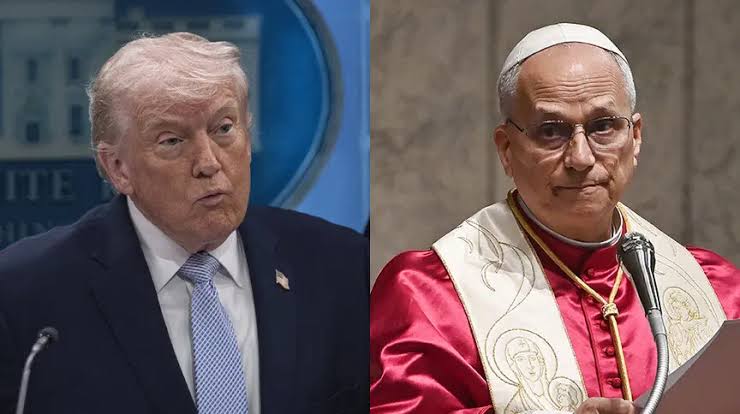
A deepening confrontation between and has ignited a global debate that transcends personalities and enters the realm of moral authority, political legitimacy, and the ethics of power.
At the heart of the dispute lies a fundamental divergence in worldview. Pope Leo XIV has positioned himself as a moral critic of contemporary geopolitics, warning against the normalization of war, the erosion of human dignity, and the rise of authoritarian tendencies cloaked in nationalist rhetoric. His interventions reflect a long-standing tradition within Catholic social teaching that prioritizes peace, justice, and the sanctity of life over strategic expediency.
Trump, by contrast, embodies a realist conception of leadership—one that privileges national interest, strength, and unilateral decision-making. His response to the Pope’s remarks has been unapologetically direct, dismissing the Vatican’s stance as impractical and accusing the pontiff of encroaching into political domains beyond his remit. In doing so, Trump reframes the debate: not as a question of morality, but of sovereignty and effectiveness.
The rhetorical escalation between both figures has transformed what might have remained a policy disagreement into a symbolic contest between two distinct sources of authority. On one side stands the institutional weight of the Catholic Church, with its transnational moral voice and historical influence. On the other stands a populist political figure whose appeal derives from electoral legitimacy and a narrative of strength in an uncertain world.
Yet, the question of who holds the “moral high ground” resists easy resolution. The Pope’s authority is grounded in ethical universality, but it operates without coercive power. Trump’s authority, while politically grounded, is inherently contingent—subject to electoral cycles, public opinion, and institutional constraints.
This tension underscores a broader crisis in global leadership: the fragmentation of moral consensus in an era marked by geopolitical rivalry and ideological polarization. In such a context, claims to moral superiority are no longer universally recognized but are instead filtered through competing lenses of belief, identity, and interest.
Ultimately, the Trump–Papal rancour is less about individual personalities and more about a deeper structural question: can moral authority meaningfully shape political behavior in a world increasingly defined by power politics? The answer remains uncertain—but the confrontation itself reveals that the struggle over who defines “right” and “wrong” in global affairs is far from settled.