
WhatsApp messages, military mobilisation plans and a proposed post-Tinubu agenda emerge as proceedings expose the alleged depth of the 2025 conspiracy
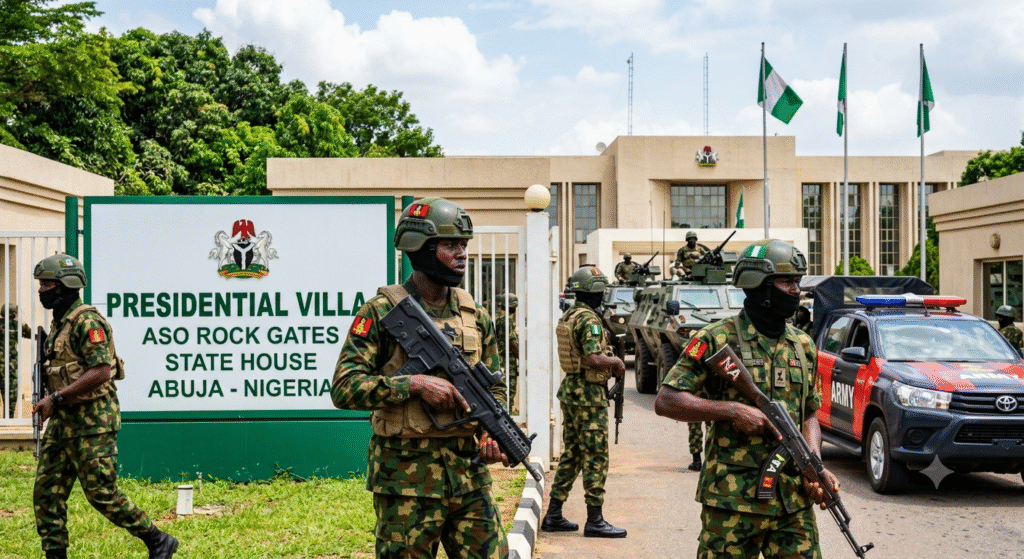
ABUJA — What began as reports of a foiled attempt to overthrow Nigeria’s elected government is now unfolding in considerably greater detail before the courts, with investigative documents revealing an alleged plan to seize the Presidential Villa, disrupt the military command structure and establish a new political order.
The evidence emerging from the proceedings paints a picture of a conspiracy that investigators say went beyond private conversations among disgruntled officers. According to prosecution materials and statements attributed to some of the accused, plans were allegedly being developed around troop mobilisation, the occupation of strategic facilities and the removal or detention of senior military commanders.
It is important, however, to stress that these remain allegations before the courts. The defendants have pleaded not guilty, and it is ultimately for the courts to determine whether the prosecution’s evidence establishes their guilt.
The alleged mastermind
At the centre of the investigation is Colonel Mohammed Ma’aji, an officer of the Defence Space Administration, whom investigators have identified as a key coordinator of the alleged plot.
Court-related evidence reportedly places Ma’aji at the heart of discussions concerning the proposed operation.
Retired naval captain Erasmus Victor, who is among those facing charges, reportedly told investigators that he knew about the alleged plan but advised Ma’aji against pursuing it.
According to the account, those warnings were ignored.
The evidence suggests that the alleged conspirators were not merely contemplating a change of government in the abstract. They were discussing how such an operation could actually be executed.
Aso Rock at the centre of the plan
Among the most serious allegations is that the Presidential Villa was identified as a principal target.
Investigative documents reportedly contain plans for the mobilisation of troops, vehicles and other military resources, with different individuals allegedly assigned specific responsibilities.
Some of those allegedly involved were expected to secure strategic locations, while others were linked to plans concerning the movement of troops and the neutralisation or detention of senior commanders.
The alleged objective was to disrupt the country’s military command structure quickly enough to prevent an effective response.
That detail, if established in court, would significantly alter the public understanding of the episode. It would suggest a plan that was conceived not simply as a political protest, but as an attempt to paralyse the institutions responsible for defending the constitutional government.
The WhatsApp messages
Among the evidence reportedly presented to investigators are WhatsApp communications.
Navy Lieutenant Commander Bayawo Abdullahi, 38, from Kogi State, reportedly admitted in a written statement that he sent a message to Ma’aji describing President Bola Ahmed Tinubu as “scared” following the cancellation of the 1 October 2025 Independence Day parade.
The parade was eventually cancelled amid heightened security concerns.
The significance of the communication lies less in the individual message than in the wider trail investigators are attempting to establish: whether seemingly ordinary exchanges between officers formed part of a larger network of communication surrounding the alleged conspiracy.
That is now a matter for the court to determine.
They allegedly planned what would come next
Perhaps the most revealing aspect of the evidence is that the alleged plotters were reportedly thinking beyond the seizure of power.
Investigators say they discovered a three-point agenda outlining some of the policies the proposed administration would pursue.
Among the issues reportedly identified was the reversal of President Tinubu’s removal of the petrol subsidy—a policy that has generated intense public debate and significant economic hardship.
The alleged agenda suggests that the conspirators understood the political importance of public anger over the cost of living.
In effect, they appeared to be considering how economic dissatisfaction could be transformed into political legitimacy for an unconstitutional transfer of power.
That raises a broader question: where does legitimate public frustration end and an attempt to exploit that frustration for military intervention begin?
The danger of military politics
Nigeria knows the consequences of military intervention better than most African countries.
From the first coup in 1966 through decades of military rule, the country experienced repeated disruptions of constitutional government. The return to democracy in 1999 was supposed to close that chapter permanently.
For more than a quarter of a century, Nigeria has maintained constitutional civilian rule.
That record should not be taken for granted.
If the allegations before the courts are eventually established, the 2025 episode would demonstrate that military intervention remains a potential threat even in a country that has spent 27 years under uninterrupted democratic government.
But there is another lesson.
The state cannot defend democracy by abandoning democratic principles.
Those accused of plotting a coup must face the law. Evidence must be examined. Witnesses must be tested. The prosecution must prove its case. And the accused must retain the rights guaranteed by the Constitution.
Anything less would create the very institutional weakness that makes unconstitutional intervention possible in the first place.
A test for Nigeria’s democracy
The unfolding proceedings are therefore about more than Colonel Ma’aji, the other defendants or the alleged events of 2025.
They are about the resilience of Nigeria’s democratic institutions.
A successful coup would have been a profound assault on constitutional government. But a response based on arbitrary detention, political persecution or punishment without due process would also damage the same democratic order.
The courts now have the difficult responsibility of separating fact from allegation, evidence from speculation, and genuine conspiracy from association.
For Nigerians, the central question is no longer simply whether a coup was contemplated.
It is whether the country has built institutions strong enough to ensure that no individual, military or civilian, can overturn the constitutional order—and strong enough to ensure that those accused of attempting to do so receive justice under the same Constitution they are alleged to have threatened.
That is ultimately the real test of Nigeria’s democracy.