
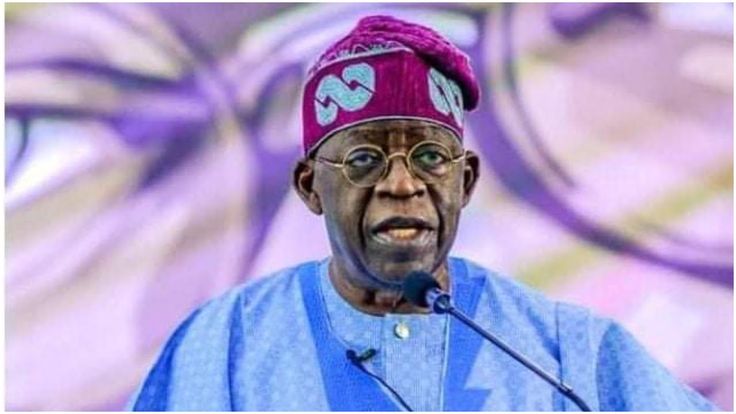
Defections and endorsements across the Southwest are strengthening the President’s re-election prospects, but translating elite alliances into votes remains the real test
ABUJA — President Bola Ahmed Tinubu’s 2027 re-election campaign is gaining political momentum as opposition figures and structures in key Southwest states increasingly align themselves with the incumbent, exposing growing fractures within the opposition camp.
The latest development comes from Ekiti State, where the Peoples Democratic Party (PDP) candidate in the June 2026 governorship election, Dr Wole Oluyede, announced the formation of the Oluyede Progressive Alliance for Renewed Hope Agenda (OPARHA), bringing together elements of the PDP, Accord, Action Democratic Party (ADP), Young Progressive Party (YPP), Action Alliance (AA) and other political groups in support of Tinubu’s second-term bid.
Oluyede urged his supporters and political associates to put the outcome of the Ekiti governorship election behind them and unite around Tinubu’s 2027 presidential campaign.
The development is politically significant because Ekiti, traditionally one of the more competitive political environments in the Southwest, is now producing an opposition-linked structure openly supporting the incumbent president.
Adeleke’s Alignment Adds Another Layer
The realignment is not confined to Ekiti.
In Osun, Governor Ademola Adeleke has repeatedly reaffirmed his support for Tinubu’s re-election. The Osun State Government reported in March that Adeleke described the President as a leader of the Southwest and urged his political structures to consolidate support for the President.
More recently, reports emerged that Adeleke and the Accord Party adopted Tinubu as their preferred presidential candidate for 2027. The move represents a striking political realignment, given Adeleke’s background in the PDP and his position as a sitting opposition governor.
There is, however, an important qualification. Earlier in the year, Accord’s national leadership had publicly denied reports that the party had endorsed Tinubu, insisting that its immediate priority was Adeleke’s Osun governorship campaign. The later reported endorsement therefore illustrates how rapidly political positions are evolving ahead of 2027.
The Arithmetic Matters
Nigeria’s presidential elections are not won through endorsements alone. But endorsements matter when they come with functioning political structures.
That is the strategic value of the emerging realignment.
A presidential candidate benefits not simply from prominent individuals crossing political lines, but from the possibility that those individuals can transfer grassroots networks, local organisers, ward structures and voter mobilisation capacity.
If the emerging alliances remain intact through the election season, Tinubu could enter 2027 with an expanded political footprint in parts of the Southwest that traditionally provide crucial electoral support.
But the reverse is equally true: opposition parties may retain substantial voter bases even when their political elites defect.
The critical question is therefore whether political loyalty follows the politician or remains with the party and its voters.
The Opposition’s Coalition Problem
The opposition entered the post-2023 period with an obvious strategic objective: consolidate disparate political forces into a single formidable platform capable of challenging an incumbent president.
Instead, the emerging picture is increasingly complicated.
While opposition groups continue to discuss coalition arrangements, some of the political figures expected to constitute the foundation of such a coalition are moving closer to the President.
That creates a difficult political equation. A coalition without prominent politicians is possible; a coalition without their organisational structures is considerably harder.
The opposition must therefore confront two questions simultaneously: who will lead its coalition, and what political machinery will remain available to mobilise voters behind it?
Lagos Shows Why the APC Must Still Watch Its Own House
Yet the apparent expansion of Tinubu’s national coalition should not be mistaken for complete political consolidation.
Lagos offers a useful reminder.
Deputy Governor Obafemi Hamzat has emerged as the APC’s governorship candidate for 2027 after receiving the backing of the party’s Governors’ Advisory Council and subsequently securing the party’s ticket. He has already unveiled a development agenda focused on jobs, infrastructure, education, healthcare and security.
His emergence appears to have reduced uncertainty around the APC succession question in Lagos, but the state’s political importance means that the party will still need to manage competing interests carefully.
Hamzat himself has publicly rejected suggestions that he would serve only one term, indicating that questions surrounding succession and internal power arrangements will remain part of the political conversation.
The Bigger 2027 Picture
The emerging pattern suggests that the 2027 contest is already becoming less about a simple APC-versus-opposition confrontation and more about which political camp can assemble the broadest and most functional coalition.
For Tinubu, the advantage is becoming increasingly visible: he is not merely defending the APC’s traditional base; he is attracting support from politicians and groups previously associated with opposition parties.
But there is a danger in overestimating elite realignment.
Nigeria’s electoral history repeatedly demonstrates that politicians can change parties without automatically carrying their supporters with them. Endorsements may generate headlines, but elections are ultimately won through voter mobilisation, credible organisation and the ability to persuade citizens that a candidate deserves their vote.
The opposition therefore still has time to rebuild.
For now, however, the political arithmetic is moving in Tinubu’s favour.
One defection may be dismissed as politics. Several begin to look like a pattern.
And as 2027 approaches, the central question for the opposition is no longer simply how to defeat Tinubu.
It is whether it can keep its own political house from emptying before the campaign truly begins.