
LAGOS, NIGERIA
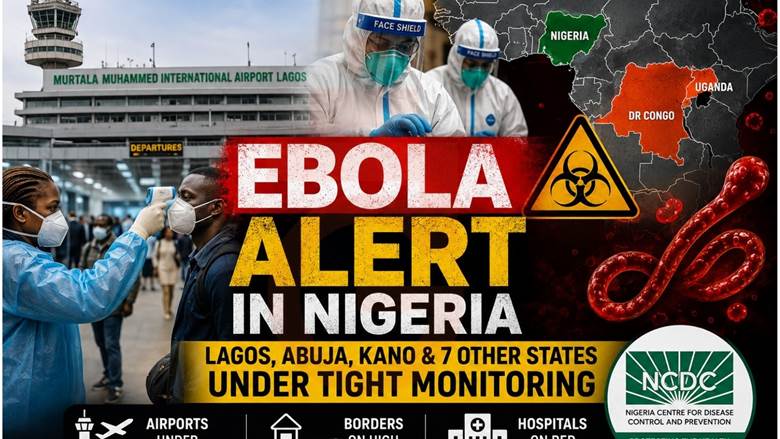
Nigerian health authorities have placed Lagos, Abuja, Kano and seven other states on high alert following fears that the Ebola virus outbreak currently spreading in parts of Central and East Africa could enter the country.
The Nigeria Centre for Disease Control and Prevention (NCDC) announced on Thursday that it has increased disease monitoring across the country because of the Ebola outbreak linked to the Bundibugyo strain currently affecting Uganda and the Democratic Republic of Congo (DRC).
According to the agency, Nigeria is at risk because many people travel in and out of the country daily through airports and land borders.
Apart from Lagos, Kano and the Federal Capital Territory (FCT), other states placed under high-risk watch include Rivers, Enugu, Borno, Akwa Ibom, Cross River, Taraba and Adamawa.
Kaduna, Katsina, Bauchi and Plateau states were placed under moderate monitoring.
The World Health Organization (WHO) recently declared the outbreak a serious international public health emergency, raising concerns across African countries.
Although no Ebola case has been confirmed in Nigeria, the NCDC said all states must strengthen monitoring systems, prepare emergency response teams and remain alert to stop any possible outbreak before it spreads.
Why Authorities Are Worried
Health officials say Nigeria is especially vulnerable because Lagos, Abuja and Kano have some of Africa’s busiest airports and receive thousands of international travellers regularly.
The NCDC explained that frequent movement of people across African countries and illegal border crossings could allow infected persons to enter Nigeria without being detected quickly.
The Bundibugyo strain of Ebola may not be as deadly as some previous Ebola strains, but experts warn that it can still spread fast and become dangerous, especially in crowded communities.
Ebola spreads through direct contact with blood, body fluids or body tissues of infected persons or animals.
Common symptoms include sudden fever, weakness, body pain, headache and sore throat. In severe cases, patients may begin vomiting, bleeding or suffer organ failure.
Health experts say early detection and immediate isolation of suspected cases remain the best ways to prevent a wider outbreak.
Nigerians Remember 2014 Ebola Outbreak
The latest alert has brought back memories of Nigeria’s 2014 Ebola outbreak, which caused nationwide panic at the time.
Nigeria recorded its first Ebola case in July 2014 when a Liberian-American diplomat, Patrick Sawyer, arrived in Lagos carrying the virus.
Because Lagos is heavily populated and commercially busy, many feared the disease could spread rapidly across the country.
Health authorities immediately launched emergency measures including contact tracing, quarantine, public awareness campaigns and strict hospital monitoring.
Nigeria eventually recorded 20 confirmed cases and eight deaths before the outbreak was successfully contained within a few months.
The country later received international praise from the WHO and global health experts for stopping the virus from spreading further.
Since then, Nigeria has strengthened its disease monitoring and emergency response systems through the NCDC and other public health agencies.
Airports, Borders, Hospitals Under Close Watch
Under the latest directive, airports, hospitals and border communities across the affected states are now under tighter surveillance.
Hospitals have been instructed to quickly report any unusual illness that looks similar to Ebola symptoms, while health workers have been told to strictly follow infection prevention guidelines.
The NCDC also advised Nigerians to avoid unnecessary travel to countries currently battling the outbreak.
Citizens were urged to immediately visit the nearest hospital if they notice symptoms such as sudden fever, unexplained bleeding, vomiting or severe weakness.
Authorities also warned Nigerians against spreading fake news or panic, stressing that no Ebola case has been detected anywhere in Nigeria for now.
The agency assured the public that emergency response teams remain on standby nationwide while health officials continue monitoring the situation in Uganda and the Democratic Republic of Congo.