
Why political actions rarely disappear — they return
By Babafemi Ojudu
There is an old truth politics repeatedly teaches but very few politicians truly believe while power is still in their hands:
Power expires. Consequences do not.
Today, I wish to write about karma — not in its mystical or theological dimensions. I leave that to philosophers, clerics, and spiritual scholars who devote their lives to exploring the deeper mechanics of divine justice and cosmic balance.
I wish instead to speak of karma as ordinary people encounter it in everyday life: the quiet, almost invisible process by which actions eventually circle back to their authors.
Politics offers endless examples of this phenomenon.
The powerful often behave as though institutions are disposable tools, as though intimidation carries no future cost, as though today’s advantage will somehow remain permanent. But history is patient. It records everything. And eventually, the wheel turns.
This is not an attempt to ridicule anyone. Age and experience have taken me beyond the politics of bitterness. One reaches a stage in life where memories are no longer weapons for revenge, but lessons for reflection.
I tell these stories not to settle scores, but to remind younger politicians that the methods they use today may one day be used against them.
The Ekiti Lesson
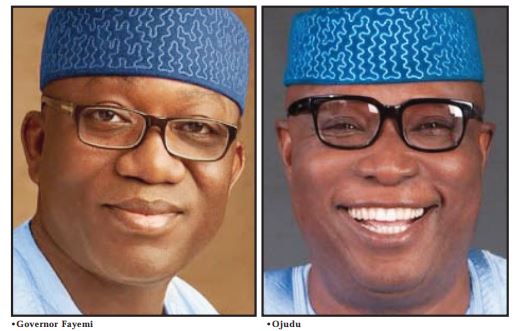
Some years ago, a number of my colleagues and I became openly critical of my brother and friend, Dr. Kayode Fayemi, then Governor of Ekiti State.
The response from the political establishment around him was swift and unforgiving.
The machinery of party and state power was allegedly mobilised against us. Pressure mounted on ward executives to organise our expulsion from the party. I, Senator Tony Adeniyi, Hon. Oyetunde Ojo, Hon. Bimbo Daramola, and many of our supporters suddenly found ourselves isolated and targeted.
The chairman of my ward, Mr. Clement Afolabi, was reportedly threatened, arrested, and detained because he refused to cooperate with efforts aimed at forcing my expulsion.
Politics in our environment often resembles warfare more than democratic engagement.
In response, we announced the suspension of the governor himself and publicised the decision widely. Tensions escalated rapidly until the national leadership of the party intervened and appealed for restraint on both sides.
But even after that intervention, harassment allegedly continued. Police authorities were reportedly recruited to pursue criminal libel claims against us. Our lawyers resisted successfully, yet the broader objective remained obvious: humiliation, intimidation, and political isolation.
The irony, however, is that politics rarely ends where its practitioners expect it to.
I have often struggled to convince myself that Dr. Fayemi played absolutely no role in the later suspension of Comrade Adams Oshiomhole from his ward and his eventual removal as National Chairman of the APC. The methods felt hauntingly familiar.
Even before attempts were made to expel me, another symbolic drama had unfolded.
A local government party structure, allegedly acting under instruction, reportedly dumped five bags of rice at my gate — a theatrical attempt to “return” the truckloads of rice I had distributed to party members during the COVID period. The offence, apparently, was that party members accepted relief materials from me.
Such was the bitterness of political rivalry.
Ironically, many of those same political actors have since shifted camps and are now reportedly aligned against Fayemi himself.
That, too, is the nature of power.
The enforcer of yesterday often becomes the victim of tomorrow. Political seasons change faster than those inside them realise.
It was therefore impossible not to notice the irony when Dr. Fayemi recently lamented intolerance, exclusion, and abuse of party structures within the APC.
Many of his observations were not incorrect. Yet much of what he now condemns are practices critics believe flourished under his own influence as governor and later as Chairman of the Nigerian Governors’ Forum.
Life sometimes forces us to drink from wells we once dug for others.
That is one of politics’ oldest lessons.
To be clear, I have since forgiven Dr. Fayemi. We speak occasionally and exchange warm conversations. I remain grateful for his presence at my son’s wedding.
Age teaches one the futility of permanent bitterness.
But forgiveness is not forgetfulness.
History leaves scars even after reconciliation.
The Yar’Adua–Buhari Story
The second story goes beyond Ekiti.
After the disputed 2007 presidential election, INEC declared Alhaji Umaru Musa Yar’Adua winner while General Muhammadu Buhari was announced defeated.
Buhari challenged the outcome from the Tribunal all the way to the Supreme Court.
Three days before judgment, President Yar’Adua reportedly summoned PDP governors and influential political actors for consultations.
What he allegedly told them remains one of the more remarkable moments in Nigeria’s democratic history.
Intelligence available to him, he reportedly said, suggested the Supreme Court might rule against him. But he was prepared to accept the judgment. Buhari, he allegedly told the gathering, was his brother. If Buhari became President, life would continue.
It is important to remember that Yar’Adua himself publicly acknowledged that the election which brought him to office was flawed.
But according to accounts widely circulated within political circles, several governors fiercely resisted the idea of surrendering power.
What followed belongs to that dark archive of Nigerian political history many know privately but few discuss openly.
The judgment many expected never arrived.
Yar’Adua remained President.
One of the prominent political figures long associated with helping shape that outcome later found himself loudly lamenting that he too had been rigged out during a party primary.
And there lies the lesson.
The instrument once used against others eventually returned to its wielder.
Karma.
Cosmic balance.
History completing a circle.
The two judges believed to have resisted pressure during that period were later appointed ambassadors by President Buhari — one to London, the other to Washington — perhaps as recognition for institutional courage.
When Institutions Collapse
The deeper tragedy is not merely personal hypocrisy.
It is institutional destruction.
A politician who participates in undermining due process loses moral authority when he later becomes a victim of injustice himself.
One cannot celebrate the weakening of democratic institutions when it serves immediate political interests and later demand fairness once those same weakened institutions turn against him.
This is how nations decay.
Institutions are not destroyed overnight. They erode gradually each time powerful actors decide principles are inconvenient obstacles rather than necessary protections.
The danger, of course, is that nobody remains permanently powerful.
The safeguards destroyed today for political convenience may become the very safeguards one desperately needs tomorrow.
The Universe Remembers
In the end, karma is not always mystical.
Sometimes it is simply history keeping records.
Sometimes it is political memory returning unexpectedly.
Sometimes it is life quietly reminding us that no condition is permanent, no throne eternal, and no abuse of power ever fully disappears.
The universe has a long memory.
And eventually, it calls people back to answer for what they once believed they had escaped.