
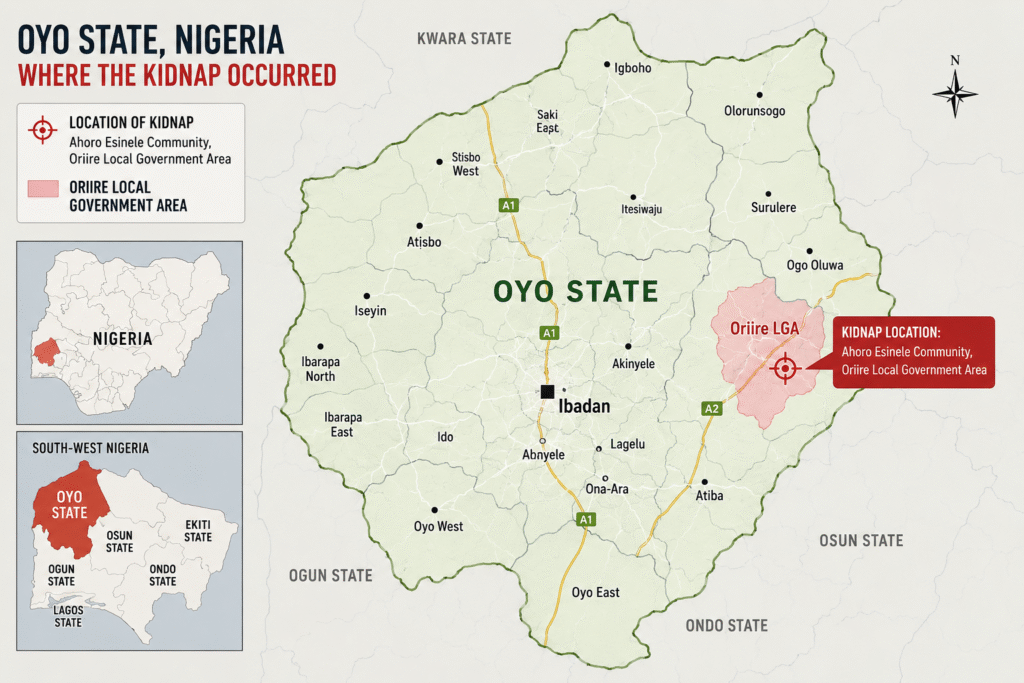
Fresh fear has spread across parts of Oyo State after repeated kidnapping attacks pushed the Nigerian military to send more troops, surveillance aircraft and intelligence officers into affected communities.
The Armed Forces of Nigeria said the move became necessary after a series of abductions in the state, including the shocking kidnapping of dozens of schoolchildren and teachers in Oriire Local Government Area.
The order came from the Chief of Defence Staff, General Olufemi Oluyede, who directed security agencies to immediately strengthen operations in troubled areas and hunt down the criminals behind the attacks.
Military authorities said specially trained soldiers, supported by air surveillance and intelligence teams, are now working to rescue victims and destroy criminal hideouts in the state.
Speaking during a briefing in Abuja, the Director of Defence Media Operations, Major General Michael Onoja, assured Nigerians that security forces would continue operations until those responsible are arrested and peace returns to the affected communities.
According to him, attacks on innocent civilians are a serious threat to Nigeria’s security and stability. He also said ongoing operations are already helping the military gather useful intelligence on the criminals operating in the area.
School Kidnapping in Oyo Raises Fresh Alarm
The latest military deployment followed one of the most disturbing attacks recorded in South-West Nigeria in recent months.
On May 15, gunmen invaded schools in the Ahoro Esinele community in Oriire Local Government Area of Oyo State and abducted 39 students alongside seven teachers.
Reports from the community said one teacher was killed during the attack, while another was allegedly beheaded after being taken into captivity.
The incident shocked many Nigerians because mass school kidnappings have mostly been linked to northern states such as Kaduna State, Katsina State and Zamfara State.
Security experts now fear that criminal gangs and extremist groups displaced from the North may be moving into forests and rural communities in other parts of the country, including the South-West.
The Defence Headquarters recently linked the Oyo attack to suspected members of Jama’atu Ahlis Sunna Lidda’awati wal-Jihad, also known as JAS, a faction associated with Boko Haram.
According to military authorities, the suspects are believed to be terrorists forced out of their former strongholds in the North-East due to intensified military operations.
That revelation has increased fear among many residents in the South-West, who worry that kidnappers and insurgents may now be taking advantage of poorly secured rural areas outside their usual base of operation.
Just days after the school attack, gunmen also reportedly kidnapped workers of the Cocoa Research Institute of Nigeria in Ibadan, further raising tension across the state.
Nigeria’s Security Challenges Continue
Nigeria has battled insecurity for years, with different parts of the country facing terrorism, bandit attacks, kidnapping, farmer-herder clashes and oil theft.
What started mainly as an insurgency in the North-East has gradually spread into a wider national security problem affecting highways, villages and communities across the country.
Major incidents such as the 2014 abduction of schoolgirls in Chibok and later attacks in places like Kankara, Jangebe and Kuriga exposed serious weaknesses in local security systems and led to stronger calls for better intelligence sharing, improved policing and modern military technology.
In recent years, the Nigerian military has increasingly relied on drones, surveillance aircraft and special operations forces to track armed groups hiding in forests and remote areas.
Military authorities also disclosed this week that troops operating in different parts of the country arrested more than 300 suspects, killed over 100 terrorists and rescued more than 200 kidnapped victims during operations carried out in May.
Army War College Calls for Smarter Security Strategy
As military operations continue, the Army War College Nigeria says Nigeria also needs a new generation of military leaders prepared for modern security threats.
Speaking during the Seventh Annual Symposium on the Nigerian Civil War at the Tukur Yusuf Buratai Auditorium in Abuja, the Commandant of the college, Umar Mohammed Alkali, said today’s security challenges require officers who are not only trained for combat but also equipped with strategic and intellectual skills.
The symposium examined lessons from the Nigerian Civil War and how past military experiences can help shape current counterterrorism efforts, national unity and relations between civilians and the military.
Security analysts believe the discussion is important as Nigeria faces growing threats from kidnappers, insurgent groups, illegal arms networks and cyber-related crimes.
For many residents in Oyo State, however, the biggest concern remains safety.
Families across affected communities are now hoping that the latest military operation will finally stop the kidnappings and prevent insecurity from spreading deeper into South-West Nigeria.