
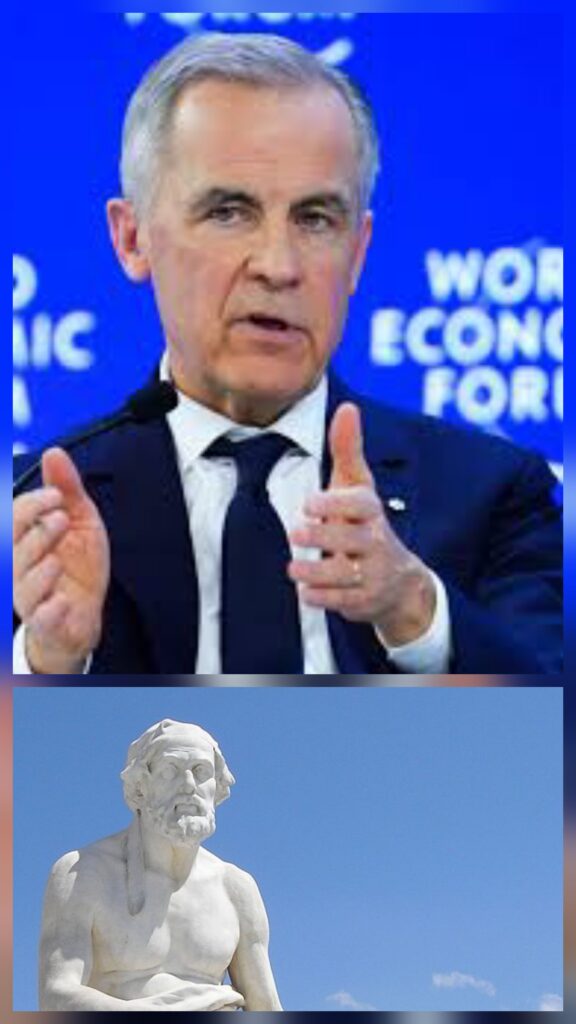
When former Bank of England Governor Mark Carney stepped back into the global conversation with arguments for rewiring the financial architecture of capitalism, many listeners heard a technocrat speaking about markets, climate, and risk.
But Carney’s project is far more ambitious. It is an attempt to redefine the strategic rationale by which international order is organized, preserved, and legitimised. In that sense, he is resurrecting the analytic imagination of Thucydides, the Athenian historian whose study of the Peloponnesian War remains the foundational text on the tragic mechanics of power.
Carney is not alone in sensing that the post–Cold War order is unraveling; what distinguishes him is his wager that financial coordination—not brute force—may yet rebuild a workable international equilibrium. Where Thucydides analyzed power through fear, interest, and honor, Carney analyzes it through liquidity, valuation, incentives, governance, and legitimacy. And where Thucydides chronicled a world collapsing into violence, Carney proposes a world reorganized before collapse arrives.
Thucydides in the Age of Sanctions
The Peloponnesian War turned on naval supremacy and alliance formation. Today’s conflicts turn on financial flows, sanctions, and payment systems. The war in Ukraine has demonstrated that modern warfare is prosecuted as much through the international financial system as through artillery or drones.
The United States and its allies deployed an unprecedented suite of sanctions, cutting Russian banks from SWIFT, freezing state reserves, restricting dual-use technologies, and weaponizing supply chains. These measures represent the contemporary equivalent of denying sea lanes to an adversary.
Yet Russia survived financial isolation by redirecting energy flows to Asia, leveraging commodity diplomacy, and accelerating integration into non-Western financial circuits—from Chinese payment systems to bilateral currency swap lines. Carney’s worldview interprets this not as a moral failure of sanctions but as evidence that global capital is no longer a singular domain controlled by one hegemon.
Thucydides would have recognized this as the moment when a rising or resilient power refuses to accept the restraints imposed by an incumbent.
BRICS and the Currency Question
The rise of BRICS—and the bloc’s recent expansion—illustrates another Thucydidean dynamic: the increasing institutional sophistication of rising powers. While China, Brazil, India, Russia, and South Africa are hardly ideologically aligned, their collaboration on settlement mechanisms, de-dollarization experiments, digital currency pilots, and reserve pooling signifies an attempt to reduce systemic exposure to U.S. leverage.
Talk of a unified BRICS currency is premature, but the strategic intent is not. What matters is the recognition that monetary dominance is a geopolitical asset, not a neutral market outcome. Athens controlled the Aegean by triremes; Washington controls the world by dollar-denominated trade, sanctions compliance, and clearing channels. BRICS seeks to dilute hegemonic incumbency by expanding strategic choice.
Carney anticipates this shift. His climate-finance diplomacy and financial-governance proposals are built on the assumption that if the West does not coordinate and standardize, others will innovate and defect. Thucydides described this as the logic of rising powers who seek to modify the order before confronting it outright.
Energy as the New Grain
In the ancient world, grain supply shaped war. Today, energy markets define both conflict and diplomacy. Russia re-routed oil to India and China at discounted rates, demonstrating that the West could deny Europe hydrocarbons, but not deny Moscow a revenue base.
Meanwhile, Saudi Arabia and the United Arab Emirates have repositioned themselves as autonomous brokers, pricing energy strategically, engaging China commercially, and negotiating security through transactional multivector diplomacy.
Carney’s worldview treats energy not merely as a commodity but as collateral for geopolitical coordination. His push for climate finance frameworks is partly moral, partly economic, and partly strategic—an effort to securitize the transition in a manner that binds major powers to standardized valuation models, reducing systemic volatility. Thucydides would have recognized the motive: stabilizing supply to stabilize power.
Trump’s Peace Diplomacy and Institutional Improvisation
Into this crowded arena enters a different kind of improvisation: Donald Trump’s “Board of Peace”, pitched as an alternative conflict-resolution platform. Russia’s recent offer of $1 billion to fund the initiative—sourced from frozen assets and conditioned on a Ukraine settlement—illustrates that diplomacy is no longer chained exclusively to the UN Security Council or OSCE frameworks.
Whether Trump’s platform evolves into a durable institution or a symbolic deal-making hub remains to be seen. But its emergence underscores the fragmentation of the peace architecture and the rise of entrepreneurial diplomacy in which financial commitment substitutes for multilateral consensus. Carney would not design institutions this way, but he would understand the structural pressure producing them: when incumbents fail to maintain order, new forms appear.
The Central Question: Can Coordination Replace Coercion?
Thucydides warned that equilibrium collapses when the distribution of power outpaces the distribution of legitimacy. The United States retains financial incumbency but suffers from declining trust in its predictability, alliance coherence, and institutional reliability. China possesses rising capacity but uncertain legitimacy. Europe sustains normative ambition but lacks strategic autonomy. BRICS offers pluralism but not cohesion.
Carney proposes a fourth path: financial governance as strategic equilibrium—a system where standardization, pricing, and capital allocation replace coercion, tribute, and force. But Thucydides would caution that order cannot be sustained by norms alone. When Athens lost legitimacy, it reached for coercion; when coercion failed, it collapsed.
The Tragic Horizon
The world approaches a similar tragic horizon. The Ukraine war, Middle East escalations, sanctions proliferation, nuclear modernization, digital currency weaponization, artificial intelligence dual-use risks, and ecological destabilization all compound into a moment where miscalculation becomes easier than accommodation.
Carney resurrects Thucydides not to celebrate realism but to avoid it. His project is an attempt to prevent multipolarity from maturing into confrontation, to channel rivalry into valuation and governance rather than war.
Whether that is naïve, visionary, or merely technocratic realism remains undecided.
Thucydides did not believe tragedy was inevitable; he believed it emerged when structural realities overpowered political judgment.
Carney’s wager is that modern institutions can do what ancient city-states could not: reform before collapse.
For now, the jury is out.