
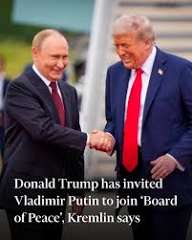
When Russian President Vladimir Putin announced Moscow’s readiness to commit $1 billion to U.S. President Donald Trump’s proposed “Board of Peace,” many observers dismissed it as yet another headline in the theatre of great-power diplomacy. It is more than that.
The pledge, drawn from frozen Russian assets and attached to conditions linked to a possible Ukraine peace settlement, positions the Board of Peace not merely as a rhetorical device of the Trump administration but as a potentially transactional platform for conflict settlement and post-war reconstruction.
At a time when the United Nations Security Council is struggling to manage wars from Ukraine to Gaza, and when regional mechanisms face capacity strain from the Sahel to Central Asia, any platform promising accelerated diplomatic results warrants scrutiny—especially when backed with capital.
The Diplomatic Logic Behind Moscow’s Gesture
Putin’s offer is not philanthropic. It is strategic. Moscow is seeking a structured pathway to negotiate post-war reconstruction, sanctions relief, and re-entry into the global financial system. Frozen Russian assets, currently held or controlled across Western jurisdictions, constitute both economic pressure and bargaining leverage. If Trump’s Board of Peace becomes a diplomatic clearinghouse in which reconstruction finance substitutes for traditional sanctions diplomacy, Russia gains a new avenue for negotiation outside EU frameworks and Security Council veto dynamics.
For Washington, the appeal lies in the flexibility. Trump’s foreign policy posture has long favored transactional diplomacy, bilateral bargaining, and institutional improvisation. A Board of Peace—light on multilateral procedure but heavy on deal-making—would allow the United States to convene settlements without the theatrics of vetoes and working groups.
Challenging the UN’s Mediation Monopoly
The United Nations has historically claimed moral jurisdiction over questions of war and peace. Yet, its operational monopoly has eroded. The wars in Syria, Ukraine, Gaza, Sudan, Ethiopia, Mali, Burkina Faso, and Niger have revealed the limits of consensus-based multilateralism. Peacekeeping is under strain; peace negotiations are fragmented; and reconstruction funding increasingly flows through bilateral or coalition-led financing instruments rather than UN channels.
Trump’s proposed platform challenges the existing architecture in two ways. First, by suggesting that financing and political will—not mandates or resolutions—are the primary bottlenecks in conflict termination. Second, by positioning peace mediation as a competitive domain where major powers can exercise influence and extract diplomatic concessions.
If taken seriously, the Board of Peace could inaugurate a shift from institutional mediation to capital-backed mediation, where reconstruction promises become the bargaining chip that ends wars. That is a profound departure from 20th-century diplomatic norms.
The Global South and the Multipolar Turn in Peace-making
For Africa and the broader Global South, the development arrives amid an already visible transformation in the global order. Beijing has brokered a détente between Saudi Arabia and Iran; Turkey negotiates corridors in the Black Sea; Qatar mediates hostage and ceasefire deals; the African Union attempts crisis diplomacy in the Sahel and Horn; and BRICS seeks a political identity beyond economic coordination.
Russia’s pledge to Trump’s Board adds a new axis to this landscape: peace entrepreneurship. Major powers are no longer competing only through arms sales, defense pacts, and sanctions; they are now contesting who gets to certify peace, who finances reconstruction, and who garners diplomatic credit.
From Abuja’s vantage point, this competition matters. Nigeria retains an interest in maintaining the relevance of the UN—a system that protects sovereignty and provides predictable diplomatic channels—while simultaneously exploring alternative pathways for stabilization finance and peacebuilding partnerships in the Sahel, Lake Chad Basin, and broader ECOWAS region. If peace becomes capital-driven, states with security challenges will court not only diplomatic recognition but reconstruction investment.
Could the Board of Peace Become a Parallel Institution?
Institutionally, Trump’s platform faces structural uncertainties. Who participates? Who funds? Who adjudicates? Who enforces compliance? Without clarity, the Board risks becoming symbolic. Yet, Russia’s $1bn gesture gives it one element the UN often lacks—earmarked financial commitments tied to outcomes.
In peace mediation, credibility derives from enforcement and financing. If Trump can secure contributions from the Gulf states—especially Saudi Arabia, the UAE, and Qatar—or from other actors such as India, the platform could emerge as a credible clearinghouse.
If Europe rejects it, the initiative could become a geopolitical wedge.
More radically, the Board could affect the future of sanctions, transforming them from punitive instruments into bargaining collateral, exchanged for reconstruction credit and market re-entry.
What Comes Next?
Three tests will determine the Board’s future:
Ukraine: If it proves useful for post-war settlement and reconstruction, the platform gains legitimacy.
Funding: If major non-Western capitals contribute, the institution becomes multipolar.
Institutional Architecture: If it develops rules, instruments, and dispute mechanisms, it becomes durable.
If these conditions fail, Putin’s pledge will remain a diplomatic spectacle rather than a structural shift.
Conclusion: The Stakes of Reinventing Peace
The emergence of the Board of Peace signals an inflection point in conflict mediation. The monopoly of the UN is no longer guaranteed; peace has entered the domain of competitive entrepreneurship; and reconstruction finance may soon dictate geopolitical alignments more than ideology.
In that landscape, Putin’s $1bn offer is not merely a contribution. It is a bet on what comes after the UN, after Ukraine, and after the old consensus on how wars end.