
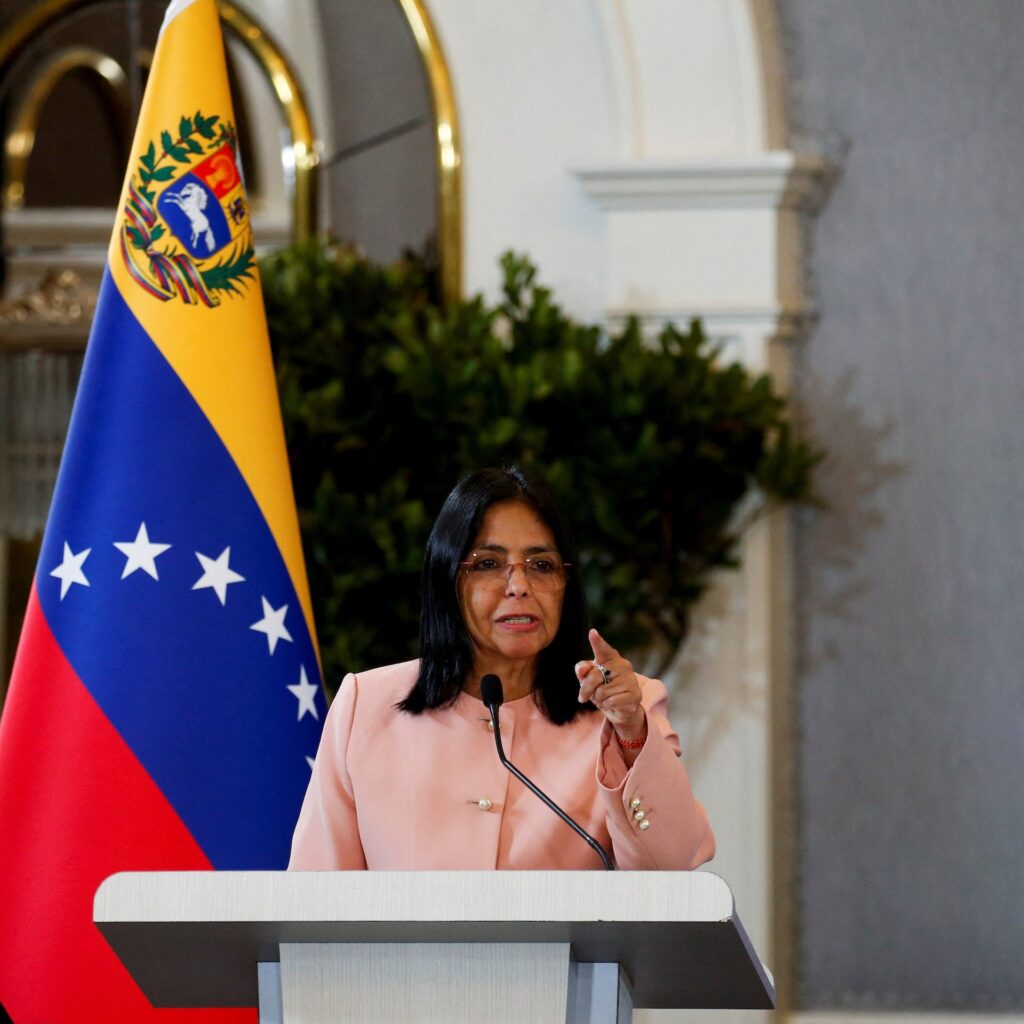
Venezuela’s National Assembly has sworn in Vice President Delcy Rodríguez as interim president following reports that President Nicolás Maduro was arrested and transferred to the United States, a development that has sharply escalated the country’s political and diplomatic crisis.
Rodríguez, 56, was sworn in during an emergency session of parliament in Caracas, acting on authorization earlier granted by Venezuela’s Supreme Court. The Venezuelan military has publicly recognized her as acting president for an initial 90-day period, according to official statements cited by state media.
The swearing-in followed reports that Maduro was detained during an overnight U.S. operation on Saturday and flown to New York, where he appeared in federal court on Monday and pleaded not guilty to multiple charges, including narco-terrorism conspiracy, cocaine importation, and weapons-related offences. His next court appearance has reportedly been scheduled for March 17. These claims have not been independently verified by TMN, and no formal confirmation has been issued by the Venezuelan government or U.S. authorities beyond public statements attributed to officials.
During the ceremony, Rodríguez described Maduro and his wife, Cilia Flores, as having been “kidnapped,” and pledged to pursue all legal and diplomatic avenues to secure their release. She said her interim administration would focus on maintaining internal stability and preserving what she called Venezuela’s political, economic, and social tranquility.
The reported U.S. operation has drawn strong condemnation from Venezuelan officials and allied governments. At an emergency meeting of the United Nations Security Council, Venezuela’s ambassador, Samuel Moncada, described the action as an “illegitimate armed attack without legal justification.”
In response, the U.S. ambassador to the UN, Mike Waltz, defended the move as a “surgical law enforcement action,” describing Maduro as an illegitimate leader and a fugitive from justice. U.S. officials have insisted the operation was intended to enforce international law rather than engineer regime change, although senior figures have acknowledged plans for a managed political transition.
In Washington, U.S. President Donald Trump said the United States would oversee Venezuela’s administration until what he termed a “safe and judicious transition” could be achieved. Senate Minority Leader Chuck Schumer, after a classified briefing, criticized the plan as lacking clarity and warned of broader implications for U.S. foreign policy. House Speaker Mike Johnson rejected claims of regime change, saying the action was aimed at compelling behavioral change and protecting U.S. national interests, including energy security.
Within Venezuela, Rodríguez consolidated political authority as the National Assembly also re-elected her brother, Jorge Rodríguez, as parliamentary speaker. Maduro’s son addressed lawmakers, pledging family support for the interim leadership and expressing confidence that his parents would return to the country.
Thousands of Maduro supporters gathered outside the Federal Legislative Palace during the ceremony, while Venezuelan authorities reported isolated security incidents near the presidential palace later in the day, saying the situation remained under control.
The interim government announced the formation of a special commission, co-chaired by Jorge Rodríguez and Foreign Minister Yvan Gil, tasked with pursuing Maduro’s release and managing international engagement. Rodríguez signaled conditional openness to dialogue with Washington “within the framework of international law,” though President Trump warned of severe consequences if U.S. demands—reportedly including political reforms and oil sector access—are not met.
Despite the leadership change, the ruling United Socialist Party of Venezuela (PSUV) and its allies retain overwhelming control of the National Assembly, underscoring continuity within the country’s power structure.
Attention is expected to focus on Maduro’s upcoming court proceedings in the United States, possible UN or regional diplomatic interventions, and whether the interim government can stabilize domestic conditions while navigating intensifying international pressure. The developments mark a critical moment for Venezuela’s sovereignty, regional stability, and international norms surrounding intervention, with potential implications beyond the country’s borders.