
Iran’s Supreme Leader Khamenei Dead After
Ali Khamenei Confirmed Dead After US-Israel Strikes as Global Powers Trade Accusations at UN
Tehran/Jerusalem/New York
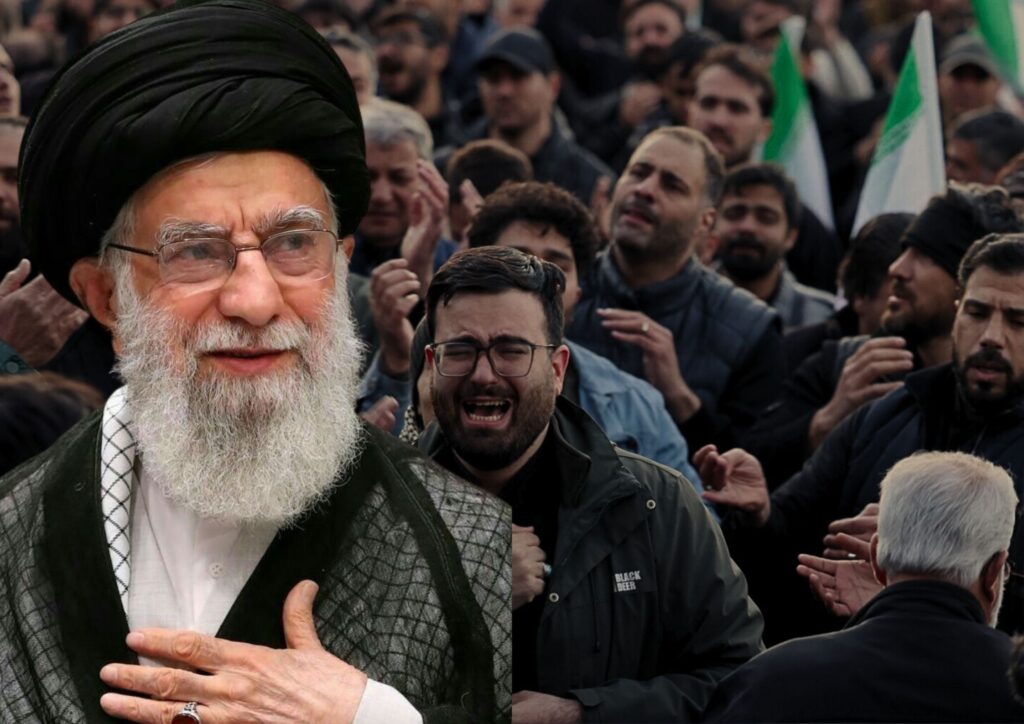
Iran has confirmed that its Supreme Leader, Ali Khamenei, was killed in coordinated United States and Israeli strikes, a development that has sent shockwaves across the Middle East and triggered fears of a wider regional war.
The announcement followed earlier remarks by Israeli Prime Minister Benjamin Netanyahu, who said there were “many signs” that Khamenei was no longer alive after what he described as targeted operations against key Iranian leadership and security sites.
“This morning we destroyed the compound of the tyrant Khamenei,” Netanyahu said in a video statement, accusing the Iranian leader of sponsoring terrorism and pursuing Israel’s destruction.
Iranian state media later confirmed Khamenei’s death, reporting that several senior security officials and members of his family were also killed in the strikes.
Iranian President Masoud Pezeshkian condemned the killing as “a great crime” and declared seven days of public holidays, alongside a 40-day national mourning period.
He described the strike as an “open declaration of war against Muslims,” particularly the Shia community, and vowed that Iran would respond.
State television aired footage of large crowds gathering in Tehran and at the shrine of Imam Reza in Mashhad, where mourners wept and chanted religious slogans. Demonstrations were also reported in Shiraz, Yasuj, and Lorestan.
However, international media reports suggested that reactions within Iran were not uniform. Witnesses cited by Reuters said some residents in Tehran, Karaj, and Isfahan celebrated the news, highlighting deep political and social divisions within the country.
The official IRNA news agency reported that a temporary three-member council — comprising the president, the head of the judiciary, and a jurist from the Guardian Council — will oversee leadership duties until a new supreme leader is selected.
Khamenei had led Iran since 1989, succeeding Ruhollah Khomeini after the 1979 Islamic Revolution. For more than three decades, he was the central authority in Iran’s political, military, and religious structure.
Iran’s elite Islamic Revolutionary Guard Corps (IRGC) pledged revenge, announcing that it had launched strikes on 27 bases hosting US troops in the region as well as Israeli military facilities in Tel Aviv.
Explosions were reported in Qatar and the United Arab Emirates, prompting several Middle Eastern countries to temporarily close their airspace amid heightened security alerts.
Iran said its retaliatory operations targeted Israeli and US assets in Qatar, the UAE, Kuwait, Bahrain, Jordan, Saudi Arabia, and Iraq.
US President Donald Trump warned Tehran against further escalation, saying the United States would respond with force “never seen before” if attacks continued.
In southern Iran, state media reported that at least 201 people were killed across 24 provinces in the joint US-Israeli strikes, citing figures from the Red Crescent. A particularly devastating strike on a girls’ elementary school in Minab reportedly killed at least 148 people and injured dozens more, with casualty figures still rising.
The crisis dominated an emergency meeting of the United Nations Security Council in New York, where diplomats traded sharp accusations.
UN Secretary-General António Guterres warned that failure to contain the crisis could lead to “a potential wider conflict with grave consequences for civilians and regional stability.”
He noted that both the US-Israeli strikes and Iran’s retaliatory actions raised serious legal and humanitarian concerns.
The US ambassador defended Washington’s actions as lawful and necessary to prevent Iran from acquiring nuclear weapons. Israel’s envoy described the strikes as essential to eliminate what he called an existential threat.
Iran’s ambassador accused both countries of committing war crimes and urged the Security Council to intervene decisively.
Russia and China condemned the strikes, calling for an immediate halt to military operations. European powers including Britain, France and Germany urged a return to diplomatic talks over Iran’s nuclear programme.
Beyond Iran, reactions poured in from across the world.
Russian President Vladimir Putin described the killing as a “cynical murder” and offered condolences to Iran. China called the strike a violation of sovereignty, while North Korea labelled it an illegal act of aggression.
In Iraq, authorities declared three days of mourning. Protests erupted near Baghdad’s heavily fortified Green Zone, and demonstrations were reported in Pakistan’s Karachi.
Armed groups aligned with Iran, including Hamas and Yemen’s Houthi leadership, condemned the killing and blamed the US and Israel for destabilising the region.
The European Union’s foreign policy chief described Khamenei’s death as “a defining moment in Iran’s history,” while urging restraint from all sides.
Beyond the political fallout, global markets are watching nervously.
Tensions around the Strait of Hormuz — a critical artery for global oil shipments — have raised fears of supply disruptions. Maritime security agencies have warned of potential missile, drone, and naval threats in the Arabian Gulf, Gulf of Oman, and Northern Arabian Sea.
Shipping firms are reportedly reviewing routes, while insurers reassess risk exposure. Analysts warn that prolonged instability could drive up oil prices, freight costs, and insurance premiums, affecting global trade and energy markets.
Industry observers say any disruption to crude exports from Iran or neighbouring Iraq could quickly ripple through international markets.
Khamenei’s death marks one of the most dramatic moments in Iran’s modern history. For more than three decades, he shaped the country’s domestic politics, regional alliances and strategic posture toward the West.
With no publicly designated successor and military exchanges ongoing, Iran now faces a leadership transition under extraordinary pressure.
Diplomatic channels remain open, but the exchange of threats and retaliatory strikes suggests that tensions remain dangerously high.
As governments, markets and ordinary citizens across the Middle East brace for what comes next, the coming days may determine whether the crisis remains contained — or expands into a broader conflict with far-reaching global consequences.