
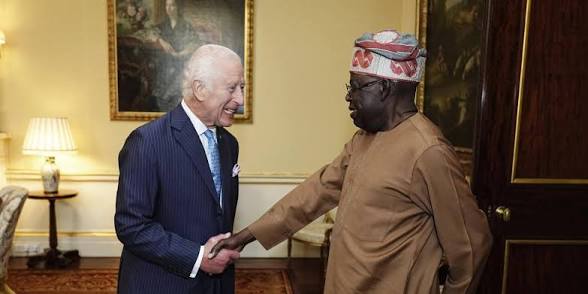
President Bola Tinubu’s two-day state visit to the United Kingdom — the first by a democratically elected Nigerian leader and only the fourth ever — concluded on Thursday with landmark agreements spanning maritime infrastructure, migration reform, defence, trade, and cultural cooperation, repositioning the Nigeria-UK partnership on an unprecedented footing.
LONDON / ABUJA — President Bola Ahmed Tinubu concluded a landmark two-day state visit to the United Kingdom on Thursday, wrapping up what has been described on both sides as the most consequential bilateral engagement between the two nations in a generation. Tinubu and First Lady Oluremi Tinubu departed having presided over the signing of multiple formal agreements and witnessed a diplomatic spectacle that, in pageantry and substance, signalled a deliberate reset in relations between Africa’s most populous nation and its former colonial power.
The visit — the first state visit by any Nigerian president to the UK since military ruler Ibrahim Babangida met Queen Elizabeth II in 1989 — carried layered significance. It was the first such honour extended to a democratically elected Nigerian head of state, and also the first state visit to the United Kingdom by a Muslim head of government during the holy month of Ramadan in nearly a century, with the programme specially adapted to accommodate the occasion.
Royal Welcome at Windsor
The ceremonial opening of the visit on Wednesday unfolded with all the weight of British soft power. Prince William and Princess Catherine received the Nigerian president and first lady at the Fairmont Windsor Park Hotel — with Catherine notably wearing a coat dress by Tolu Coker, a young British-Nigerian fashion designer, in what observers read as a pointed act of cultural diplomacy. The couple then escorted the Tinubus to Windsor town centre, where King Charles III and Queen Camilla extended a formal welcome before a ceremonial guard of honour mounted by the 1st Battalion Grenadier Guards.
More than 1,000 soldiers were deployed for the occasion. A Royal Salute was fired at the Home Park and at the Tower of London, the Nigerian national anthem was performed, and the two heads of state inspected the guard before joining a carriage procession through Windsor — both Nigerian and British flags lining the route — that terminated at the 900-year-old Windsor Castle. In the afternoon, the King and Queen invited their guests to view items from the Royal Collection relating to Nigeria, including artefacts dating from the colonial era.
The long and shared history between our countries is obvious, and much valued by us — today is the opportunity to take that to another level -Prime Minister Keir Starmer, 10 Downing Street
The evening saw a lavish state banquet held in the historic St George’s Hall at Windsor Castle, attended by the King, Queen, the Prince and Princess of Wales, senior members of the British establishment, and Nigeria’s own high-level delegation, which included Senate President Godswill Akpabio, Attorney General Lateef Fagbemi, National Security Adviser Nuhu Ribadu, and Minister of Finance Wale Edun, among others.
The £746m Ports Deal: Infrastructure at the Centre
The most tangible economic outcome of the visit was the signing of a £746 million financing agreement between UK Export Finance (UKEF), the Nigerian Ports Authority (NPA), and Nigeria’s Federal Ministry of Finance.
The deal is intended to fund the comprehensive refurbishment of two of Nigeria’s most critical maritime gateways: the Lagos Port Complex at Apapa and the Tin Can Island Port Complex. Embedded within this arrangement is a separate £70 million steel supply contract, under which British Steel will deliver approximately 120,000 tonnes of steel to support the port upgrade works.
Both facilities are vital arteries of Nigeria’s import-dependent economy, and their deteriorating state has long been cited by logistics operators as a drag on trade competitiveness. The UK-backed financing package is expected to accelerate modernisation timelines and is seen in Lagos business circles as a signal of renewed British commercial interest in Nigerian infrastructure beyond the traditional oil and gas sector.
Starmer at Downing Street: Trade, Defence and MoUs
On the second day of the visit, Tinubu proceeded to 10 Downing Street for high-level talks with Prime Minister Keir Starmer. The two leaders emerged having overseen the formalisation of multiple Memoranda of Understanding spanning trade, investment, defence cooperation, and cultural exchange. Starmer characterised the visit as “historic,” noting the significance of the first state visit by a West African leader in 37 years and stressing that the agreements reached on exports opened a new chapter in the bilateral relationship.
Tinubu, for his part, framed the engagement in the context of a wider global moment, telling reporters: “What we are facing is not a small challenge. Currently, the entire world is challenged.” He stressed that Nigeria and the UK must build on their longstanding ties by strengthening trade links and expanding mutually beneficial economic cooperation.
Bilateral trade between the two nations now stands at a record high of approximately $10.7 billion annually, with Nigerian companies — including financial institutions — reportedly announcing expanded operations in the UK and the creation of hundreds of jobs, further anchoring Nigeria’s position as a gateway to African markets for British business.
Migration: A Thorny Agreement
Perhaps the most politically charged outcome of the state visit was the new UK-Nigeria migration and returns agreement, announced by UK Home Secretary Shabana Mahmood and Nigeria’s Minister of Interior Olubunmi Tunji-Ojo. Under the deal, the Nigerian government has for the first time agreed to recognise UK letters — an alternative identification document used by British authorities when deporting individuals without valid passports — removing a longstanding administrative obstacle to removing Nigerian nationals with no right to remain in the UK.
The British government reported that annual returns of Nigerian nationals to Nigeria have nearly doubled to 1,150. The agreement also includes a new joint operation and intelligence-sharing framework targeting criminal gangs exploiting visa routes, a standardised document-checking system to combat sham marriages and fake sponsorships, and a dedicated “fusion cell” model bringing together public bodies, banks, and tech firms to tackle romance fraud, investment scams, and cryptocurrency schemes that have disproportionately targeted UK residents.
Nigeria’s Minister of Interior sought to contextualise the agreement in broader relationship terms: “This relationship with the UK means a lot to Nigeria. For us to sustain it, we must be as open and as fair as possible. Hopefully, this strengthened partnership will be a template for other bilateral understandings.”
The first time since Nigeria returned to democracy that a democratically elected Nigerian head of state is being afforded this honour by the British monarchy.”— Ikenna Okonkwo, SBM Intelligence
Diplomatic Significance and Analytical Context
Analysts have been quick to place the visit within a broader geopolitical frame. Nigeria is the UK’s 36th largest trading partner, with the bilateral relationship underpinned by a Strategic Partnership signed in November 2024 during then-Foreign Secretary David Lammy’s visit to Abuja. That framework covers six pillars: growth and jobs, defence and security, migration, development finance, climate, and people-to-people links — all of which received fresh impetus from this week’s engagements.
Security experts in Abuja noted that the visit’s timing — coming as Nigeria navigates persistent threats from Islamist insurgency in the Northeast and armed banditry across the Northwest — made the defence cooperation dimensions particularly consequential. Kabir Adamu of Beacon Security and Intelligence Ltd observed that the UK secures deeper commercial access to Africa’s largest market, while Nigeria gains foreign direct investment and security backing that could help stabilise its domestic environment.
Tinubu’s decision to proceed with the visit despite a suicide bombing in Borno State on Monday — which killed 23 people and injured more than 100 — was itself a statement of political resolve. The President condemned the attack as the work of “evil-minded” groups, asserting that “Nigeria will not succumb to fear.”
Mixed Reactions at Home and in the Diaspora
For Nigeria’s large diaspora community in the UK — estimated at over 270,000 British residents of Nigerian birth according to the 2021 census — sentiment around the visit was divided. Some community members welcomed the diplomatic elevation and its potential to unlock investment flows. Others were more sceptical. “What is he coming here for? He needs to sort out the issues at home,” one London-based business owner told Al Jazeera, reflecting widespread frustration with Nigeria’s persistent cost-of-living crisis, security deterioration, and infrastructural deficits.
Those tensions are not easily dismissed. Tinubu’s economic reform programme — which scrapped fuel subsidies, devalued the naira, and liberalised the foreign exchange market — has drawn praise from the IMF and World Bank for its macroeconomic ambition, with Nigeria’s economy growing 3.9% in the first half of 2025 and inflation falling to 15% in January 2026 from a peak of 34%. But the reforms have simultaneously triggered sharp increases in the cost of living that have yet to translate into material improvement for most Nigerians.
The question of whether the diplomatic gains of this state visit — significant as they are on paper — will reach ordinary Nigerians remains, for now, an open one. What is beyond dispute is that after 37 years, Nigeria has reasserted itself on the stage of British state diplomacy, and the terms of its re-engagement carry ambition commensurate with its weight as Africa’s most populous nation and largest economy.
Well written