
Nigeria will not be going to the 2026 FIFA World Cup.
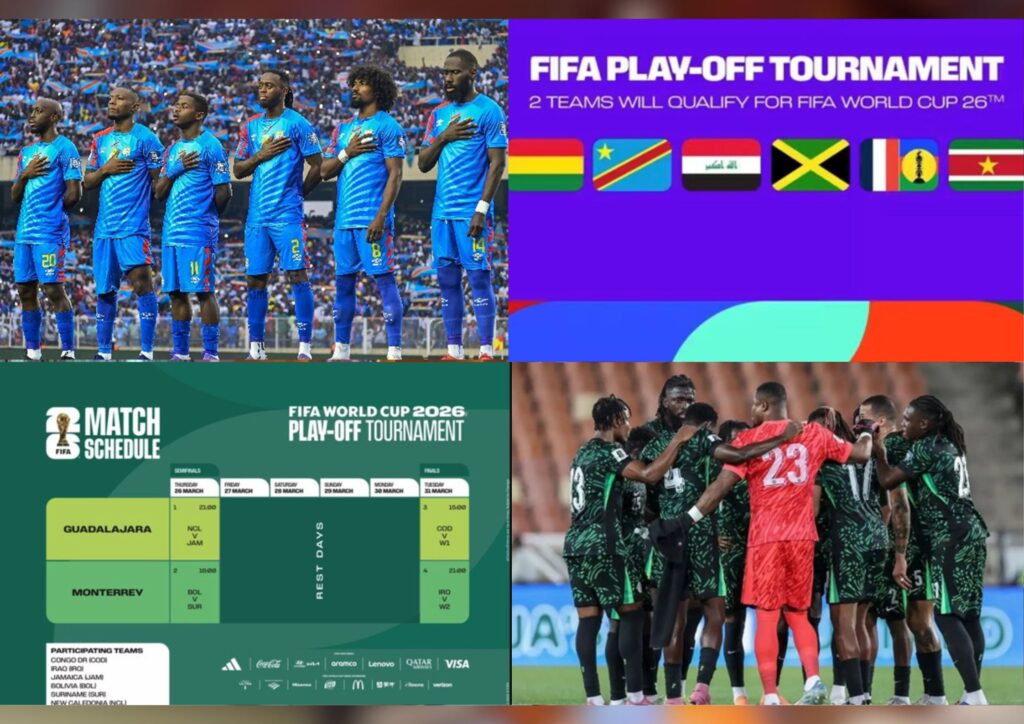
That reality became official after FIFA confirmed the final list of countries that will compete in this month’s inter-confederation play-off tournament — and DR Congo national football team was named as Africa’s representative.
With that announcement, Nigeria’s last hope of sneaking back into the qualification race has finally ended.
In a notice sent to journalists ahead of the tournament, FIFA explained that six countries will compete for the final two remaining spots at the 2026 World Cup.
According to FIFA, the play-off tournament will run from March 26 to March 31, 2026, in Guadalajara and Monterrey, Mexico.
The six teams confirmed are:
- Bolivia
- DR Congo
- Iraq
- Jamaica
- New Caledonia
- Suriname
That list does not include Nigeria.
And that is what officially ends the Super Eagles’ campaign.
Nigeria’s elimination originally happened in November 2025 during a CAF play-off against DR Congo.
That match ended 1–1 after full time. It then went to penalties, where DR Congo won and knocked Nigeria out.
But the story did not end there.
The Nigeria Football Federation (NFF) filed a formal protest after the game. The federation claimed that DR Congo fielded ineligible players and asked for the result to be overturned.
If that protest had succeeded, Nigeria could have been reinstated into the inter-confederation play-offs.
For months, many Nigerian fans believed there was still a chance. Social media was filled with hope that an administrative decision might return the Super Eagles to the race.
However, FIFA’s latest announcement made no mention of any sanctions or changes to the result. By confirming DR Congo as Africa’s team for the play-off, FIFA has clearly shown that Nigeria’s protest did not succeed.
Even though there was no separate public ruling explaining the decision in detail, the message is clear: the result stands.
The inter-confederation play-off involves six teams fighting for the final two tickets to the 2026 World Cup.
Under FIFA’s format:
- The four lowest-ranked teams — Bolivia, Jamaica, New Caledonia and Suriname — will first play semi-final matches.
- The two highest-ranked teams — DR Congo and Iraq — automatically move to the finals.
This means DR Congo is just one match away from qualifying for the World Cup. They will face the winner of Jamaica vs New Caledonia.
For Nigeria, however, the journey has ended.
The 2026 World Cup will be historic.
It will be the first time the tournament expands from 32 teams to 48 teams. It will also be hosted across three countries — the United States, Canada and Mexico — in 16 different cities.
Africa was given more direct qualification slots under this expanded format. That was supposed to increase opportunities for African nations.
That makes Nigeria’s absence more painful.
The Super Eagles are not a small football country. Since their World Cup debut in 1994, Nigeria has qualified six times — in 1994, 1998, 2002, 2010, 2014 and 2018. The team reached the Round of 16 three times.
Nigeria already missed the 2022 World Cup in Qatar after losing to Ghana on away goals in a play-off.
Now, missing 2026 — even with more qualification slots available — will be seen by many as a serious setback.
Nigeria has a strong football reputation in Africa.
The Super Eagles have won the Africa Cup of Nations three times and have produced top players who shine in Europe’s biggest leagues.
The golden generation of the 1990s — the team that played at USA ’94 — helped build Nigeria’s image as a football powerhouse.
But in recent years, qualification campaigns have been more difficult. Coaching changes, administrative issues, tactical problems, and strong competition from other African countries have all played a role.
The penalty shootout loss to DR Congo in November 2025 was already a painful blow. Many fans described it as “football’s cruel lottery.” The protest that followed gave supporters hope — but that hope has now ended.
Missing the World Cup is not just about pride.
It also affects money and development.
When a country qualifies for the World Cup:
- The football federation earns more revenue.
- Sponsors increase investment.
- Players gain global exposure.
- Youth interest in football rises.
Missing two consecutive World Cups raises serious questions about planning and structure.
Many analysts say Nigeria needs to look at:
- Grassroots football development
- Coaching stability
- Domestic league improvement
- Transparent football administration
For some players currently in their prime, the next chance to play at a World Cup will be 2030 — and not everyone will still be active by then.
With qualification officially over, attention will now shift to rebuilding.
The Super Eagles will focus on upcoming tournaments, including the next Africa Cup of Nations and preparation for the 2030 World Cup qualifiers.
Football experts say long-term success requires more than talented players. It requires:
- Stable leadership
- Clear technical direction
- Proper youth development
- Accountability in administration
There may also be renewed pressure on the NFF to explain what went wrong and how it plans to fix it.
FIFA’s confirmation has settled the matter.
Nigeria will not compete for the final two World Cup spots later this month in Mexico. DR Congo will carry Africa’s last inter-confederation hopes.
For millions of Nigerian fans, it is disappointing news.
But it is now official.
The dream of 2026 is over.
The journey to 2030 begins.