
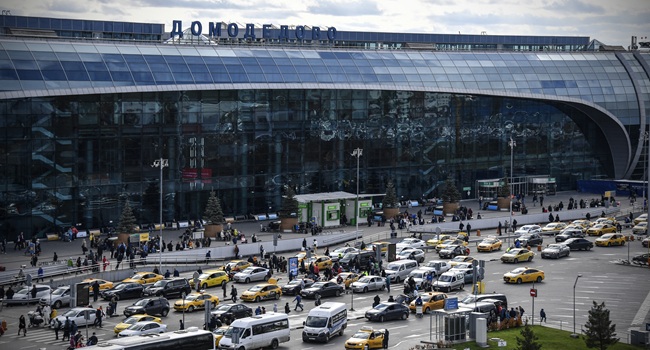
Russia has completed the sale of Moscow Domodedovo Airport, the country’s fourth-busiest aviation hub, to the managing company of Sheremetyevo Airport, following a court ruling that transferred the asset to the state earlier this year.
In June, a Russian court ordered Domodedovo’s ownership to be nationalised, ruling that its former owners, Dmitry Kamenshchik and Valery Kogan, were foreign residents and therefore had no legal right to manage a strategic infrastructure asset. The ruling paved the way for the airport’s transfer to state control and its subsequent resale.
Sheremetyevo’s operator, acting through its wholly owned subsidiary Perspektiva LLC, together with Bank PSB PJSC, announced that it had signed an agreement to acquire Domodedovo. The airport was sold on the second attempt for about $850 million, nearly half the original asking price of $1.6 billion, highlighting the valuation pressure surrounding state-mandated asset transfers.
According to Russian business outlet RBC, Sheremetyevo Airport is majority-owned by TPS Avia Holding and the Russian government, which retains a 30 per cent stake. TPS Avia Holding was re-registered from Cyprus back to Russia in 2022, amid sweeping corporate restructurings triggered by Western sanctions.
Russian media have also linked Arkady Rotenberg, a close associate of President Vladimir Putin, to TPS Avia Holding’s shareholder structure, though full ownership details have not been publicly disclosed.
A Pattern of State Consolidation
The Domodedovo transaction fits into a broader pattern of state-driven asset consolidation since Russia sent troops into Ukraine in 2022. Since then, billions of dollars’ worth of assets have been seized, nationalised, or transferred under state oversight, including holdings previously owned by Western companies such as French dairy group Danone and German energy firm Uniper.
Russian authorities frame these actions as necessary to protect national security, prevent capital flight, and maintain continuity in critical sectors amid sanctions. In practice, analysts say, the process has followed a recurring sequence: legal reclassification of ownership, transfer to the state, and resale to domestically aligned or state-linked entities.
Business-Risk Implications for Foreign Investors
For foreign investors, the Domodedovo case underscores a fundamental shift in Russia’s investment climate. Legal risk has become inseparable from political risk, particularly in sectors deemed strategic, including aviation, energy, transport, food, and infrastructure.
Ownership structures once considered routine—such as offshore registration or foreign residency—are now increasingly vulnerable to legal challenge. Asset valuations have also come under sustained pressure, as forced or constrained sales occur at significant discounts, eroding shareholder value and limiting exit options.
Capital controls and sanctions have further complicated profit repatriation, turning many investments into capital traps rather than growth assets. As a result, Russia is now widely viewed by global firms not as an expansion market, but as a high-risk jurisdiction requiring active exposure management or orderly exit.
A Broader Signal Beyond Russia
While Russia’s situation is shaped by war and sanctions, analysts warn that the precedent matters beyond its borders. The use of national security and economic sovereignty to justify ownership changes could influence other sanctioned or geopolitically pressured states, reshaping assumptions about asset protection in emerging markets.
For global investors, the lesson from Domodedovo is clear: commercial logic alone no longer guarantees security. In geopolitically charged environments, alignment, ownership structure, and strategic sector exposure now weigh as heavily as financial fundamentals.