
In late 2025, an unexpected flashpoint emerged between Nigeria and the United States that at first seemed destined to spiral into diplomatic rupture. The U.S. President Donald Trump triggered alarm in Abuja and across Nigeria by publicly alleging a Christian massacre in the country and warning of possible military action unless the Nigerian government “stopped the killing.” Nigeria was placed on the U.S. State Department’s Country of Particular Concern watchlist for religious freedom, stoking fears in Abuja of sanctions, aid cuts or even unilateral U.S. military moves — language that revived memories of foreign incursions and tested questions of sovereignty.
What followed, over the ensuing months, was a fascinating reversal: Nigeria strategically defused tension, challenged the narrative with diplomatic pushback, and ultimately pivoted toward multilateral security cooperation with Washington — not as a supplicant, but as an assertive partner in its own counter-insurgency efforts.
From Alarm to Assertive Rebuttal
Trump’s initial claims were widely criticised at home and abroad as oversimplified and inflated — reflective more of domestic political posturing than of Nigeria’s complex, multi-ethnic, multi-religious security realities. Nigeria’s government swiftly and publicly rejected the accusations of a targeted Christian genocide, noting that terrorist violence in the country affects communities of all faiths and arises largely from deeply rooted insurgency, banditry and political marginalisation.
Experts and independent analysts later highlighted that violence by groups such as Boko Haram, ISWAP and loosely affiliated militants has claimed tens of thousands of lives over years — with victims spanning Christians, Muslims and traditional believers — making the “genocide” framing both inaccurate and polarising.
Rather than escalate the diplomatic crisis, Nigerian authorities adopted a dual strategy: they prevented a full public breakdown in relations while simultaneously pushing back against simplistic characterisations of the conflict. Nigeria’s civil and diplomatic outreach worked to clarify that the problem was a shared security challenge, not a sectarian crisis of the kind presented in some U.S. political discourse.
Strategic Shift Toward Security Cooperation
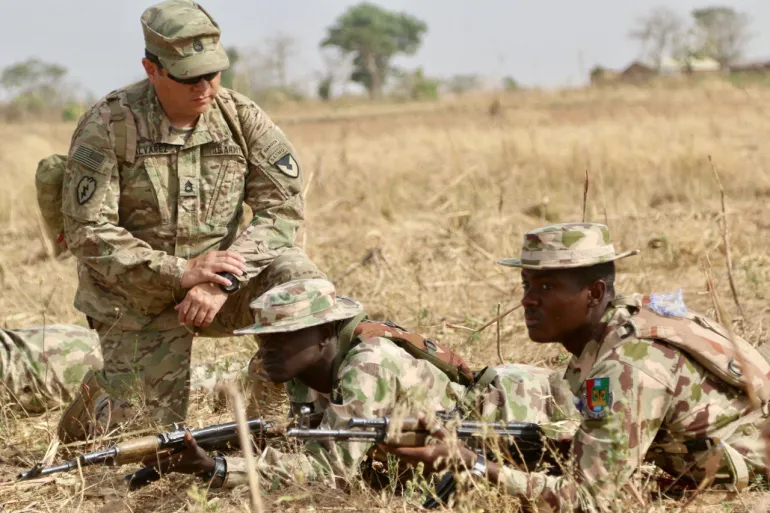
Remarkably, within a few months of the initial standoff, relations transformed. What once looked like a blistering confrontation gave way to practical security cooperation. In February 2026, approximately 100 U.S. military personnel arrived in Nigeria to provide training, technical support and intelligence sharing in Nigeria’s ongoing fight against armed and jihadist groups — at the formal request of the Nigerian government. The deployment is explicitly non-combat and operates under Nigerian command, preserving Nigeria’s sovereignty while leveraging U.S. capabilities.
This tighter cooperation reflects a broader recalibration: both countries recognise that Nigeria’s security crisis is a regional and global concern, and that enhanced Nigerian capacity, supported by external expertise, yields better results than unilateral intervention. In practical terms, Nigeria benefits from actionable U.S. intelligence, specialised training and interoperability, without ceding operational control.
Diplomacy, Domestic Politics and Narrative Management
Nigeria’s response to the allegations — neither capitulation nor confrontation — was rooted in calculated diplomatic messaging. Abuja engaged U.S. interlocutors and global audiences to emphasise socio-economic causes of violence and the equal suffering of diverse communities, while welcoming support against armed groups. That posture helped shift discourse from punitive rhetoric to collaboration.
It is notable that the diplomatic pivot was not unilateral. U.S. strategic calculus evolved as well. The shift from Trump’s aggressive language to tactical cooperation suggests Washington’s recognition that information warfare and on-the-ground insecurity require nuanced partnership rather than blunt military threats. This mirrors previous U.S. engagements in Africa, where capacity building often outlives headline liberal interventions.
Opportunities and Risks Ahead
Nigeria’s navigation of this episode reveals several broader lessons:
- Security Cooperation Over Rhetoric: By inviting U.S. personnel to assist within a defined advisory role, Nigeria has kept its sovereignty front and centre, while tapping into global resources to strengthen counter-insurgency efforts that have long strained its own military.
- Narrative Control Matters: Countering simplistic foreign narratives — especially those driven by domestic politics abroad — requires proactive diplomacy. Nigeria’s rebuttal of the “Christian genocide” label did not erase the violence, but reframed it in a way that better reflected the national and regional security context.
- Balancing Sovereignty and Support: Maintaining command over operations while accepting foreign support is a delicate balance; Nigeria’s current arrangement emphasises security partnership without operational dependency.
- Limits of Military Assistance: Analysts caution that while U.S. technical support and air power capabilities improve tactical capacities, they do not address the deeper socio-economic roots of insurgency, such as unemployment, governance deficits and marginalisation — long-term drivers that require equally sustained domestic policy focus.
Conclusion
The arc from potential diplomatic confrontation — fuelled by exaggerated claims — to cooperative security partnership underscores Nigeria’s growing diplomatic dexterity and strategic maturity. By rejecting polarising narratives and aligning external support with its own operational priorities, Nigeria has turned a potentially divisive moment into an opportunity to bolster its fight against insecurity.
Yet this cooperation should not be mistaken for conflict resolution. Military support, even when welcomed, is a tactical tool. Sustainable peace demands investment in governance, economic inclusion and community resilience — a long game that extends far beyond any one bilateral arrangement.