
Abuja
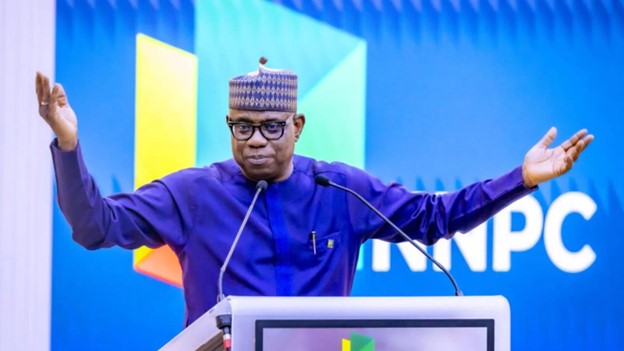
The Group Chief Executive Officer of NNPC Limited, Bayo Ojulari, has acknowledged that Nigeria’s national oil company currently lacks the capacity to operate state-owned refineries profitably, describing the costly reactivation of the Port Harcourt Refinery as a strategic misstep that resulted in sustained financial losses for the country.
Ojulari disclosed on Wednesday while speaking at the 2026 Nigerian International Energy Summit, where he offered a rare and candid assessment of the challenges confronting Nigeria’s downstream oil sector and the limitations of NNPC’s operational model.
His remarks come against the backdrop of renewed national debate over the viability of government-owned refineries, years of failed rehabilitation efforts, and the shifting dynamics created by the emergence of private-sector refining capacity.
According to Ojulari, the attempt to resume operations at the Port Harcourt Refinery and Petrochemical Company (PHRPC) turned out to be financially unsustainable, forcing NNPC to shut the facility again after months of losses.
The refinery, which underwent rehabilitation at an estimated cost of about $1.5 billion under the leadership of former NNPC GCEO Mele Kyari, was reopened in November 2024 after nearly three years of repairs. However, by May 2025, operations were halted once more following mounting operational losses.
Ojulari said an internal review conducted after the restart revealed that the refinery was operating far below optimal levels and bleeding value.
“The first thing that became clear was that we were running at a monumental loss to Nigeria. We were just wasting money. I can say that confidently now,” he said.
Explaining the reasons behind the failure, Ojulari noted that refinery operations require a combination of strong financing, technical competence, and operational discipline — elements he said NNPC currently lacks at the required scale.
According to him, the Port Harcourt facility was operating at only 50 to 55 per cent utilisation, even as NNPC continued to feed it with crude oil cargoes that had significant market value.
“We were pumping cargo into the refinery every month, but utilisation was around 50 to 55 per cent. Those cargoes have value, and we were losing that value,” he said.
“We were spending a lot of money on operations and contractors. But when you look at the net outcome, we were just leaking value, and there was no clarity on how to turn those losses into positive returns.”
The decision to shut down the refinery, he explained, was taken to stop further financial damage and allow for a reassessment of strategy.
Ojulari said the experience has forced NNPC to confront a difficult reality: that running refineries profitably requires far more than routine contracting or operations-and-maintenance arrangements.
“To make a refinery work, you need three things,” he said.
“First, financing to support operations. Second, a competent EPC contractor. Third, world-class operational capacity to run the refinery.”
He stressed that NNPC’s board has now approved a shift in approach, moving away from reliance on contractors and service providers towards partnerships with entities that have proven experience in owning and operating refineries on a commercial basis.
“We are not looking for contractors. We are not looking for O&M service providers. We are looking for an entity that actually runs refineries,” Ojulari said.
This signals a possible move towards concessioning, joint ventures or outright operational partnerships for Nigeria’s refineries, a subject that has generated political sensitivity in the past.
Ojulari acknowledged that the successful commencement of operations at the Dangote Refinery has significantly reduced pressure on the Federal Government to rush decisions on reviving state-owned facilities.
“There was a lot of pressure about continuity, but we were not under that pressure. And thank God for Dangote Refinery,” he said.
“Whether you love Dangote or hate him, thank God. Thank God he is a Nigerian and not someone from another continent. That gave us breathing space because we now have a refinery that is working.”
The 650,000-barrel-per-day privately owned Dangote Refinery has begun supplying petroleum products into the domestic market, reshaping Nigeria’s downstream landscape and challenging the long-held assumption that state-owned refineries must be revived at all costs.
Beyond refining, Ojulari also addressed Nigeria’s crude oil production outlook, expressing cautious optimism while warning against unrealistic projections.
He said Nigeria could realistically reach 1.8 million barrels per day in 2026, but described the Federal Government’s 2025 budget benchmark of 2.06 million barrels per day as overly ambitious.
According to him, average oil production last year stood at about 1.7 million barrels per day, reflecting persistent challenges including pipeline vandalism, theft, operational disruptions and underinvestment.
“For this year, we have a target of two million barrels per day, but the budget is based on about 1.8 million barrels per day. So we are not overcommitting,” he said.
Ojulari warned that overestimating oil production and revenue can have severe consequences for public finances, pointing to Nigeria’s experience in the previous year.
He noted that lower-than-expected oil prices and production shortfalls disrupted fiscal plans, as government spending commitments had already been made based on optimistic assumptions.
“Spending plans had already been made based on those assumptions, and that has far-reaching consequences,” he said.
According to him, realistic planning and credible projections are essential to preventing future fiscal shocks and ensuring sustainable economic management.
Ojulari’s remarks mark one of the most forthright admissions by an NNPC chief executive regarding the limits of the national oil company’s capacity to run refineries efficiently.
They also reflect a broader shift in thinking within Nigeria’s energy sector — away from symbolic revival of state assets and towards commercially viable, partnership-driven solutions.
As Nigeria grapples with energy security, fiscal pressures, and the need to attract investment, NNPC’s direction on refinery operations and production planning is likely to shape the country’s oil and gas trajectory in the years ahead.