
By Adejumobi Richard
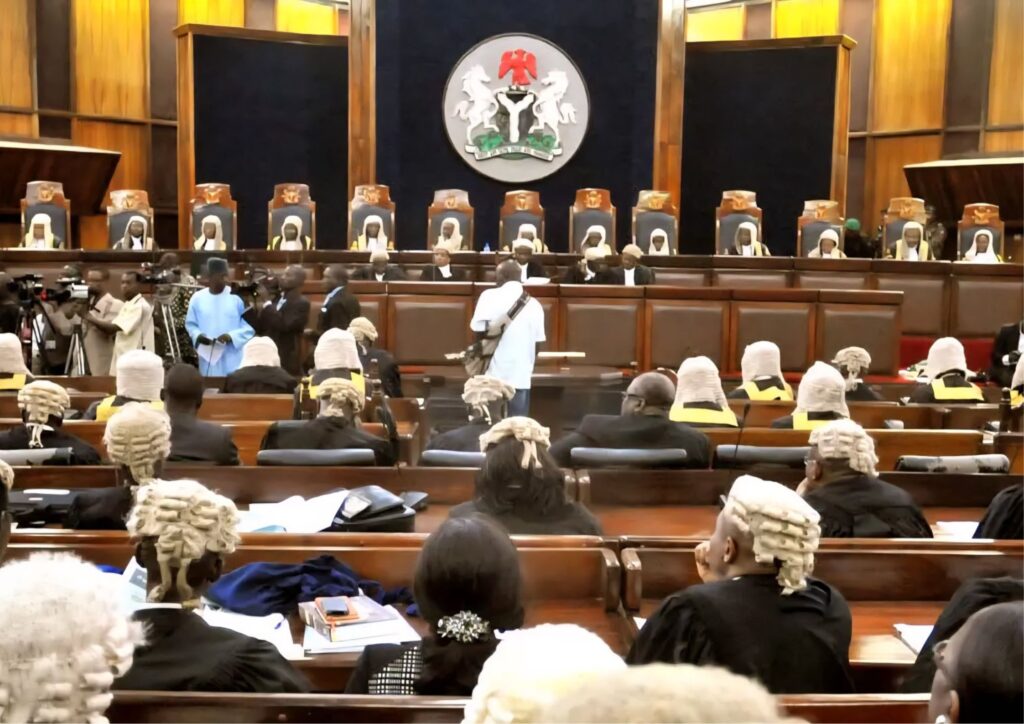
In 2025, Nigeria’s judiciary emerged as one of the most defining institutions in the country’s political and constitutional life. Across a succession of high-profile rulings, the courts asserted state authority, clarified the limits of institutional power, and responded to evolving security, economic, and social realities. Collectively, these decisions revealed a judiciary inclined toward legal certainty and institutional order, even as its posture raised enduring questions about democratic safeguards and accountability.
One of the most consequential legal moments of the year occurred on December 15, 2025, when the Supreme Court upheld President Bola Ahmed Tinubu’s declaration of a state of emergency in Rivers State. The ruling followed the President’s earlier decision, announced on March 18, to impose a six-month emergency in response to escalating political instability and widespread pipeline vandalism in the oil-producing state. As part of the emergency measures, the governor, deputy governor, and members of the state House of Assembly were suspended, and a sole administrator was appointed to oversee governance.
In its judgment, the Supreme Court accepted that the President acted within the ambit of Section 305 of the 1999 Constitution, which empowers the executive to declare a state of emergency where there is a serious breakdown of law and order.
Section 305(1): Power to Declare Emergency
The President may, by issuing a Proclamation, declare a state of emergency in the Federation or in any part of it.
Section 305(2): Publication
The proclamation must be published in the Official Gazette of the Government of the Federation.
Section 305(3): Conditions That Justify an Emergency
A state of emergency may be declared if:
- (a) Nigeria is at war or faces imminent danger of invasion
- (b) There is actual breakdown of public order and public safety in any part of the country
- (c) There is a clear and present danger of such a breakdown
- (d) There is an occurrence or danger of natural disaster or epidemic
- (e) There is any other public danger threatening the existence of the Federation
- (f) The President receives a request from a State Governor (supported by a resolution of the State House of Assembly) declaring that public order has broken down in the state and federal intervention is required
Section 305(4): Approval by the National Assembly
The proclamation must be approved by the National Assembly:
- Within 2 days if the Assembly is in session
- Within 10 days if it is not in session
If not approved, the proclamation ceases to have effect.
Section 305(5) & (6): Duration
- An emergency proclamation lasts six months
- It can be extended, but only with National Assembly approval
Section 305(7): Revocation
The President may revoke the proclamation at any time, and the National Assembly may also revoke it by resolution.
While critics, including the Peoples Democratic Party, warned that the suspension of elected officials threatened federalism and stretched constitutional limits, the court’s decision effectively reinforced executive discretion in matters touching on national and regional stability. At the same time, it reopened debates about the balance between emergency powers and democratic norms.
National security and terrorism jurisprudence also featured prominently in the courts’ work during the year. In November 2025, the Federal High Court in Abuja convicted Nnamdi Kanu, leader of the proscribed Indigenous People of Biafra, on multiple terrorism-related charges and sentenced him to life imprisonment. The court found that Kanu had directed violence, enforced unlawful regional lockdowns, and incited attacks on government installations. In reaching its decision, the court held that while the right to self-determination is recognised in law, any attempt to pursue it outside constitutional frameworks, particularly through violence, is illegal.
The judgment followed years of protracted legal proceedings, including Kanu’s arrest in Kenya and subsequent extradition to Nigeria. While the ruling affirmed the state’s authority to prosecute perceived threats to national security, it also drew renewed scrutiny to issues of extradition processes, fair trial standards, and the limits of political expression within separatist movements.
Beyond questions of security and executive power, the judiciary also confronted issues of governance structure and institutional legitimacy. In a case initiated by the Department of State Services, the Federal High Court in Abuja ruled against attempts by Professor Pat Utomi to establish what was described as a “shadow government.” The court held that such parallel governance arrangements have no legal foundation under Nigeria’s presidential system and are inconsistent with constitutional order. By restraining the initiative, the court reaffirmed that political engagement, even in symbolic or innovative forms, must operate within established democratic institutions.
Fiscal federalism was another area in which the Supreme Court provided critical clarification. In December 2025, the court ruled on a suit filed by the Osun State Attorney General challenging the federal government’s withholding of local government allocations. In a split decision, the court held that the Attorney General lacked the legal standing to institute the action on behalf of the state’s local governments, asserting that only duly elected local government chairpersons possess the authority to litigate such matters. Nonetheless, the court acknowledged that the federal government’s actions breached constitutional principles, thereby reinforcing both procedural discipline in constitutional litigation and the autonomy of local government institutions within Nigeria’s federal system.
The courts also demonstrated an awareness of Nigeria’s changing economic landscape. In July 2025, the Federal High Court in Lagos affirmed the authority of the Federal Inland Revenue Service to collect Value Added Tax on services provided through digital platforms, including ride-hailing and food delivery services. By upholding the decision of the Tax Appeal Tribunal, the court signalled its willingness to interpret fiscal laws in a manner that accommodates emerging business models and technological innovation. The ruling underscored the judiciary’s role in aligning legal frameworks with economic transformation.
Questions of religion and state neutrality were similarly addressed. In December 2025, the Federal High Court in Lagos dismissed a suit challenging the legality of the Nigerian Christian Pilgrims Commission Act and the National Hajj Commission Act. The court held that the establishment of these bodies does not amount to the adoption of a state religion, affirming Nigeria’s constitutional approach to secularism as one of neutral accommodation rather than strict separation. The judgment provided legal clarity on the role of religious institutions within public administration.
Electoral accountability also remained a focus of judicial intervention throughout the year. Appellate courts upheld convictions of electoral officials found guilty of manipulating election results, reinforcing the principle that those entrusted with administering elections are individually accountable under the law. These rulings sent a clear signal that electoral misconduct would not be excused by claims of external pressure or superior orders.
What These Rulings Mean for Ordinary Nigerians
For ordinary Nigerians, the impact of these decisions is both direct and subtle. Emergency powers affect how quickly elected representation can be suspended in times of crisis. Security rulings influence how protest, dissent, and separatist expression are policed. Fiscal decisions shape how funds reach—or fail to reach—local communities through councils closest to the people. Tax rulings affect the cost of digital services Nigerians use daily, from transportation to food delivery. Religious judgments determine how faith-based activities interact with government structures, while electoral cases speak to whether votes truly count and whether officials who undermine elections face consequences.
In essence, these rulings determine who holds power, how far that power can go, and what legal remedies remain available to citizens when institutions fail.
A Judiciary of Order—and a Test for the Republic
Taken together, the decisions of 2025 portray a judiciary firmly committed to order, authority, and institutional clarity. The courts chose stability over experimentation, procedure over populism, and constitutional structure over political improvisation. In doing so, they strengthened the state and clarified the law.
But clarity is not the same as justice, and authority is not the same as legitimacy. A judiciary can define the boundaries of power, but it cannot ensure that power is exercised with restraint, wisdom, or empathy. That responsibility lies with elected leaders, lawmakers, and citizens themselves.
In 2025, Nigeria’s courts did not shout. They spoke carefully, firmly, and with consequence. The message was clear: the law will hold the line. What remains uncertain is whether the nation’s politics will rise to meet that standard—or continue to test its limits.