
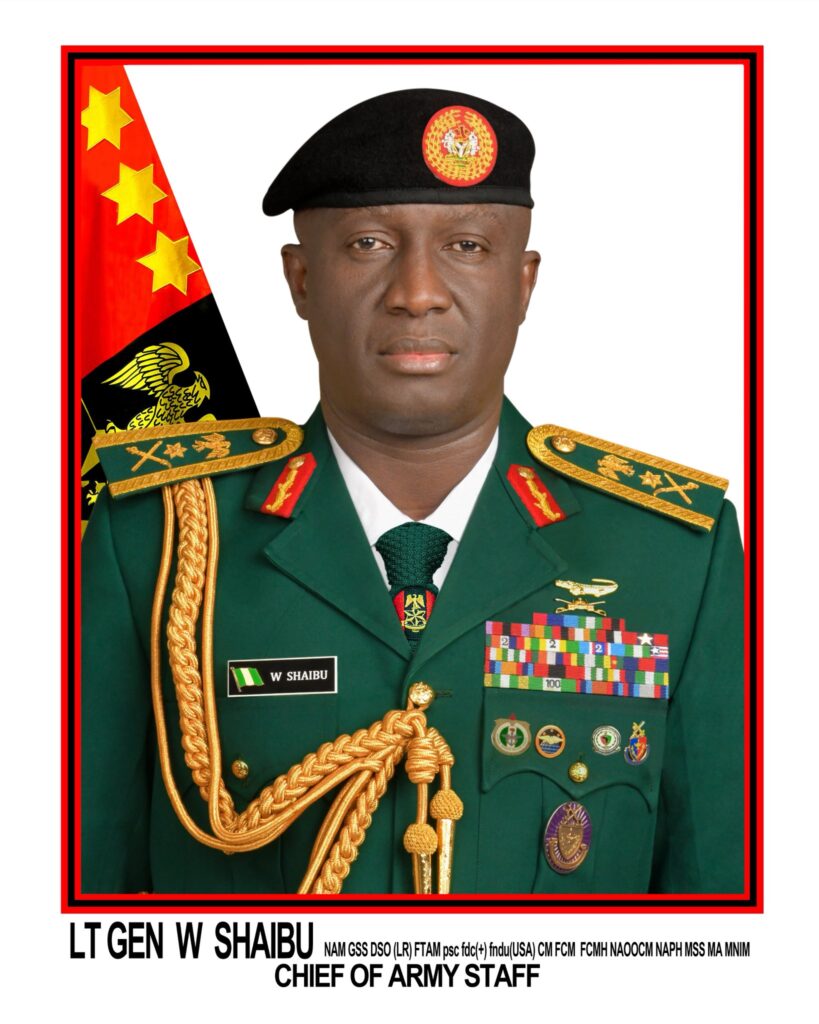
The Chief of Army Staff (COAS), Lieutenant General Waidi Shaibu, has reaffirmed the Nigerian Army’s commitment to an intelligence-driven, technology-enabled and multi-domain strategy to counter evolving asymmetric threats to national security.
Lieutenant General Shaibu made the statement on Tuesday while delivering a strategic lecture titled “Combating Asymmetric Threats to National Security in Nigeria: The Nigerian Army in Perspective” to participants of Course 34 at the National Defence College (NDC), Nigeria.
According to the Army chief, the global security landscape has shifted significantly from conventional, state-centric warfare to complex intra-state conflicts dominated by non-state actors. These include terrorists, insurgents, bandits, cybercriminals and transnational organised crime networks that exploit governance gaps, social vulnerabilities and emerging technologies.
He explained that in response, the Nigerian Army has recalibrated its operational doctrine and force posture, integrating kinetic operations with intelligence fusion, inter-agency collaboration, joint operations with sister services and sustained international partnerships.
“Asymmetric threats thrive on adaptability, anonymity and attacks on civilians aimed at eroding public confidence and state authority. Our response must be equally adaptive, proactive, intelligence-led and collaborative,” the COAS said.
Lieutenant General Shaibu noted that Army operations across Nigeria’s geo-political zones are tailored to specific threat environments. In the North-East, sustained counter-insurgency operations have continued to degrade terrorist groups through offensive manoeuvres, intelligence-driven strikes and population-focused stabilisation efforts.
In the North-West, he said joint operations have intensified pressure on bandit groups by disrupting logistics and financing networks while improving the protection of vulnerable communities. Meanwhile, stabilisation operations in the North-Central region have focused on area domination, civilian protection and the containment of communal and militia-related violence.
The COAS further highlighted the increasing role of advanced technologies, enhanced training and deeper jointness with other security services in improving situational awareness and operational effectiveness. He stressed that modern national security now extends beyond territorial defence to include economic security, cyber resilience, environmental stability and human security.
He added that sustainable peace can only be achieved when military efforts are complemented by effective governance, justice delivery and inclusive socio-economic development.
Urging participants of NDC Course 34 to adopt forward-looking and integrated security frameworks, Lieutenant General Shaibu described them as Nigeria’s future strategic leaders who must address both the symptoms and root causes of conflict.
He reassured Nigerians of the Nigerian Army’s continued resolve to defend national sovereignty, protect lives and property, and secure critical national infrastructure amid evolving security challenges.