
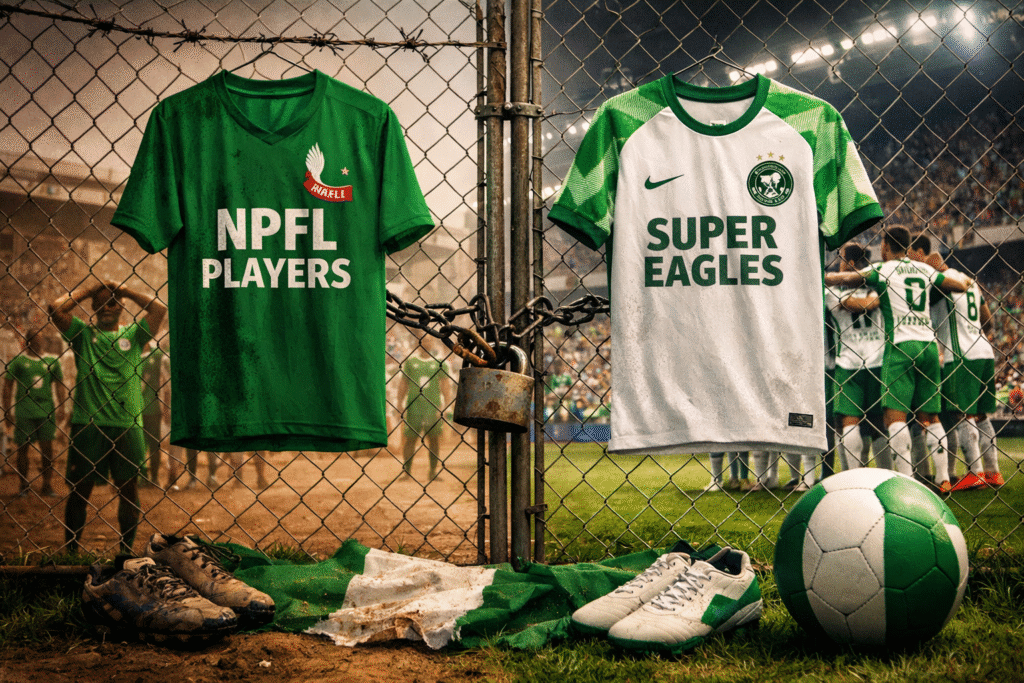
Nigeria Football Federation (NFF) Technical Director Augustine Eguavoen has intensified criticisms of the Super Eagles’ AFCON 2025 roster, faulting head coach Éric Sekou Chelle for fielding a squad that excluded all Nigeria Premier Football League (NPFL) players. The intervention, which has gained traction across Nigerian sporting circles and on X.com, has reopened longstanding debates about national team selection, domestic league valuation, and pathways for home-grown talent.
Nigeria concluded the 2025 Africa Cup of Nations in Morocco in third place, finishing the tournament with a competition-best fourteen goals and securing bronze after a penalty win over Egypt. While the squad’s performance was seen as respectable, Eguavoen argued the achievements did not negate concerns over the absence of NPFL representatives, particularly when several foreign-based players received limited or no minutes throughout the competition.
Speaking in media engagements and amplified through trending posts on X, Eguavoen described the situation as “disappointing” and insisted that at least a handful of domestic players merited inclusion for technical depth and developmental considerations. He further contended that appraising NPFL quality solely through the prism of the African Nations Championship (CHAN) — which fields exclusively home-based players — was analytically reductive and failed to reflect league performance dynamics.
The remarks align with wider reactions circulating on social platforms, where fans and pundits questioned whether structural biases against domestic football continue to marginalize NPFL prospects, despite the league’s improving tactical standards and competitive intensity. Supporters of Chelle’s selection approach countered that AFCON remains a performance-critical tournament and that optimizing internationally-exposed talent remains the most reliable path to podium finishes.
Eguavoen’s standpoint adds a layer of institutional sensitivity for the NFF, which has historically defended coaching autonomy in squad decisions while also advocating expanded domestic scouting. The federation has not publicly rebuked Chelle, but Eguavoen’s comments have drawn attention to the broader policy issue of aligning elite national football outcomes with domestic football development objectives.
Analysts note that previous Super Eagles squads blending foreign-based and NPFL players — most memorably during the 2013 AFCON title run — demonstrated both tactical balance and symbolic reinforcement of Nigeria’s local football ecosystem.
The renewed debate underscores a strategic choice confronting Nigerian football: whether to continue prioritizing overseas-based selections for international tournaments or to embed a more deliberate talent pipeline that incentivizes domestic league performance and strengthens NPFL legitimacy. The outcome of this debate is likely to influence future squad-building processes, youth pathways, and the internationalization of the Nigerian football market.