
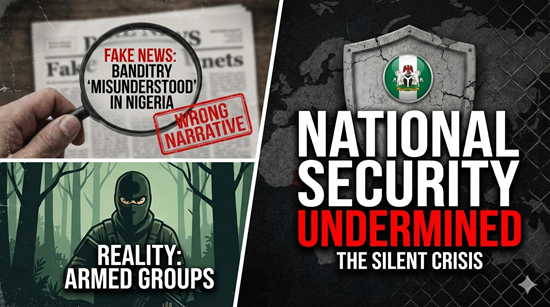
Armed groups operating in Nigeria’s North-West are no longer engaged in isolated acts of banditry. Security analysts increasingly warn that these groups have evolved into a more sophisticated insurgency, a shift underscored by reports and images showing the emergence of high-grade military weapons such as IWI Tavor rifles in the hands of non-state actors.
For years, Nigeria has comforted itself with a dangerous misdiagnosis — the belief that insecurity in the North-West could be explained primarily as cattle rustling and sporadic rural crime. That description may have held some validity a decade ago. Today, however, the crisis has mutated far beyond village raids. What is now unfolding reflects a hardened, networked threat, marked by improved weaponry, mobility, and regional linkages.
The IWI Tavor is not a firearm one casually encounters in informal markets. Designed and produced for military and specialist security units, it is a controlled, high-grade rifle associated with elite forces and counter-terrorism operations worldwide. Its reported appearance in Nigeria’s internal conflict space is therefore not merely a sign of increased firepower, but an indicator of deeper connections — to trans-Sahel arms trafficking routes, to the destabilizing fallout of conflicts in Libya and Mali, and to illicit smuggling corridors stretching from the Maghreb to the Gulf of Guinea.
This evolution demands a more honest national conversation. Mislabeling an insurgent threat as “banditry” does not simply obscure reality; it shapes policy responses that underestimate the scale, organization, and external linkages of the adversary Nigeria now faces.
For years, I have argued that Nigeria’s insecurity has undergone a transformation. Today’s armed groups are not the ragtag rustlers of old. They are structured, mobile, ideologically fluid, and financially empowered. They negotiate ransoms like corporations, recruit like militias, and fight like irregular armies. The Tavor rifle simply confirms what many security experts have known, but leaders have been reluctant to admit: the threat has crossed the threshold.
This is why Nigeria’s current terminology is not just wrong—it is dangerous. Words shape policy. Calling insurgents “bandits” automatically shapes the state’s response into policing, not counterinsurgency. It downplays the threat, misdirects resources, and gives the enemy a soft landing.
A group that can acquire Tavor rifles is not a group you send local vigilantes to chase. It is a group you trace, disrupt, and dismantle using intelligence-driven, regionally coordinated, and politically honest strategies.
So what must change?
First, Nigeria needs to overhaul its intelligence ecosystem. If insurgent groups can source specialist rifles, Nigeria should be able to trace and intercept the channels. That requires technical intelligence, human intelligence, and cross-border partnerships—not siloed agencies competing for relevance.
Second, the state must abandon the banditry narrative. The longer we mislabel the threat, the longer it grows inside our blind spot.
Third, Nigeria must pursue aggressive diplomatic engagement across the Sahel. Arms trafficking is regional; no state can solve it alone.
Finally, governance must return to abandoned rural spaces. Insurgency feeds on ungoverned territories. You cannot militarize your way out of a legitimacy vacuum.
The appearance of Tavor rifles is the flashing red light on Nigeria’s security dashboard. It signals that the nation is operating in a new security era—one with higher stakes, deeper connections, and more dangerous adversaries.
Pretending we are dealing with bandits is no longer an error.
It is a national security risk