
Abuja
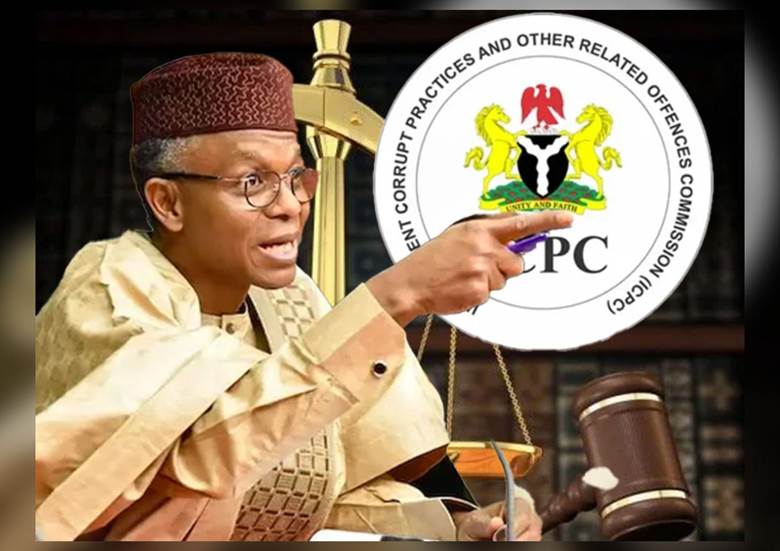
Former Kaduna State Governor Nasir El-Rufai has launched a sweeping legal challenge against Nigeria’s security and anti-corruption agencies, filing separate suits against the Department of State Services (DSS) and the Independent Corrupt Practices and Other Related Offences Commission (ICPC), seeking a combined ₦3 billion in damages.
The former governor is asking the courts to quash criminal charges filed against him and declare unlawful a recent search conducted at his Abuja residence — a move that escalates an already tense standoff into a full-scale courtroom battle.
In one of the cases before the Federal High Court, El-Rufai is seeking to strike out Charge Number FHC/ABJ/CR/99/2026 instituted by the DSS. The matter is scheduled for hearing on February 25, 2026, before Justice Joyce Abdulmalik.
Through his legal team, he argues that the charges are legally incompetent, disclose no known offence under Nigerian law, and amount to what he describes as a gross abuse of court process.
Among the reliefs sought are:
- An order discharging him on grounds that no prima facie case has been established.
- ₦2 billion in costs against the DSS for alleged misuse of the criminal justice system.
Court documents indicate that the application is anchored on 17 grounds, including constitutional invalidity, lack of prosecutorial competence, absence of credible evidence, and claims of political persecution.
His lawyers contend that the prosecution violates constitutional protections such as the presumption of innocence, the right against self-incrimination, and the principle that offences must be clearly defined in written law.
The court’s ruling later this month could determine whether the case proceeds to full trial or ends at the preliminary stage.
In a separate fundamental rights enforcement suit, El-Rufai is demanding ₦1 billion in damages over what he describes as an unlawful invasion of his residence at House 12, Mambilla Street, Aso Drive, Abuja.
The suit challenges a search warrant issued on February 4 by a Chief Magistrate of the FCT Magistrate’s Court. Named as respondents are the ICPC, the Chief Magistrate, the Inspector-General of Police, and the Attorney-General of the Federation.
Filed by his lead counsel, Oluwole Iyamu (SAN), the suit seeks seven key reliefs, including a declaration that the search warrant was invalid, null and void.
El-Rufai argues that the warrant lacked specificity, contained drafting errors, and failed to establish probable cause, thereby violating Section 37 of the Constitution, which guarantees the right to privacy.
He further contends that the February 19 search by ICPC and police officers breached his rights to dignity, personal liberty, fair hearing, and privacy under Sections 34, 35, 36, and 37 of the Constitution.
The ₦1 billion claim is broken down as follows:
- ₦300 million as compensatory damages for psychological trauma and emotional distress.
- ₦400 million as exemplary damages to deter future misconduct.
- ₦300 million as aggravated damages for alleged malicious and oppressive conduct.
He is also seeking ₦100 million in legal costs.
His legal team argues that the warrant violated provisions of the Administration of Criminal Justice Act (ACJA), 2015, and the ICPC Act, 2000, insisting that it was not supported by sworn evidence establishing reasonable grounds for suspicion.
According to an affidavit filed by a principal aide, officers seized personal documents and electronic devices during the search, allegedly without lawful authority, and have yet to return them.
The twin lawsuits represent a defining moment in the confrontation between El-Rufai and federal authorities. Beyond personal stakes, the cases raise broader questions about prosecutorial discretion, the limits of investigative powers, and the constitutional safeguards surrounding search warrants and criminal charges.
As proceedings begin, the courts will be tasked with determining whether the agencies acted within the law — or overstepped their authority.
For now, the dispute has shifted decisively from political exchanges to legal argument. The outcome could shape not only the future of the charges against the former governor but also the interpretation of investigative powers under Nigeria’s criminal justice framework.