
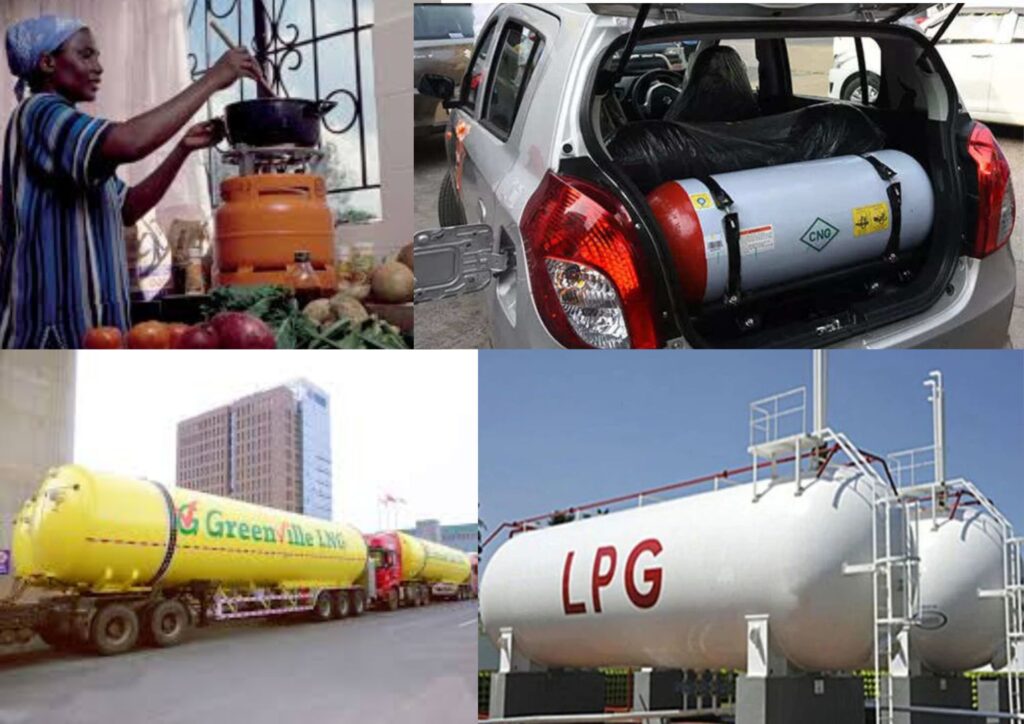
Gas has quietly become part of everyday life for millions of Nigerians.
From cooking meals in family kitchens, to powering buses and tricycles, to running factories and electricity plants, gas is now central to how Nigerians live and work. Yet despite how common they are, many people still use the words LPG, LNG, and CNG interchangeably — even though they are very different fuels, used in various ways, and carry different safety risks.
This confusion is not harmless. Treating these gases as the same can lead to accidents, higher costs, and poor energy choices.
Here is what every Nigerian needs to know about the three major gas fuels in simple, practical terms.
LPG: The Cooking Gas in Most Nigerian Homes
Liquefied Petroleum Gas (LPG) is the most familiar gas in Nigeria. It is what people commonly call cooking gas.
LPG is produced during crude oil refining and natural gas processing. It is mainly a mix of propane and butane, which are gases that can easily be turned into liquid when put under moderate pressure. That is why LPG can be stored in cylinders and tanks that fit inside kitchens, restaurants, and small businesses.
Inside the cylinder, LPG is stored as a liquid under pressure. When you open the valve, it turns back into gas and burns for cooking.
Where LPG is used
- Home cooking
- Restaurants and bukas
- Bakeries
- Small industries
- Welding and heat treatment
- Some vehicles converted to run on gas
Why LPG is popular
- It is portable
- Easy to store
- Widely available
- Cleaner than kerosene or firewood
- Cheaper than petrol for heating
The major safety risk
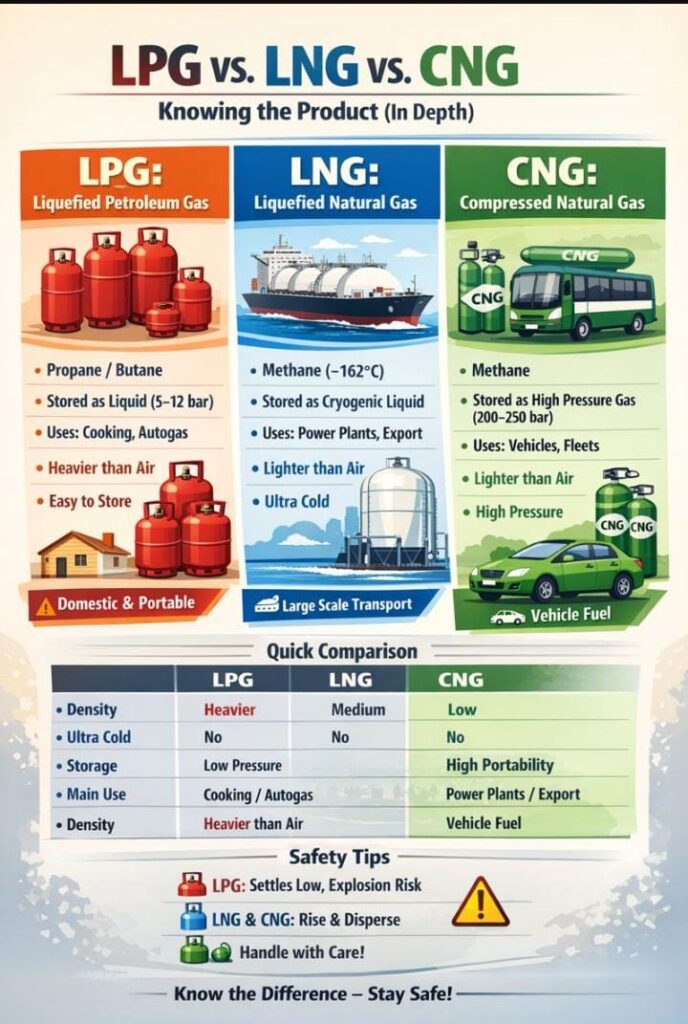
LPG is heavier than air. This means if it leaks, it does not rise — it settles on the floor and can build up in enclosed spaces like kitchens, shops, or stores.
If a spark occurs, this trapped gas can explode.
That is why:
- LPG cylinders must be well ventilated
- They must not be kept in sealed rooms
- They must never be placed near heat
- They must never be laid sideways
LNG: The Gas for Power Stations and Export
Liquefied Natural Gas (LNG) is not used in homes. It is mainly for large industries, power plants, and international export.
LNG is natural gas (mostly methane) that has been cooled to about –162°C. At that temperature, the gas turns into liquid and its volume shrinks by about 600 times, making it easy to transport long distances by ship.
This is the gas Nigeria exports to many countries through Nigeria LNG in Bonny Island.
Where LNG is used
- Power generation
- Large factories
- Heavy industries
- International gas export
LNG is stored in special cryogenic tanks designed to handle extremely low temperatures. Unlike LPG, it is kept at near normal pressure, but at a very low temperature.
Safety profile
LNG is lighter than air. If it leaks, it quickly rises and disperses, reducing the risk of explosion in open spaces. However, it is extremely cold and can cause severe frostbite, which is why only trained professionals handle it.
LNG is about scale, not convenience — it is designed for big energy needs, not household use.
CNG: The Gas Powering Cars and Buses
Compressed Natural Gas (CNG) is also natural gas, mostly methane. But instead of being cooled like LNG, it is compressed to very high pressure — usually between 200 and 250 bar — and stored in strong cylinders.
CNG remains a gas, not a liquid.
Where CNG is used
- Cars and buses
- Tricycles (keke)
- Commercial transport fleets
- Some industrial heating systems
CNG is becoming popular in Nigeria because it is cheaper than petrol and diesel, and burns cleaner.
Why CNG is considered safer
Like LNG, CNG is lighter than air. If it leaks, it rises and disperses quickly, reducing the chance of explosion in open areas.
However, its safety depends heavily on the cylinder. Because the pressure is very high:
- Cylinders must be certified
- They must never be welded
- They must never be drilled or modified
- Old or damaged cylinders must be replaced
Why Nigerians Often Confuse LPG, LNG, and CNG
The confusion comes from one simple reason: they are all called “gas”.
They all burn cleanly, produce heat, and are promoted as alternatives to petrol or diesel. But how they behave in storage, transport, and accidents is very different.
Here is the simple way to remember:
- LPG settles if it leaks → dangerous indoors
- CNG rises if it leaks → safer in open spaces
- LNG rises but freezes everything it touches → only for professionals
Which Gas Is Best for You?
- LPG → Best for home cooking and small businesses
- CNG → Best for vehicles and transport
- LNG → Best for power plants and large industries
Using the wrong gas for the wrong purpose can be expensive — or deadly.
As Nigeria pushes for cleaner energy and cheaper fuel alternatives, gas will play an even bigger role in daily life. But understanding the difference between LPG, LNG, and CNG is not optional — it is about safety, savings, and smart choices.
Knowing what gas you use, how it behaves, and how to handle it properly can protect your home, your business, and your life.
In the end, gas is only a good servant when it is properly understood.