
Lagos, Nigeria
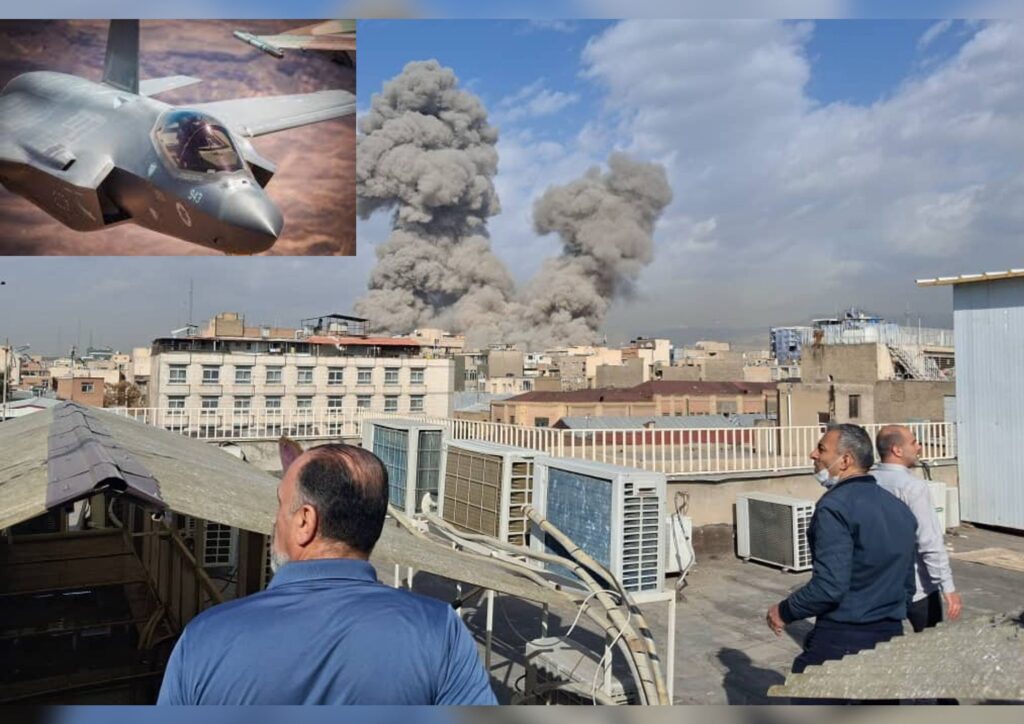
As the sun rises over the bustling streets of Lagos on this March morning in 2026, the distant echoes of conflict in the Middle East feel uncomfortably close. The joint US-Israeli military campaign against Iran, dubbed Operation Epic Fury by the Americans and Operation Roaring Lion by the Israelis, has now stretched into its fifth day. Fresh explosions have reverberated through Tehran and other Iranian cities, punctuated by the dramatic downing of an Iranian Yak-130 aircraft by an Israeli F-35I Adir stealth fighter over the capital – a historic first for the advanced jet in manned combat. Meanwhile, global Brent crude oil prices have surged to around $83 per barrel, casting a shadow of economic uncertainty across the world. Here in Nigeria, where the hum of generators and the daily commute rely heavily on affordable fuel, experts are sounding alarms that petrol prices could climb to ₦1,000 per litre or higher this week, deepening the struggles of families already navigating high living costs in our deregulated market.
Take a moment to picture the scene: in Tehran, a city of ancient bazaars and modern skyscrapers, the night sky has been lit by airstrikes, while across the Gulf, oil tankers idle nervously, their crews watching for drone silhouettes. This isn’t just a far-off war; it’s a ripple that touches our shores, influencing everything from the price of garri at the market to the stability of the naira. As we delve deeper into this unfolding story, let’s explore it step by step, drawing on the threads of history that have led us here, voices from experts who help make sense of the chaos, and visual insights that bring the data to life.
The conflict erupted on February 28, 2026, with precision strikes that claimed the life of Iran’s Supreme Leader Ayatollah Ali Khamenei and several top officials – an unprecedented aerial assassination of a national leader. By midday on March 4, the Pentagon reported nearly 2,000 targets struck in Iran, including the destruction of 17 naval vessels. In retaliation, Iranian forces have unleashed missiles and drones across the Middle East, resulting in the deaths of six US service members and damage to vital energy infrastructure in Gulf states. Iran’s Red Crescent has tallied over 787 casualties, while Lebanon reports dozens killed in spillover strikes.
US President Donald Trump, in a measured statement on March 3, indicated the operation might extend to “four to five weeks” or beyond, yet emphasized that forces are “substantially ahead” of schedule. “Just about everything has been knocked out,” he remarked to reporters, leaving open the possibility of deploying ground troops. Israeli Prime Minister Benjamin Netanyahu has been unequivocal about the goal: regime change in Tehran, with sources close to the operation telling Reuters that progress is outpacing the initial two-week timeline.
To fully grasp the gravity of these events, we must pause and reflect on the deep-rooted tensions that have simmered for decades, building to this boiling point. It’s a story of alliances turned sour, ideological clashes, and the ever-present shadow of nuclear ambitions – one that reminds us how history shapes the present in ways both profound and perilous.
Imagine the Middle East as a vast tapestry, woven with threads of ancient empires, colonial legacies, and modern power struggles. The current conflict between the US, Israel, and Iran didn’t ignite overnight; its roots stretch back over seven decades, through coups, revolutions, and proxy wars that have reshaped the region time and again.
Let’s trace this history gently, like following a winding river. It begins in the early 20th century, when Iran (then Persia) was viewed by the US as a trustworthy power against British and Russian colonial interests. But the pivotal moment came in 1953, when the United States and Britain orchestrated a coup in Iran, overthrowing Prime Minister Mohammad Mosaddegh after he nationalized the country’s oil industry – a move seen as threatening Western interests. This intervention reinstated the Shah, Mohammad Reza Pahlavi, as a pro-Western monarch, but it sowed seeds of resentment that would bloom into revolution. The Shah’s regime became a close ally of the US and Israel, with Iran recognizing Israel in 1949 and maintaining diplomatic ties until 1979. During the Cold War, Iran served as a bulwark against Soviet influence, receiving military aid and even nuclear technology under President Eisenhower’s “Atoms for Peace” program in 1957, which ironically kickstarted Iran’s nuclear ambitions.
By 1979, widespread discontent with the Shah’s autocratic rule, corruption, and Westernization led to the Islamic Revolution, led by Ayatollah Ruhollah Khomeini. The new Islamic Republic severed ties with the US, labeling it the “Great Satan,” and with Israel as an illegitimate occupier of Muslim lands. The revolution’s immediate aftermath saw the US Embassy hostage crisis in Tehran, lasting 444 days from November 1979 to January 1981, where 52 Americans were held captive. This event severed diplomatic relations, imposed sanctions on Iranian oil, and froze assets – marking the beginning of over four decades of enmity.
The 1980s brought direct confrontations: armed clashes in the Gulf during the Iran-Iraq War (1980-1988), where the US supported Iraq to counter Iran. Iran began supporting proxy groups like Hezbollah in Lebanon, escalating its shadow war with Israel. In 1983, a bombing linked to Hezbollah killed 241 US service members in Beirut, the deadliest single-day loss for the US military since the Vietnam War’s Tet Offensive. This led to the US designating Iran as a state sponsor of terrorism in 1984.
Tensions simmered through the 1990s but exploded in the early 2000s with revelations of Iran’s secret nuclear program. President George W. Bush labeled Iran part of the “Axis of Evil” in 2002, while Israel viewed a nuclear-armed Iran as an existential threat. The US invasion of Iraq in 2003 removed Saddam Hussein, Iran’s rival, allowing Iran to expand its influence across the region through proxies.
Fast-forward to the 2010s: The 2015 Joint Comprehensive Plan of Action (JCPOA), or Iran nuclear deal, briefly eased sanctions in exchange for limits on Iran’s nuclear activities. But in 2018, President Trump withdrew from the agreement, reimposing “maximum pressure” sanctions and ordering the 2020 drone strike that killed Iranian General Qasem Soleimani – a move that nearly sparked full-scale war. Iran responded by enriching uranium beyond deal limits and bolstering proxies, leading to tit-for-tat strikes, including Israel’s assassinations of Iranian nuclear scientists like Mohsen Fakhrizadeh in 2020 using a remote-controlled machine gun.
The turning point came in 2024-2025. Amid increasing regional tensions from the Gaza war, Iran and Israel exchanged missiles directly for the first time in April 2024. By June 2025, Israel launched unilateral strikes on Iranian nuclear and military facilities, sparking what became known as the “12-Day War” or “Twelve-Day War.” Israel targeted sites like Natanz, Fordow, and Isfahan, with the US joining on June 21, 2025, using bunker-busting bombs. Iran retaliated with missiles on Israeli cities and US bases, such as Al Udeid in Qatar, but a US-brokered ceasefire ended hostilities on June 24, 2025. A fragile peace held, but protests in Iran and renewed US pressure under Trump set the stage for the current offensive in 2026.
As one expert notes, “The Israel-Iran conflict is rooted not in territorial disputes, but in ideological hostility dating back to 1979.” This history of betrayal, proxy battles, and nuclear brinkmanship explains why today’s strikes feel like the culmination of long-simmering grievances.
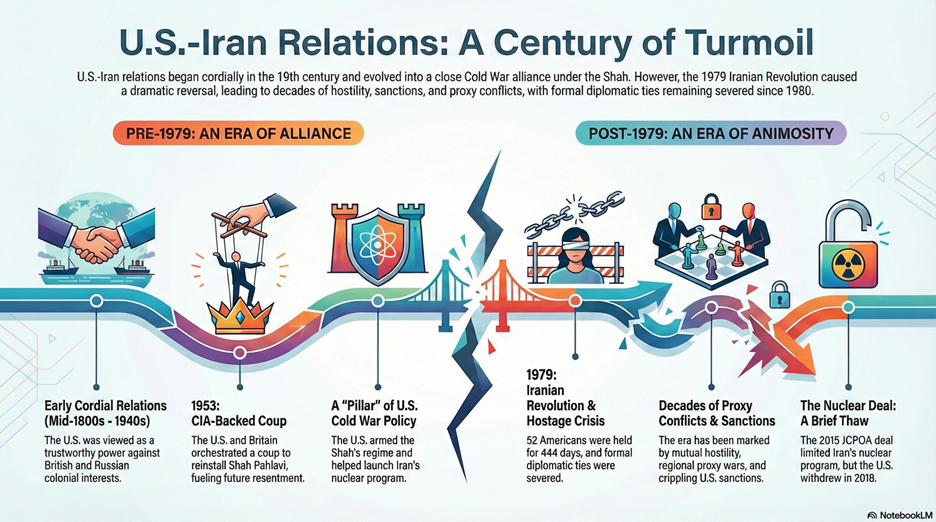
*Above: An infographic timeline of US-Iran relations from 1979 to 2026, illustrating the shift from alliance to animosity through key events like the revolution, hostage crisis, nuclear deal, and recent wars – a visual journey through decades of turmoil.*
Day 5: Intensification on the Ground
Now, on Day 5 of the 2026 war, the battlefield has expanded dramatically, turning what began as targeted strikes into a regional conflagration. Israel unleashed a “broad wave” of overnight airstrikes into Wednesday, targeting missile production sites, command centers, and air defenses in Tehran, Isfahan, and beyond – involving dozens of aircraft and building on Tuesday’s hits on leadership complexes in Qom, where clerics reportedly voted remotely for a new Supreme Leader amid security threats. These strikes aim to dismantle Iran’s ability to retaliate, focusing on its ballistic missile program and nuclear-related facilities, though the IAEA has confirmed no radiological risks from damage at Natanz.
The Pentagon’s briefing, timed around 2 p.m. WAT, revealed over 50,000 US troops committed to Operation Epic Fury, supported by 200 fighter jets, two aircraft carriers, and bombers. CENTCOM Commander Admiral Brad Cooper stressed ongoing efforts to suppress Iranian retaliation, noting the destruction of mobile missile launchers with released aerial footage showing precision hits amid urban landscapes.
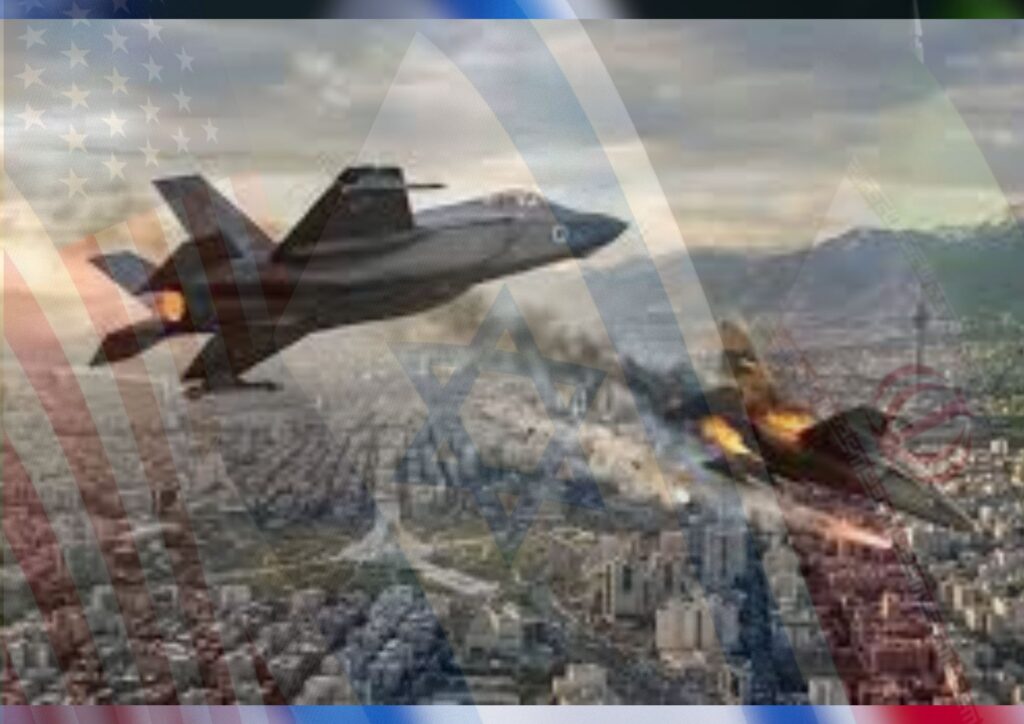
A pivotal moment came with the Israeli F-35I Adir’s downing of an Iranian Air Force Yakovlev Yak-130 over Tehran. The IDF confirmed this as the first manned shootdown by an F-35 variant, underscoring the technological gulf. The Yak-130, a Russian-designed subsonic trainer/light attack jet – with Iran receiving deliveries around 2013 and more in 2024 – was repurposed for defensive patrols despite sustained strikes on facilities like the 8th Tactical Air Base near Isfahan. The engagement occurred during Israeli air operations targeting military infrastructure around the capital. No further details on the intercept method or weapon were released, and Iranian authorities have remained silent on the loss, though social media images showed the aircraft operating over Tehran earlier in the week.
US forces have played a supportive role, targeting Iranian mobile missile launchers and providing intelligence. Iran’s Islamic Revolutionary Guard Corps (IRGC) claimed a missile strike on a US destroyer near Indian waters, unconfirmed by the Pentagon but hinted at by NASA’s heat maps showing anomalies and fires in the area. Iranian media reported collateral damage to cultural sites, including the historic Golestan Palace, a UNESCO World Heritage site, from stray airstrikes – a reminder of how war blurs lines between military and civilian targets.
Amid the chaos, Iran’s Interim Leadership Council appointed Mojtaba Khamenei, son of the late Supreme Leader, as the new Supreme Leader – a move signaling continuity and defiance, even as bombardments continue. This appointment, made under duress, highlights the regime’s resilience but also its vulnerability, with experts questioning how long the clerical establishment can hold amid internal protests sparked by the war.
The war has widened regionally, drawing in proxies and allies. Hezbollah in Lebanon fired rockets at Israel, prompting retaliatory strikes on Beirut and southern Lebanon, including a hotel in Hazmieh, killing dozens and wounding hundreds. Hezbollah, long armed by Iran, continued its barrages into northern Israel, displacing communities and straining Israel’s Iron Dome defenses. Drones targeted a British RAF base in Cyprus, leading UK Prime Minister Keir Starmer to deploy the destroyer HMS Dragon for added protection. France responded by sending fighter jets over the UAE and anti-missile systems to Cyprus, while the UK, France, and Germany collectively vowed “defensive action” to safeguard their interests.
In the Gulf, Iran’s attempt to close the Strait of Hormuz – a narrow chokepoint carrying 20% of global oil and LNG – has caused immediate havoc. Qatar paused LNG production after drone hits on its facilities, Saudi Arabia suspended refinery operations to avoid risks, and Iraq reduced output by over a million barrels daily, with some reports citing up to 1.5 million bpd due to storage and export limits. Hundreds of tankers are stranded offshore, with hire costs quadrupling to $400,000 per day amid soaring insurance premiums. Oman reported drone strikes on its ports, while QatarEnergy extended shutdowns to downstream products like urea, essential for fertilizers. Saudi Aramco is exploring alternative routes via the Red Sea, but fears escalation from Iran’s Houthi allies in Yemen, who have a history of targeting shipping.
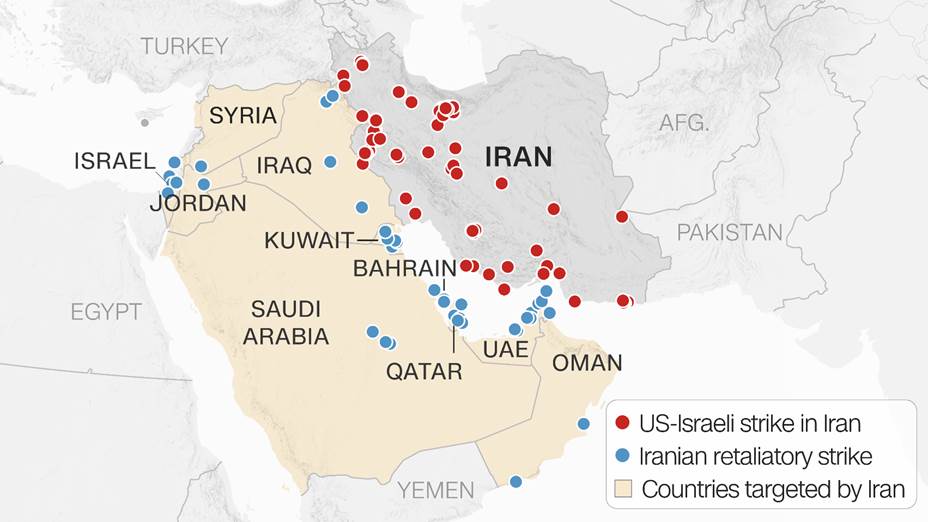
Above: A detailed map visualizing US-Israeli strikes in Iran (red dots) and Iranian retaliatory strikes (blue), highlighting key locations like the Strait of Hormuz and affected countries – a stark illustration of the conflict’s geographic spread and its chokehold on global energy routes.
Casualties continue to rise, painting a grim human picture amid the strategic maneuvers. Iran’s Red Crescent updated its toll to over 787 dead, including 165 civilians from a devastating strike on a girls’ school in Minab and hits on hospitals, where medical staff worked tirelessly under fire. In Lebanon, 52 have been killed and 246 wounded in just two days of cross-border exchanges. Six US troops perished in Iranian attacks on Kuwait, with four identified as Army Reserve soldiers in a drone strike that highlighted the vulnerabilities of forward bases. Three US jets were accidentally downed by Kuwaiti defenses in the confusion, though all crews survived ejection. Civilian deaths have also been reported in the UAE, Kuwait, and Bahrain from stray missiles and drones, including reported damage to the US Consulate in Dubai – incidents that underscore the war’s indiscriminate toll.
UN officials have expressed deep alarm over attacks on civilian infrastructure like schools and hospitals, calling for “maximum restraint” to prevent a humanitarian catastrophe. The International Atomic Energy Agency (IAEA) confirmed damage to Iran’s Natanz nuclear site but reassured that there are no radiological risks or evidence of an active weapons program, though skeptics point to past allegations of uranium enrichment for up to 11 bombs, denied by the IAEA. Russia has condemned the strikes as “armed aggression” and urged immediate diplomacy, while Iran’s UN ambassador labeled US actions “totally stupid,” accusing betrayal of Gulf mediators and insisting Tehran targets only military assets, not civilians.
Democratic US senators, fresh from classified briefings, voiced fears over the lack of clear objectives and the specter of “boots on the ground” deployment, which could entangle America in another protracted Middle East quagmire. Retired US Army Lt. Gen. Mark Hertling warned in a recent interview, “Iran gets a vote – they get to fight back,” highlighting the risks of prolonged conflict and underestimating Iranian resilience. President Trump reiterated US readiness for longer operations, suggesting naval escorts for Hormuz tankers and US-backed maritime insurance to mitigate disruptions.
Tensions escalated after failed US-Iran nuclear talks in Oman, where promises of renewed JCPOA-like restraints faltered amid mutual distrust. On February 28, joint US-Israeli strikes hit Khamenei’s compound, killing him and key leaders – the first aerial assassination of a national leader in history. Iran struck back, targeting US bases and attempting to close Hormuz, setting off a chain reaction.
Days 1-2 (Feb 28-29): Over 550 killed in initial strikes across Iran, including tragic hits on civilian sites like schools where girls were caught in the crossfire. Iran retaliated by striking embassies in Saudi Arabia and Kuwait, signaling its intent to widen the fight.
Day 3 (March 1): The war spread to Lebanon with Hezbollah involvement and Cyprus via drone attacks on bases; oil prices surged 15% as markets reacted to Hormuz threats.
Day 4 (March 2): US forces destroyed Iranian naval ships in the Gulf; Israel targeted leadership complexes, further decapitating command structures.
Day 5 (March 3-4): The F-35 shootdown over Tehran, continued broad-wave strikes, and Mojtaba Khamenei’s appointment as leader amid escalating regional involvement.
Trump claimed Iran had sought talks but declared it “too late,” while a US envoy alleged Iran possessed uranium sufficient for 11 bombs – a claim swiftly denied by the IAEA, echoing past disputes over nuclear transparency.
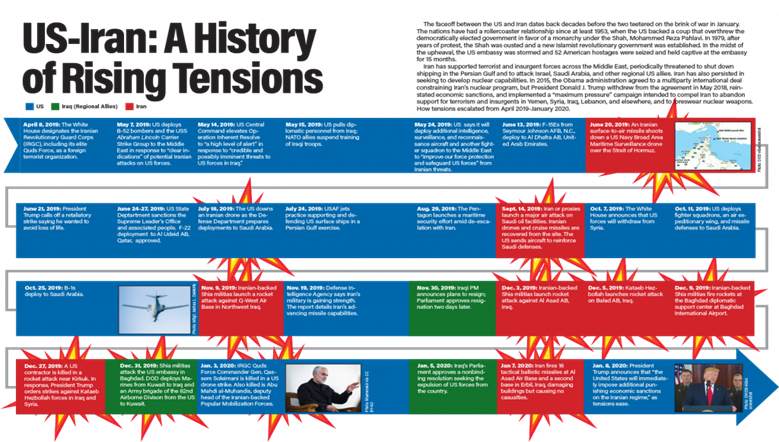
Above: A timeline infographic of US-Iran tensions, charting rising escalations from the 1979 revolution through proxy wars, the nuclear deal’s collapse, and recent conflicts – a chronological map of how enmity has built to this moment.
To understand the risks, we’ve gathered perspectives from experts who warn of a protracted struggle. Steven Heydemann, a Brookings scholar, cautions, “Wars rarely go according to plan. In launching a war of choice with Iran, the United States and Israel have unleashed a confrontation that is unlikely to succeed and certain to produce unintended effects that they will be unable to manage or contain.” He points to the potential for Iran’s implosion, leading to chaos far worse than post-invasion Iraq or Libya.
Brian Finucane of the International Crisis Group adds, “There is no plausible legal justification for the U.S. attack on Iran… President Trump’s unauthorized attack on Iran stands apart due to its scale and likely repercussions, including for U.S. forces in the region.” Finucane highlights public opposition, noting only a fraction of Americans support regime-change wars.
Javed Ali, a former National Security Council official, emphasizes, “Iran’s leaders almost certainly see this as an existential threat… What we should expect now is a response from Tehran that utilizes all of its capabilities – even though they have been significantly degraded.” He warns of American deaths as Iran seeks escalation beyond previous strikes.
Danny Citrinowicz, a former Israeli intelligence officer, notes, “Israel will resist any US-Iran nuclear deal,” underscoring preemptive strategies that prioritize security over diplomacy. Bob McNally of Rapidan Energy Group describes the energy fallout as “a very serious development,” fearing sustained disruptions akin to the 1970s oil embargo.
Vandana Hari of Vanda Insights predicts oil at $80-90 if hostilities linger, warning of “worst-case scenarios.” Ryan Sweet from Oxford Economics states, “In isolation, the attack doesn’t have a significant impact… but shocks could pile on.” Gregory Brew highlights Trump’s sensitivity to prices as a “barometer of public sentiment.”
Louis René Beres, an expert on nuclear strategy, raises alarms about nuclear escalation: “In any future armed conflict against the Islamic Republic, Jerusalem could issue deterrent threats of an ‘asymmetrical nuclear war’… At some point, Israel’s survival could become contingent on the harms of a ‘symmetrical nuclear war.’”
These voices collectively paint a sobering picture: a war that could drag on, inflame the region, spike global prices, and even risk nuclear thresholds, with no easy path to resolution.
As the dust settles on each strike, one can’t help but wonder: How much further will this river of conflict flow before finding peace? The battlefield’s escalation serves as a stark reminder of history’s long shadow, urging us to reflect on the human cost and the urgent need for dialogue amid the din of war. TMN will continue monitoring developments. Stay tuned for updates.