
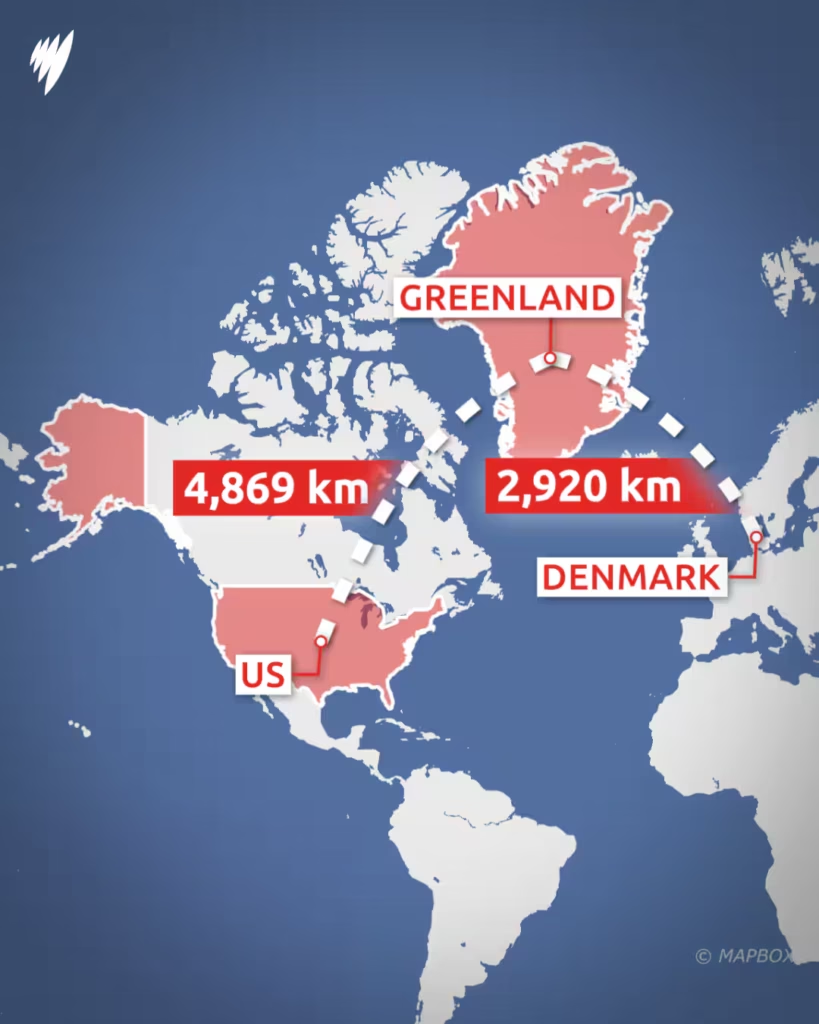
COPENHAGEN — Denmark and a coalition of European allies have issued a unified rebuke to escalating U.S. pressure over Greenland, rejecting territorial ambitions and warning that tariff threats from Washington risk damaging transatlantic relations at a sensitive geopolitical moment.
In a joint statement released on January 18, 2026, Denmark, Finland, France, Germany, the Netherlands, Norway, Sweden and the United Kingdom affirmed their commitment to Arctic security as a shared NATO priority and expressed “full solidarity” with Denmark and the people of Greenland. The communiqué stressed that the pre-planned Danish military exercise “Arctic Endurance” posed no threat to any nation and underscored the principles of sovereignty and territorial integrity.
The diplomatic push followed renewed rhetoric from U.S. President Donald Trump asserting U.S. interest in acquiring control of Greenland and threatening tariffs against European states opposed to American ambitions in the Arctic. European officials cautioned that such measures “undermine transatlantic relations and risk a dangerous downward spiral,” while pledging a coordinated response.
Danish officials have taken an increasingly assertive tone. Foreign Minister Lars Løkke Rasmussen said there was a “fundamental disagreement” with Washington over Greenland, insisting that any proposal undermining the territorial integrity of Denmark and the political self-determination of Greenland was “totally unacceptable.”
Amid the mounting tensions, Denmark has reinforced its security posture in Greenland, deploying additional naval assets, surveillance capabilities, and unmanned systems to bolster NATO’s presence in the High North. Copenhagen described the move as precautionary and consistent with rising geopolitical competition across the Arctic.
Greenland’s leadership has aligned publicly with Denmark. Prime Minister Jens-Frederik Nielsen indicated that if forced to choose, Greenland would prefer Denmark over the United States, highlighting both unity and discomfort with external pressure. Danish Prime Minister Mette Frederiksen acknowledged the diplomatic strain, saying Denmark would “stand firm” even when pressure comes from allies.
Trump’s accompanying tariff announcement has inflamed the dispute further. Danish officials condemned the measures as harmful to international trade and political stability, while the Danish Chamber of Commerce dismissed the tariff strategy as a “farce” that risks eroding business confidence.
Despite sharp rhetoric on both sides, diplomatic engagement continues. Senior officials from Copenhagen and Washington have held multiple rounds of discussions in recent days, while Denmark is pushing for a broader European response. Analysts warn that the dispute could overshadow shared NATO priorities, including managing Russia’s and China’s expanding interests in the Arctic.
The confrontation has thrust Greenland—long viewed as geographically remote—into the center of geopolitical competition, where climate change, emerging Arctic trade routes and strategic military positioning are reconfiguring the polar landscape and testing the resilience of transatlantic alliances.