
Abuja
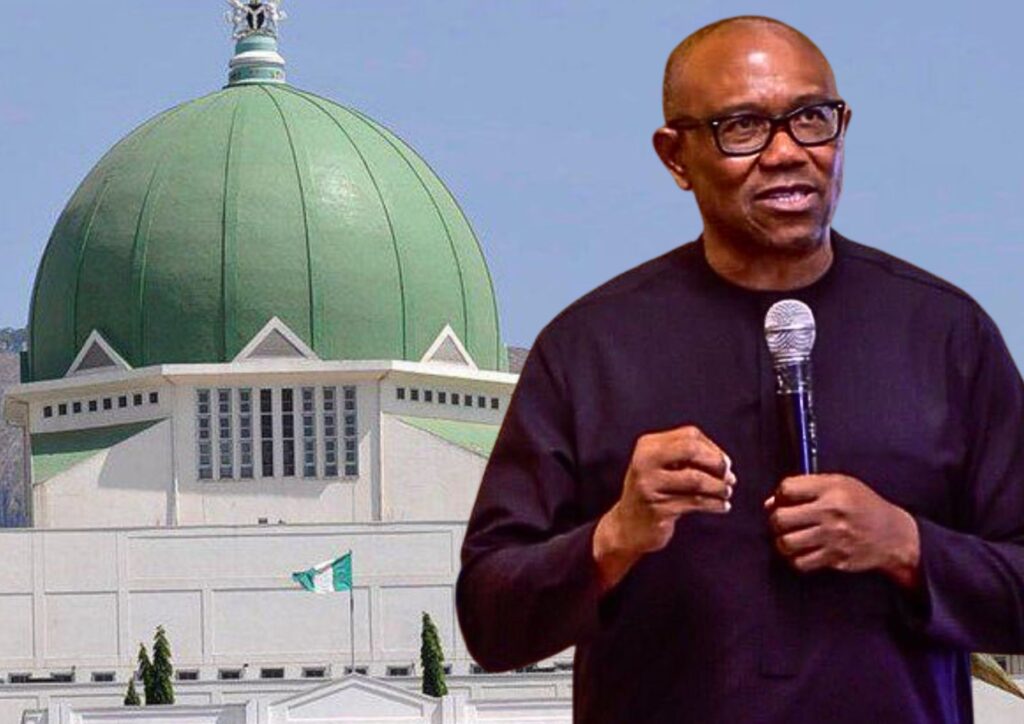
Former Labour Party presidential candidate Peter Obi on Monday joined protesters at the National Assembly complex in Abuja, lending his voice to growing calls for lawmakers to make real-time electronic transmission of election results mandatory in Nigeria’s electoral law.
The protest followed the Senate’s passage of the Electoral Act 2022 (Repeal and Re-enactment) Amendment Bill 2026 through third reading, a move that sparked public outrage after lawmakers removed the phrase “real-time” from provisions relating to the electronic transmission of election results.
Although the Senate has since issued clarifications insisting that it did not reject electronic transmission outright, demonstrators argue that the omission of the phrase “real-time electronic transmission” weakens the law and creates loopholes that could enable manipulation of election results.
For the protesters, the wording matters — and so does the memory of Nigeria’s most recent general election.
At the heart of the protest is the belief that Nigeria’s electoral integrity hinges on the speed, transparency and immutability of results transmission from polling units to central collation platforms.
During the 2023 general elections, the Independent National Electoral Commission (INEC) faced widespread criticism over glitches and delays in uploading results to its Result Viewing (IReV) portal. These failures fuelled allegations of manipulation, eroded public trust and triggered legal challenges that stretched long after voting day.
Speaking to protesters at the National Assembly gate, Obi warned lawmakers against creating legal ambiguity that could allow a repeat of those problems.
According to him, making real-time electronic transmission mandatory — rather than discretionary — is essential to safeguarding the credibility of future elections.
“Anything that leaves room for doubt, delay or discretion weakens our democracy,” Obi said, stressing that clear legal backing would compel electoral officials to adhere strictly to transparent procedures.
Obi, who contested the 2023 presidential election and is now a member of the African Democratic Congress (ADC), was seen standing among demonstrators, engaging activists and listening to speakers as the protest unfolded.
His presence added political weight to the demonstration, reinforcing his long-standing image as a vocal advocate for electoral reform, institutional accountability and democratic transparency.
For many protesters, Obi’s participation symbolised continuity in the struggle for electoral credibility — one that did not end with the last election cycle.
“He didn’t just contest elections; he is still pushing for systems that work,” said one civil society activist at the scene.
The demonstration attracted participants from a range of groups, including civil society organisations, women’s advocacy groups, and a small number of opposition ADC members.
Protesters marched from the Federal Secretariat towards the National Assembly, chanting slogans and carrying placards with inscriptions such as “Make Elections Count,” “Real-Time Transmission Now,” and “No Loopholes in Electoral Law.”
Despite the charged atmosphere, organisers repeatedly emphasised that the protest was peaceful and lawful.
Security agencies deployed heavily around the complex, with personnel from the Nigeria Police Force, Nigerian Army, and Nigeria Security and Civil Defence Corps (NSCDC) stationed at strategic points. Police officers barricaded the main entrance to the National Assembly, restricting access into the premises.
However, civil society representatives clarified that the protesters had no intention of entering the complex.
“This protest is at the gate, not inside,” one organiser told journalists. “Our goal is to send a message, not to breach security.”
In response to the backlash, the Senate leadership has insisted that the amendment does not abolish electronic transmission of results but rather seeks to refine the framework guiding its implementation.
Lawmakers argue that the law should allow flexibility, taking into account infrastructure challenges, connectivity issues and operational realities across Nigeria’s diverse terrain.
But critics remain unconvinced.
To them, removing the words “real-time” dilutes the spirit of reform introduced in the 2022 Electoral Act and risks returning discretion to officials at critical stages of result collation — discretion that past experience has shown can be abused.
“It’s not enough to say electronic transmission is allowed,” a protester said. “The law must say when and how — clearly and without loopholes.”
The protest underscores a broader national conversation about electoral reform as Nigeria looks ahead to future elections at the federal, state, and local levels.
With voter trust still fragile after 2023, many analysts argue that strengthening legal guarantees around result transmission is one of the most effective ways to rebuild confidence in the democratic process.
For Obi and other reform advocates, the issue goes beyond party politics.
“This is about the system, not individuals,” Obi said, urging lawmakers to prioritise national interest over partisan calculations.
As debates continue within the National Assembly, the demonstration adds to mounting public pressure on legislators to revisit the controversial clause and explicitly reinstate real-time electronic transmission in the amended law.
Whether lawmakers will yield to the demands remains uncertain, but the message from the streets of Abuja is clear: Nigerians are watching closely — and they want a system that guarantees transparency, speed, and trust.
With civil society mobilisation growing and prominent political figures lending their voices, the fight over Nigeria’s electoral framework appears far from over.
For now, the gates of the National Assembly have become a focal point for a broader struggle — one that pits public demand for accountability against legislative caution, and that could shape the credibility of Nigeria’s elections for years to come.