
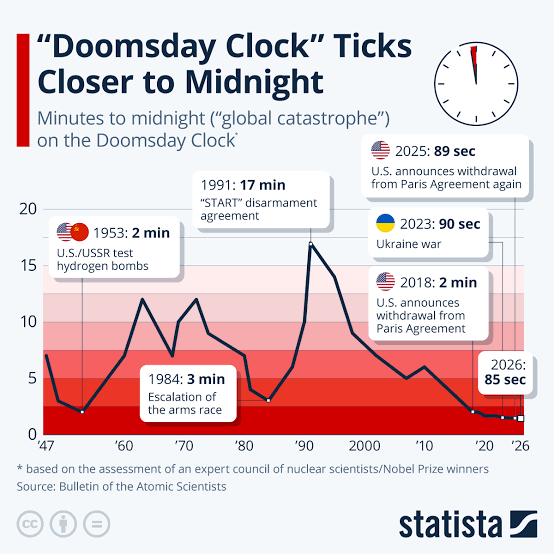
The sense that the world is edging toward catastrophe is no longer confined to popular anxiety. On Tuesday, the Bulletin of the Atomic Scientists announced that its iconic Doomsday Clock has been set closer to midnight than at any point since its creation—signaling what experts describe as an unprecedented convergence of global threats.
Midnight on the clock represents the theoretical moment of human annihilation. The latest adjustment underscores mounting concern that humanity is failing to adequately manage existential risks of its own making.
From Nuclear Anxiety to PolycrisisWhen the clock was introduced in 1947, it was set at seven minutes to midnight, reflecting fears surrounding nuclear weapons in the aftermath of World War II.
Early assessments were dominated by the Cold War arms race, particularly tensions between the United States and the Soviet Union, and the accelerating development of thermonuclear weapons.
The clock has moved both backward and forward over the decades, mirroring shifts in geopolitical stability. It reached its furthest point from catastrophe—17 minutes to midnight—in 1991, following the end of the Cold War and major nuclear arms reduction agreements.Since the early 2000s, however, the trajectory has largely been one-directional: closer to midnight.
Expanding the Definition of Existential RiskWhat distinguishes recent assessments from those of the Cold War era is the breadth of threats now considered.
While nuclear war remains central, the Bulletin now evaluates a wider risk spectrum, including: Climate change, driven by inadequate global mitigation and adaptation efforts, Emerging technologies, particularly artificial intelligence and biotechnology, advancing faster than governance frameworks, Information disorder, including disinformation that undermines democratic institutions and crisis response Geopolitical instability, marked by prolonged wars, erosion of arms-control regimes, and weakened multilateralismIn recent years, these risks have not merely accumulated—they have begun to interact, creating what experts describe as a “polycrisis,” where multiple global shocks reinforce one another.
A Symbolic Warning, Not a Prediction
The Bulletin stresses that the Doomsday Clock is not a forecast but a warning. It is intended to provoke public debate and policy action by distilling complex scientific and geopolitical assessments into a single, stark symbol.
The latest move closer to midnight reflects the judgment that current global responses are dangerously misaligned with the scale and urgency of the threats facing humanity.
As the Bulletin’s scientists and security experts have repeatedly emphasized, the clock can still be turned back—but only through coordinated international action, credible risk governance, and renewed political will.For now, however, the message is unambiguous: the margin for error is shrinking.