
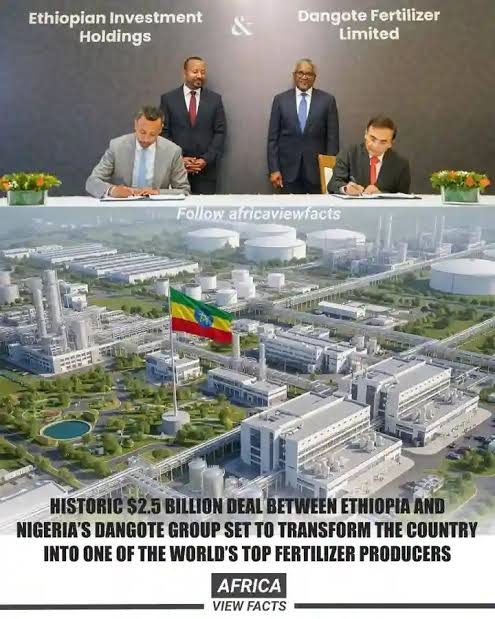
Nigeria’s Dangote Group is moving forward with its planned $2.5 billion fertiliser complex in Ethiopia, a project that could significantly reshape the country’s agricultural input market and alter the competitive balance in East
Africa’s fertiliser value chain.
The project, signed between Dangote Group and Ethiopian Investment Holdings (EIH), involves the construction of a large-scale urea fertiliser plant in Gode, southeastern Ethiopia, with an expected annual capacity of about three million metric tonnes. Dangote holds a 60 per cent stake, while the Ethiopian government retains 40 per cent .
According to officials and company disclosures, the plant will rely on domestic natural gas reserves as feedstock, a move intended to reduce Ethiopia’s dependence on imported fertiliser and stabilise supply for its largely agrarian economy .
Construction activities are reported to be either underway or entering early implementation stages, following years of negotiation over gas infrastructure, financing, and logistics. Once operational, the facility would rank among the largest single-site fertiliser plants in Africa, with output aimed at both domestic use and regional export markets.
The development comes as Ethiopia remains a key battleground for influence in Africa’s fertiliser sector. The country currently imports most of its fertiliser requirements, making it a strategic market for major producers .
In this context, Morocco’s OCP Group, the world’s leading phosphate producer, continues to maintain a presence in Ethiopia through research partnerships, soil-mapping initiatives, and agronomic advisory programmes, rather than large-scale manufacturing. OCP’s work has focused on customised fertiliser solutions tailored to Ethiopian soil conditions, particularly phosphate-based inputs.
While no new OCP fertiliser plant has been formally announced in Ethiopia, analysts view Dangote’s urea project as introducing a new competitive dynamic, potentially challenging OCP’s influence over fertiliser supply chains in the Horn of Africa .
For Ethiopian authorities, the Dangote investment aligns with broader industrialisation and food-security goals, as the government seeks to cut import bills, support farmers, and position the country as a regional agro-industrial hub.
If completed on schedule, the plant could mark a turning point in Ethiopia’s fertiliser self-sufficiency — and signal a deeper contest between Africa’s major industrial players over the continent’s agricultural future.