
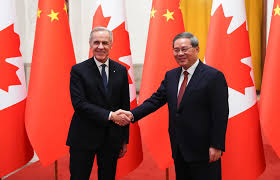
Canada has agreed to remove its 100 percent tariff on Chinese electric vehicles in return for reduced Chinese duties on Canadian agricultural products, Prime Minister Mark Carney announced after bilateral talks in Beijing. The deal signals a notable shift from United States trade policy as Ottawa moves to reset and stabilize relations with China.
Speaking at the close of the negotiations, Carney framed the agreement as the beginning of a renewed economic partnership. “We came to Beijing for Canada to forge a new strategic partnership with China — we’ll be returning with a new trade agreement and billions of dollars in export markets unlocked for Canadian workers,” he said.
The arrangement is expected to expand Chinese market access for key Canadian farm exports, including grains, canola, and meat products—sectors that have experienced periodic restrictions in recent years. In exchange, Chinese electric vehicle manufacturers will regain tariff-free entry into Canada, a step Ottawa believes will lower vehicle costs and support the country’s transition to cleaner energy.
Trade experts describe the agreement as a pragmatic effort by Canada to diversify its economic options amid growing protectionism in the United States. While Washington has maintained steep levies on Chinese electric vehicles and urged allies to adopt similar measures, Canada appears to be pursuing a more independent path focused on concrete export gains.
Canadian business groups welcomed the development, noting that improved access to the Chinese market could generate billions in new revenue and strengthen employment in rural and export-dependent communities. Environmental advocates also praised the prospect of more affordable electric vehicles, arguing it would help Canada meet its climate commitments.
Officials from both countries are expected to finalize technical details in the coming weeks, with joint working groups established to oversee implementation. The agreement marks a cautious thaw in Canada-China relations and underscores Beijing’s continued importance to Canada’s long-term economic strategy despite ongoing geopolitical tensions.