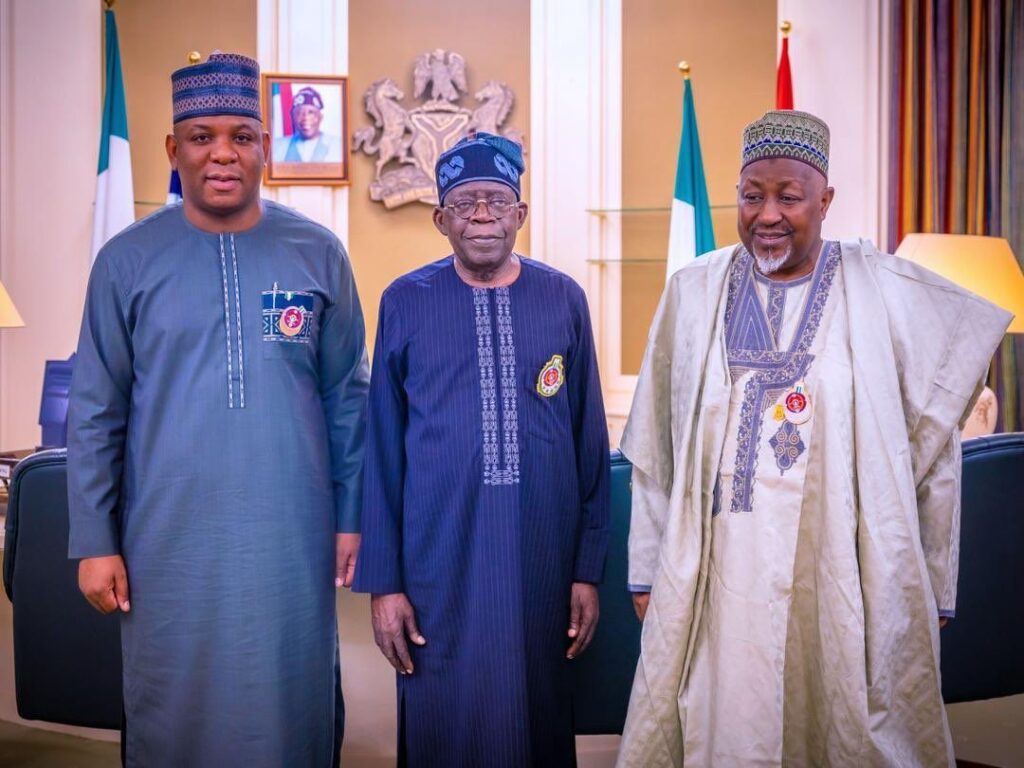
President Bola Ahmed Tinubu has directed key figures within the All Progressives Congress (APC) to resolve internal disputes and strengthen party unity ahead of the 2027 general elections, signaling an intensified effort to consolidate the ruling party’s political structure ahead of the next electoral contest.
The President gave the directive on Sunday during a special interfaith prayer session organized by members of his extended family at the Yoruba Tennis Club in Lagos. He specifically instructed his political adviser, Alhaji Ibrahim Kabiru Masari, and former Minister of Defense and former Jigawa State Governor, Alhaji Abubakar Badaru, to lead reconciliation efforts in their respective political constituencies.
According to a statement issued by the President’s Special Adviser on Information and Strategy, Bayo Onanuga, Tinubu addressed reported disagreements between Masari and Katsina State Governor, Dikko Umar Radda, urging the political figures to prioritize party cohesion over personal and factional interests.
“Alhaji Kabiru Masari, go back home and reconcile with everybody. That is the President’s order,” Tinubu reportedly said, directing him to extend the reconciliation initiative to Jigawa and other states.
The President maintained that resolving internal grievances was essential to sustaining the APC’s political strength and consolidating the achievements of his administration.
Beyond the party reconciliation agenda, Tinubu used the gathering to signal an early mobilization strategy for his anticipated 2027 re-election campaign.
Moving from his widely publicized 2022 political slogan, Emilokan (It is my turn), to Eyinlokan (It is now your turn), the President appeared to shift the emphasis towards collective responsibility among party supporters and voters in securing another electoral mandate.
He called on APC members and supporters, particularly in Lagos, to intensify grassroots mobilization and encourage eligible citizens to obtain their Permanent Voter Cards (PVCs) ahead of the 2027 elections.
“The challenge of today is much easier than that of yesterday, but we cannot take it for granted. You must knock on your neighbour’s door and tell them to collect their PVC,” he said, urging supporters to mobilize sufficient votes to overwhelm political opponents.
Tinubu also recalled the economic difficulties that preceded the 2023 presidential election, particularly the naira redesign crisis and widespread fuel scarcity, attributing his eventual electoral victory to divine intervention.
Several political figures and dignitaries at the gathering expressed support for the President’s administration and its anticipated re-election campaign.
Badaru appealed to voters in Northern Nigeria to reciprocate Tinubu’s political support for the late President Muhammadu Buhari during the 2015 and 2019 elections.
Lagos State Governor Babajide Sanwo-Olu commended Tinubu’s leadership and commitment to inclusive governance, while 94-year-old elder statesman Alhaji Lateef Femi Okunnu pledged to participate actively in mobilising support for the President.
Okunnu cited ongoing infrastructure projects, including the Lagos-Calabar Coastal Highway and the Sokoto-Badagry Superhighway, alongside the administration’s monetary reforms, as reasons for his support.
The interfaith prayer session was coordinated by the Grand Chief Imam of Lagos, Sheikh Sulaimon Oluwatoyin Abou-Nolla, alongside Christian clerics, including Reverend Honsu Oluremi of the Lagos State Government House Chapel.
Among those present were the governors of Kaduna, Kwara, Ogun and Imo states, National Security Adviser Mallam Nuhu Ribadu, Chief of Staff Femi Gbajabiamila, and members of the President’s family.
Tinubu’s directive reflects the growing importance of internal party management as the APC approaches another electoral cycle. Although the ruling party retains the advantages of incumbency, managing competing political interests, reconciling influential stakeholders and sustaining public confidence will remain central to its electoral calculations.
The President’s emphasis on reconciliation suggests an acknowledgment that internal divisions could weaken the party’s ability to mobilize effectively in 2027. Equally, his appeal for grassroots voter mobilization indicates that the administration is already laying the political groundwork for its next electoral campaign.
However, the effectiveness of this strategy will depend not merely on agreements among political elites but also on the party’s ability to translate reconciliation into organizational cohesion and demonstrate tangible improvements in the economic and social conditions affecting ordinary Nigerians.