
By TMN Economy Desk
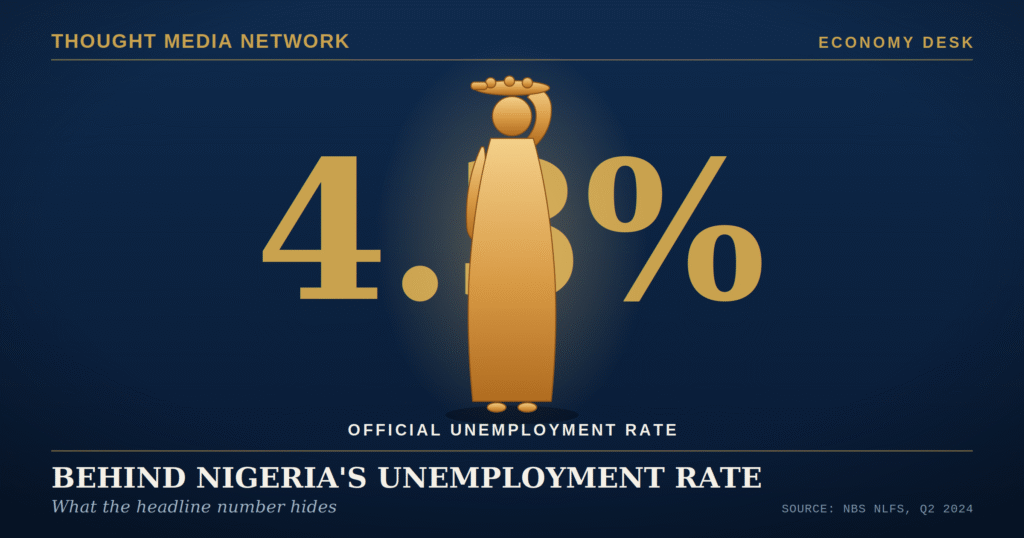
When the National Bureau of Statistics (NBS) announced that Nigeria’s unemployment rate had fallen to around 4.3 percent, the figure appeared to signal a remarkable turnaround for Africa’s largest economy. After all, just a few years earlier, Nigeria’s unemployment rate stood at 33.3 percent—one of the highest in the world.
Yet for millions of Nigerians struggling with rising living costs, stagnant incomes, and limited economic opportunities, the announcement seemed disconnected from reality. How could unemployment be so low when economic hardship remains so widespread?
The answer lies not only in the state of the economy but also in how unemployment is measured.
The Statistical Revolution
Nigeria’s unemployment figures underwent a dramatic transformation following the adoption of a new labour measurement framework developed by the International Labour Organization (ILO).
Under the previous methodology, individuals who worked fewer than 20 hours per week could still be classified as unemployed. Under the revised system, however, anyone aged 15 years and above who engages in at least one hour of economic activity for pay, profit, or family gain during the reference week is considered employed.
This methodological adjustment produced a striking outcome. Unemployment fell from 33.3 percent in 2020 to single digits without a corresponding explosion in job creation.
The new approach is internationally recognized and statistically defensible. Nevertheless, it raises a critical question: does being economically active necessarily mean being economically secure?
For many Nigerians, the answer is no.
Employment Does Not Always Mean Prosperity
A roadside trader, a motorcycle rider, a subsistence farmer, and a corporate executive may all be classified as employed, yet their economic realities differ enormously.
This distinction matters because unemployment statistics measure whether people are working—not whether their work provides sufficient income, stability, or opportunities for advancement.
In a country where survival often requires people to engage in any available income-generating activity, unemployment alone becomes an incomplete indicator of economic well-being.
The result is a labour market that appears healthy on paper but remains vulnerable beneath the surface.
The Dominance of Informal Work
Perhaps the most important labour statistic in Nigeria is not unemployment but informality.
More than 90 percent of employed Nigerians work in the informal sector. These workers generally operate without employment contracts, pensions, health insurance, workplace protections, or stable earnings.
Informality has become Nigeria’s economic safety valve. It prevents mass unemployment by absorbing millions of workers who cannot find opportunities in the formal sector.
Yet this same informality also perpetuates economic insecurity.
Many Nigerians are working hard every day but remain trapped in low-income activities with limited prospects for growth. In this sense, employment often serves as a mechanism for survival rather than a pathway to prosperity.
The Hidden Burden of Underemployment
Another challenge obscured by headline unemployment figures is underemployment.
Millions of Nigerians work fewer hours than they would prefer or earn far less than what is necessary to sustain a reasonable standard of living. Others possess qualifications and skills far beyond the demands of their current occupations.
When unemployment and underemployment are examined together, the labour market appears significantly weaker than the headline rate suggests.
The issue is not simply whether jobs exist; it is whether those jobs provide adequate and productive employment.
Nigeria’s Youth Challenge
Nowhere is this problem more evident than among young people.
Every year, millions of young Nigerians enter the labour market. While many eventually find some form of economic activity, a substantial number are absorbed into low-productivity occupations that do not match their education, training, or aspirations.
Graduate unemployment may have declined statistically, but graduate underemployment remains widespread.
The consequence is a growing mismatch between Nigeria’s human capital potential and the opportunities available within the economy.
For a country with one of the world’s youngest populations, this represents both an economic and social challenge.
The Poverty–Employment Paradox
Nigeria increasingly exemplifies a phenomenon common across many developing economies: low unemployment coexisting with high poverty.
Traditionally, employment has been viewed as the principal route out of poverty. However, when most employment occurs within low-income and informal sectors, work alone no longer guarantees economic security.
Many Nigerians are employed but remain vulnerable to inflation, income shocks, and declining purchasing power.
This helps explain why public perceptions of economic hardship often differ sharply from official labour market statistics.
Looking Beyond the Headline Figure
The 4.3 percent unemployment rate is not necessarily wrong. Rather, it tells only part of the story.
To understand the true condition of Nigeria’s labour market, policymakers and analysts must pay equal attention to:
Underemployment;
Informal employment;
Labour productivity;
Real wage growth;
Youth labour outcomes;
Poverty levels;
Income security.
These indicators provide a more comprehensive picture of whether economic growth is translating into meaningful improvements in people’s lives.
Conclusion
Nigeria’s labour market challenge is no longer simply a question of job creation. It is increasingly a question of job quality.
The country has succeeded in keeping millions economically active, largely through the resilience of its informal sector. Yet economic activity alone is not enough. Sustainable development requires productive employment capable of generating stable incomes, improving living standards, and creating pathways for social mobility.
The real issue, therefore, is not whether Nigerians are working. It is whether the work available can deliver the economic dignity and security that citizens expect from Africa’s largest economy.