
Abuja, Nigeria
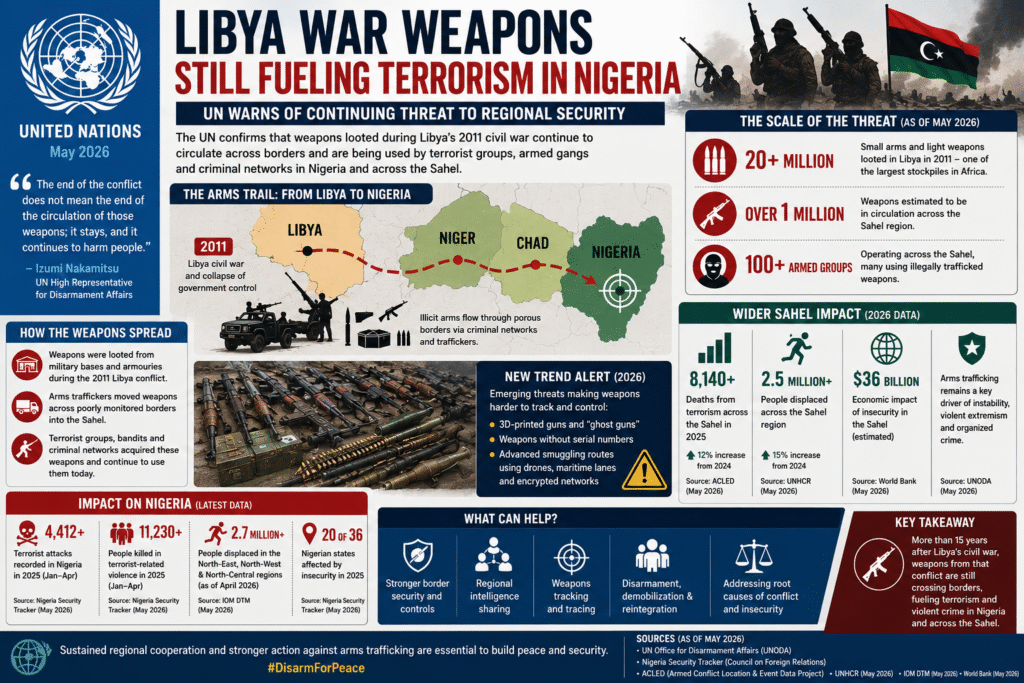
The United Nations (UN) says many of the weapons stolen during Libya’s civil war in 2011 have ended up in the hands of terrorist groups and other armed criminals operating in Nigeria and other African countries.
The warning was given by the UN’s top disarmament official, Izumi Nakamitsu, during a meeting at the United Nations Headquarters in New York, United States.
According to her, weapons taken from Libya during and after the war did not disappear when the fighting ended. Instead, many of them were smuggled across borders and are still being used today by terrorists, bandits, and other armed groups.
She said Libya remains one of the clearest examples of how a conflict in one country can create security problems across an entire region.
“Libya, where weapons looted or diverted during and after the 2011 conflict later surfaced across the wider Sahel region, including in Niger, Burkina Faso and Nigeria,” Nakamitsu told delegates.
How the Weapons Spread
Libya’s long-time leader, Muammar Gaddafi, was overthrown and killed during the 2011 uprising that plunged the country into conflict.
Before the war, Libya had huge stockpiles of military weapons, including assault rifles, machine guns, rocket launchers, explosives, and millions of rounds of ammunition.
When government control collapsed, many of these weapons were stolen from military bases and armouries. Criminal networks and arms traffickers then moved them through poorly monitored borders into several African countries.
Over the years, security experts have warned that some of these weapons found their way into the Sahel region, an area stretching across parts of West and North Africa that has become one of the world’s most troubled security zones.
Countries such as Mali, Niger, Burkina Faso, Chad, and Nigeria have all experienced increasing terrorist attacks, armed violence, and insecurity in recent years.
Impact on Nigeria
Nigeria has been battling terrorism, banditry, kidnapping, communal clashes, and other forms of violent crime for more than a decade.
Terrorist groups such as Boko Haram and the Islamic State West Africa Province (ISWAP) have often been seen using sophisticated weapons, raising questions about where those arms come from.
Security experts have repeatedly linked some of these weapons to smuggling routes running from Libya through Niger and into northern Nigeria.
The latest comments from the United Nations strengthen concerns that illegal weapons are still crossing borders and helping to fuel violence in parts of Nigeria.
Analysts say the widespread availability of small arms has contributed to attacks affecting communities across the North-East, North-West, and North-Central regions of the country.
Weapons Still Causing Harm Years Later
Nakamitsu warned that the effects of war do not end when the shooting stops.
“The end of the conflict does not mean the end of the circulation of those weapons; it stays, and it continues to harm people,” she said.
She explained that many weapons are hidden, stored, resold, or smuggled to other countries long after conflicts have ended, making it difficult for authorities to track and recover them.
According to the UN, illegal weapons not only fuel terrorism but also contribute to criminal violence, human rights abuses, the displacement of civilians, and attacks on vulnerable groups.
She stressed that controlling illegal weapons is not only a security issue but also an important step toward peace, human rights, and economic development.
New Security Concerns
The UN also raised concerns about new technologies that could make weapons harder to track.
These include 3D-printed guns, so-called “ghost guns” that do not carry serial numbers, and increasingly sophisticated international smuggling networks.
According to Nakamitsu, these developments could make it even more difficult for governments and security agencies to stop weapons from reaching terrorists and criminal groups.
Why the Warning Matters
The UN’s warning comes as Nigeria and several African countries continue efforts to improve border security and tackle rising insecurity.
Security experts say military operations alone may not solve the problem. They argue that stronger cooperation between neighbouring countries is needed to stop the movement of illegal weapons across borders.
More than 15 years after Libya’s civil war began, weapons from that conflict are still appearing in different parts of Africa, showing how the consequences of war can continue for many years.
For Nigeria, the revelation highlights the need for stronger intelligence sharing, tighter border controls, and closer regional cooperation to reduce the flow of illegal arms that continue to fuel terrorism and violent crime.