
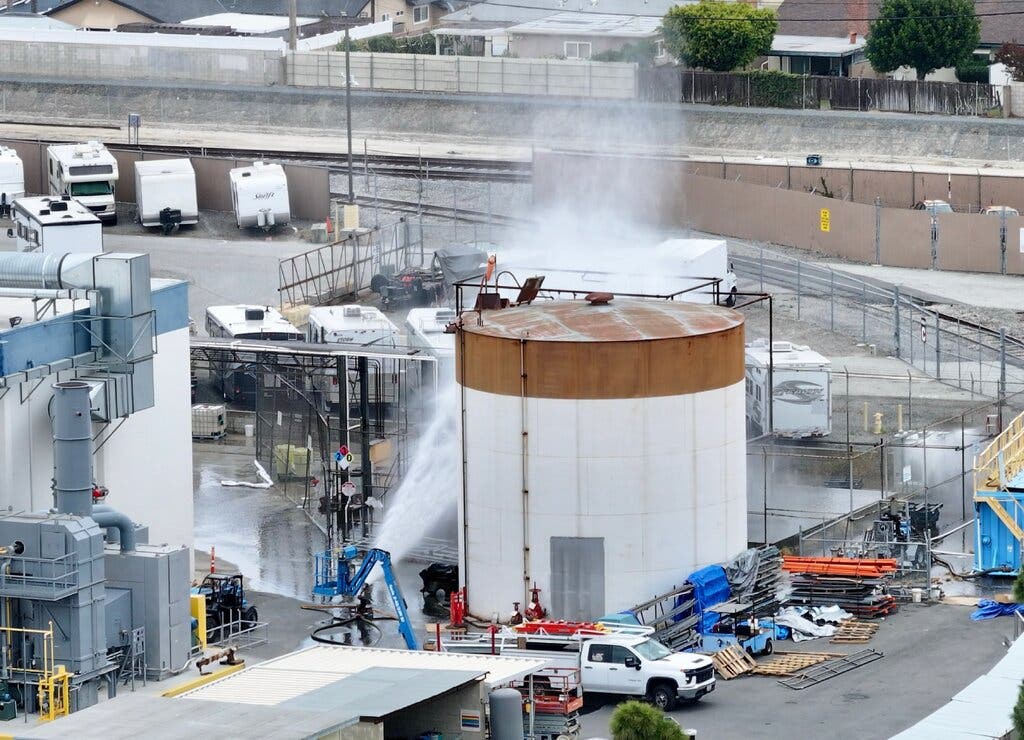
When a failing chemical tank at a California aerospace plant forced 50,000 people to flee with nowhere certain to return to
Dennis Christian grabbed his dog, Rue, stuffed what he could into a bag, and walked out of the only home he knew in Garden Groove, California.
He did not know when — or whether — he would return.
By the time officials at the GKN Earospace facility confirmed that a 34,000-gallon industrial tank containing methyl methacrylate had begun to fail, there was no longer time for orderly evacuation.
The chemical inside the vessel was not merely hazardous. It was volatile, toxic, and highly flammable — capable of releasing dangerous vapours into surrounding neighbourhoods if the tank ruptured.
Orange County Fire Authority Division Chief Craig Covey delivered the kind of warning emergency officials rarely make publicly because of how absolute it sounded.
“This is highly volatile, it’s highly toxic, it’s highly flammable,” he said during a televised briefing. “This is not precautionary. This thing is gonna fail — we just don’t know when.”
For tens of thousands of residents, those words changed the meaning of the night.
Authorities established a nine-square-mile evacuation zone surrounding the aerospace facility — an area containing apartment blocks, family homes, schools, and densely populated residential streets.
Roughly 50,000 people were forced to leave.
The geography carried a surreal irony. The evacuation perimeter sat only a few miles from Disneyland Park, where tourists continued riding attractions under fireworks and floodlights while entire neighbourhoods nearby emptied into uncertainty.
Inside emergency shelters, exhaustion settled quickly.
At the Garden Grove Sports and Recreation Center, cots stretched across gymnasium floors. Families arrived carrying pets, medications, chargers, backpacks, and hastily gathered photographs — the small things people instinctively save when they are no longer sure what will remain standing.
Children fell asleep beneath donated blankets while parents stayed awake scrolling through news alerts and emergency updates that rarely answered the only question that mattered:
When can we go home?
Inside the danger zone, firefighters confronted a problem with terrifyingly narrow margins for error.
The malfunctioning valve attached to the tank had effectively seized under pressure from an ongoing chemical reaction occurring inside the vessel. Initial cooling operations appeared promising, but crews later discovered temperatures within the tank were still rising — roughly one degree every hour.
That meant the reaction had not stabilised. It was accelerating.
“We need out-of-the-box thinking,” Covey admitted as experts from across the United States were consulted for emergency mitigation options.
Crews continued spraying water onto the tank in an effort to slow thermal escalation, but responders privately acknowledged the uncomfortable reality: they were managing time, not solving the problem.
Methyl methacrylate is widely used in aerospace manufacturing because of its durability, optical clarity, and versatility in industrial plastics.
Under controlled conditions, it is commercially valuable. Under unstable conditions, it becomes something else entirely.
The compound can ignite explosively under heat and release toxic vapours capable of spreading through surrounding communities. Officials rushed to place sand barriers and containment systems around the facility to prevent any leak from entering storm drains or waterways.
Whether those precautions would be sufficient remained unclear.
By Saturday, Governor Gavin Newsom had declared a state of emergency in Orange County, unlocking additional resources and emergency coordination powers.
The legal response moved almost as quickly as the evacuation itself.
A class-action lawsuit was filed against GKN Aerospace on behalf of Garden Grove residents, alleging the company failed to adequately protect surrounding communities from a known industrial hazard.
Attorneys involved in the case argued that even the “best-case scenario” would still leave residents displaced indefinitely while businesses, schools, and daily life remained suspended under the shadow of possible chemical release.
GKN Aerospace issued public apologies and promised continuous efforts to stabilise the situation.
What the company could not provide was certainty.
There was no timetable. No guaranteed containment plan. No assurance the tank would not rupture.
By Sunday morning, Dennis Christian and his dog Rue remained at a temporary shelter in nearby Fountain Valley.
He still did not know whether his neighbourhood would be safe by nightfall.
Outside the evacuation zone, fire crews continued directing streams of water onto a vessel that emergency officials openly believed was going to fail eventually.
The only uncertainty left was timing.
And for 50,000 displaced residents of Garden Grove, time had become the one thing no authority could reliably control.