
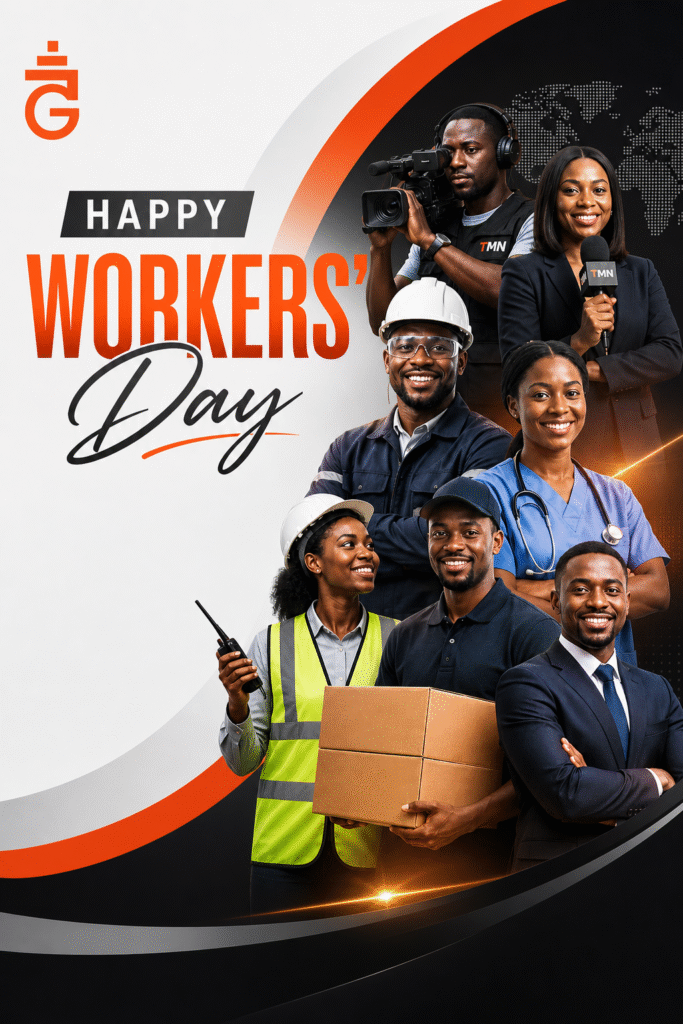
Every economy has its statistics—growth rates, inflation figures, employment data. But behind every number is a person. A worker. A story.
On International Workers’ Day, we move beyond the metrics to recognize the human engine of progress: the millions of Nigerians whose daily efforts keep homes running, businesses alive, and the nation moving forward—often against difficult odds.
From the early-morning trader setting up in a roadside market to the nurse closing a night shift in an overstretched hospital, Nigeria’s workforce operates across a vast spectrum—formal and informal, urban and rural, digital and manual.
Yet, much of this work remains undercounted and undervalued.
Nigeria’s informal sector alone employs a significant portion of the population. These are artisans, transport workers, smallholder farmers, street vendors, and gig workers—people who rarely make headlines but sustain daily life. They build the real economy from the ground up.
Progress, in Nigeria, is not abstract. It is assembled piece by piece by people who show up every day.
To work in Nigeria today is to navigate complexity.
Rising cost of living, unstable power supply, currency fluctuations, and limited access to financing are not abstract policy issues—they are daily realities for workers and small business owners. For many, “going to work” means solving a new set of problems each day just to remain productive.
And yet, the Nigerian worker adapts.
- The entrepreneur finds alternative power sources to keep operations running.
- The delivery rider navigates traffic and fuel costs to meet deadlines.
- The teacher continues to educate despite limited resources.
- The media professional reports stories that inform and hold power accountable.
This resilience is not accidental—it is a defining trait of the Nigerian workforce.Nigerian workers are not only shaping the local economy; they are influencing the global stage.
Across industries—technology, healthcare, media, finance, and the creative economy—Nigerians are exporting talent, innovation, and cultural influence.
- Tech professionals are building globally competitive solutions.
- Creatives are redefining global entertainment and storytelling.
- Healthcare workers are contributing to international systems.
- Remote workers are powering companies across continents.
In a connected world, the Nigerian workforce is no longer confined by geography. Its impact travels.
Work itself is evolving—and Nigerian workers are adapting in real time.
Digital platforms, remote work, and the gig economy are reshaping how income is earned. Side hustles have become survival strategies. Skills are being learned outside traditional institutions. Young Nigerians are building careers that didn’t exist a decade ago.
But this shift also raises important questions:
- How do we ensure job security in a gig-driven economy?
- How do workers access healthcare, pensions, and protection?
- How do we bridge the skills gap in a rapidly changing world?
Celebrating workers must also mean preparing them for the future.
International Workers’ Day is a moment—but the issues facing workers require sustained attention.
Recognition must go beyond appreciation posts and public holidays. It must translate into:
- Policies that protect workers’ rights
- Investments in infrastructure that improve productivity
- Access to education and skill development
- Fair wages and economic inclusion
- Support systems for small businesses and informal workers
Because when workers thrive, economies grow.
Every functioning system in Nigeria—transport, healthcare, finance, media, governance—depends on people who often go unseen.
The cleaner who opens an office before sunrise.
The journalist who verifies facts before publication.
The engineer who keeps systems running.
The farmer who feeds communities.
These are not background characters. They are the foundation.
Celebrating workers is not just the responsibility of governments or institutions. It is a collective obligation.
- Businesses must prioritize fair and humane work environments.
- Leaders must design systems that enable productivity, not hinder it.
- Society must value dignity in all forms of work—not just high-status professions.
Respect for work is respect for people.
“The People Behind the Progress” is not just a theme—it is a reminder.
Nigeria’s future will not be built by policies alone, but by people. By workers who continue to show up, innovate, adapt, and push forward even when conditions are far from ideal.
Today, we celebrate them—not as statistics, but as the true drivers of progress.
Because behind every headline, every system, and every success story—
there is a worker.
Happy worker’s day.