
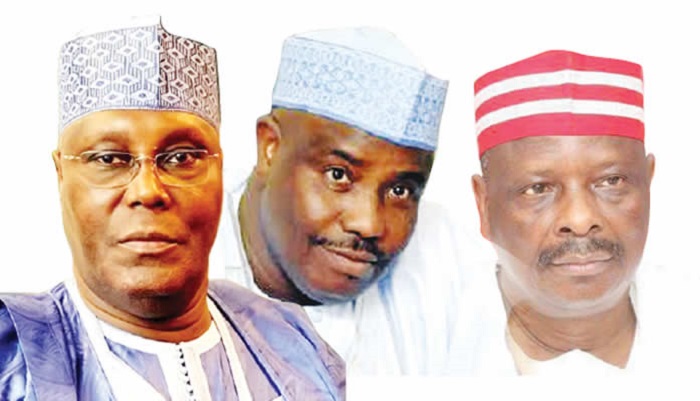
The evolving posture of Atiku Abubakar toward fellow opposition figures has introduced a contentious but unavoidable question into Nigeria’s political discourse: is the opposition’s greatest obstacle external—or internal?
At a moment that demands strategic cohesion, Atiku’s public dismissal of the presidential prospects of Rabiu Musa Kwankwaso and Aminu Waziri Tambuwal signals more than routine political rivalry. It reflects a deeper structural problem within the opposition—an inability to reconcile personal ambition with collective necessity.
Opposition politics, particularly in a fragmented and plural society like Nigeria, is not sustained by individual prominence but by coalitional discipline. Electoral success depends on the capacity to aggregate diverse regional, ideological, and elite interests into a unified front. In this context, leadership is less about dominance and more about orchestration—less about being the strongest voice and more about being the most acceptable bridge across factions.
Yet, Atiku’s approach appears to invert this logic. By openly questioning the viability of potential allies, he risks eroding the trust required for coalition-building. Such rhetoric does not merely weaken individuals; it undermines the broader architecture of opposition unity. It communicates, whether intentionally or not, a reluctance to engage in the compromises that are indispensable to forming a formidable electoral bloc.
To be clear, ambition is neither unusual nor illegitimate in politics. Indeed, it is often the driving force behind leadership. However, when ambition becomes undisciplined by strategic restraint, it transforms from an asset into a liability. The challenge facing Atiku is not the presence of ambition, but its management within a competitive multi-actor environment where no single figure can secure victory alone.
Defenders of his posture may argue that such statements are part of pre-coalition bargaining—a way of asserting dominance, shaping perceptions, and negotiating from a position of strength. This interpretation is not without merit. Political actors routinely engage in rhetorical positioning to enhance leverage ahead of alliance formation.
But this strategy carries inherent risks. In a fragile opposition ecosystem, aggressive self-assertion can trigger a coordination failure, where competing ambitions prevent the emergence of a consensus candidate. The consequence is predictable: fragmentation within the opposition and consolidation of power by the ruling party.
What makes this moment particularly significant is that it exposes a recurring paradox in Nigerian politics. Those with the stature to unify the opposition are often the least inclined to yield space for others. The result is a cycle of missed opportunities, where electoral defeat is less a product of external strength than internal disunity.
If the opposition is to become a credible alternative, it must move beyond personality-driven competition toward a framework of negotiated cooperation. This requires leaders who understand that power, in such contexts, is not seized alone but constructed collectively.
Until that shift occurs, the uncomfortable proposition embedded in this headline will continue to resonate: the opposition’s greatest challenge may not lie in confronting the ruling party, but in overcoming the centrifugal forces within its own ranks.