
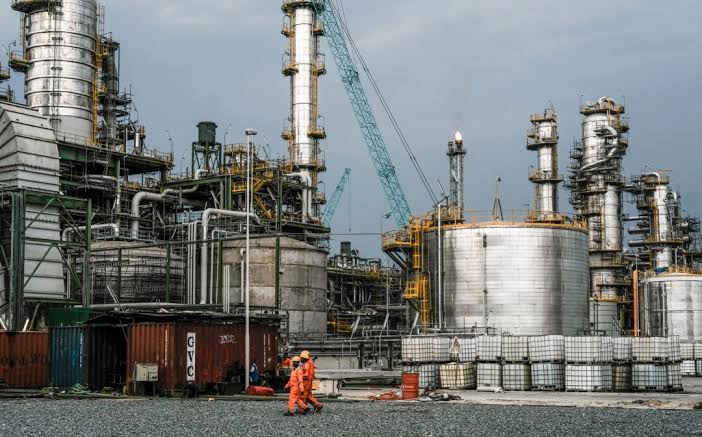
As Iranian retaliation chokes the world’s most critical oil corridor, Nigeria’s Dangote Refinery emerges as the continent’s most consequential alternative supplier — but supply headroom is narrowing fast.
LAGOS — When Iranian forces enforced a blockade across the Strait of Hormuz in retaliation for Operation Epic Fury — the coordinated US-Israeli strikes on Iranian strategic facilities launched on 28 February — the world’s most critical oil corridor fell silent. In a single move, approximately 13 to 15 million barrels per day of crude oil and nearly 20 per cent of global LNG exports were severed from their established routes.
The shockwave reached African capitals within hours.Across east and southern Africa — a region that sources roughly three-quarters of its refined fuel imports from the Middle East — governments scrambled for alternatives. The search, in nearly every case, led to one destination: the Dangote Petroleum Refinery in Lekki, Lagos.
Right now it is not about pricing, it’s about availability.— Aliko Dangote, Chairman, Dangote Group
South Africa has initiated discussions for a standard 12-month supply agreement with the Nigerian facility. Ghana, Kenya, and several other nations have also made formal approaches. The framing of those conversations, according to sources with knowledge of the negotiations, has shifted dramatically: price sensitivity has given way to urgency.
That urgency was given voice by Aliko Dangote himself, whose blunt assessment — “Right now it is not about pricing, it’s about availability” — distils the seismic inversion the crisis has produced in African energy markets.
SUPPLY CAPACITY: CRITICAL CONSTRAINT
The enthusiasm surrounding Nigeria’s moment of leverage is, however, tempered by arithmetic. Approximately 75 per cent of the Dangote facility’s 650,000-barrel-per-day nameplate capacity is reserved for domestic Nigerian consumption, leaving a sharply limited export tranche available for international buyers. Energy consultancy CITAC warns that the supply shortfall may be most acute in east and southern Africa, precisely because of the region’s structural dependence on Middle Eastern flows.
Within the domestic market, the refinery has ramped output to 40.1 million litres of petrol per day — roughly two-thirds of Nigeria’s daily requirement of 60 million litres — while doubling gasoil production to 10.9 million litres, covering more than half of local daily demand. The refinery has publicly declared domestic supply its first priority.
COST SHOCK: THE FEEDSTOCK PROBLEM
The crisis has also inflated the refinery’s operating costs in ways that complicate its ability to pass through competitive pricing. The cost of transporting crude from Nigerian terminals to the Lekki facility has surged from approximately $800,000 to $3.5 million per day. Nigerian crude, meanwhile, is commanding a $3–$6 per barrel premium above the global Brent benchmark — a reflection of tightened global supply.
The refinery confirmed it has absorbed 20 per cent of the cost escalation to shield Nigerian consumers, but the arithmetic of prolonged conflict leaves little room for sustained subsidy. Meanwhile, Kuwait Petroleum Corporation has declared force majeure and cut output; analysts predict that the UAE and Saudi Arabia may follow as storage capacity tightens across the Gulf.
DANGOTE SEEKS MORE NIGERIAN CRUDE
The refinery’s strategic response to the feedstock cost problem points directly at the Nigerian National Petroleum Company (NNPC). The facility currently receives approximately five crude cargoes per month from NNPC, but CEO David Bird confirmed it can readily absorb 13 or more, noting the plant is purpose-built around Nigerian crude. Crucially, procuring feedstock from NNPC in naira would eliminate the foreign exchange costs currently borne in transactions with international crude traders — a structural saving of considerable magnitude.
The negotiation between Dangote and NNPC has therefore acquired new strategic weight. A significant increase in domestic crude allocation would simultaneously reduce the refinery’s exposure to international price volatility, free up more refined product for export contracts, and generate naira-denominated revenue for the state oil company.
NIGERIA’S STRATEGIC WINDOW
Energy analysts view the current disruption as potentially transformative for Nigeria’s continental standing. With planned refinery expansion to approximately 1.4 million barrels per day, Dangote’s facility — complemented by Nigeria LNG and ongoing upstream licensing rounds — positions Nigeria to emerge as the dominant energy hub for Atlantic Basin markets in sub-Saharan Africa.
The window, however, is not permanently open. If the Hormuz blockade is resolved through diplomatic de-escalation — a scenario American and Gulf intermediaries are actively pursuing — Middle Eastern supply flows will resume, and the structural incentive for African governments to lock in Nigerian supply agreements will diminish. For Abuja and the Dangote Group, the calculation is urgent: long-term sovereign contracts signed during this crisis could permanently reconfigure Nigeria’s role in African energy supply chains.
The crisis has done in days what years of market advocacy could not: it has placed the Dangote Refinery at the centre of Africa’s energy security architecture. Whether Nigeria seizes that moment with the policy urgency it demands remains to be seen.