
Lagos
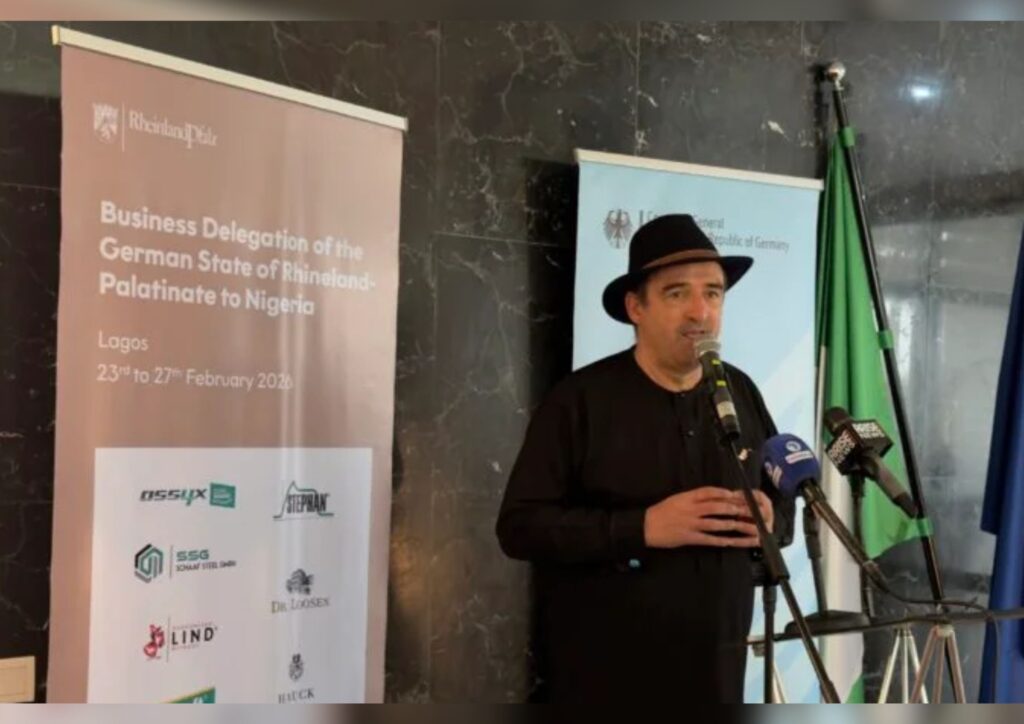
Germany’s state of Rheinland-Palatinate is stepping up efforts to strengthen trade and investment ties with Nigeria, as a delegation of government officials and business leaders visits Lagos to explore new commercial partnerships.
The visit, facilitated by the German Consulate General in Lagos, signals growing interest among German regional economies in tapping into Nigeria’s expanding market and deepening bilateral economic cooperation beyond federal-level agreements.
Rheinland-Palatinate — known in German as Rhineland-Pfalz — is one of Germany’s 16 federal states and boasts a Gross Domestic Product of approximately €185 billion. With a population of about four million people, the state is recognised for its industrial strength, advanced manufacturing capacity, and globally competitive wine production.
Speaking during a reception for the delegation in Lagos, the German Consul General, Daniel Krull, said German companies operating in Nigeria are entering 2026 with renewed confidence.
According to him, several investment initiatives are already in development, reflecting a positive outlook for economic engagement between both countries.
“Business-to-business engagement is the foundation of our economic relations, with government frameworks serving only as support where necessary,” Krull said.
He emphasised the role of small and medium-sized enterprises (SMEs) as the backbone of Germany’s economy, noting that many companies in the delegation are so-called “hidden champions” — highly specialised firms that export to more than 130 countries worldwide.
Krull added that cooperation at the level of federal states such as Rhineland-Palatinate demonstrates the decentralised strength of Germany’s economic structure and opens additional channels for collaboration beyond national agreements.
Joe Weingarten, Head of the Department of Foreign Trade at the Ministry of Economic Affairs, Transport, Agriculture and Viniculture of Rheinland-Palatinate, disclosed that Nigeria currently ranks fourth among the state’s African trade partners, behind Egypt, Algeria, and South Africa.
Trade between Nigeria and the German state has exceeded €1.5 billion, underscoring the growing commercial relationship.
With Nigeria’s population projected to continue expanding rapidly, Weingarten described the country as a strategic long-term market.
“Nigeria’s growing population is a strong factor in making it an important trade destination for us,” he said.
He noted that Germany views Nigeria not only as a market for finished goods but also as a potential production base and trade partner, suggesting opportunities for joint ventures and local value creation.
Eight companies are participating in the Lagos visit, representing sectors including wine, chemicals, pharmaceuticals, machinery, and construction.
Nearly 70 per cent of German wine production originates from Rheinland-Pfalz, making the state a global leader in the industry. Delegates expressed optimism about prospects in Nigeria’s expanding middle-class consumer market, particularly in premium food and beverage segments.
Beyond wine, the state has strong capabilities in chemicals, pharmaceuticals, automotive manufacturing, and machinery industries, where German engineering and technical standards are globally recognised.
Renewable energy is also a key area of strength. Approximately 60 per cent of Rheinland-Palatinate’s electricity generation comes from renewable sources, positioning it as a potential partner for Nigeria’s ongoing energy transition and solar storage ambitions.
Future German delegations to Nigeria are expected to focus on agrifood, ICT, solar storage, construction, and infrastructure sectors aligned with Nigeria’s development priorities.
Officials described the Lagos visit as a first step toward sustained cooperation in West Africa. The delegation is scheduled to meet with chambers of commerce, industry leaders, and private-sector stakeholders to identify areas of mutual interest.
While the immediate focus remains economic, Weingarten noted that broader political cooperation could evolve as trade relations deepen.
Analysts observe that Germany’s federal-state approach allows regions like Rheinland-Palatinate to pursue targeted partnerships tailored to their industrial strengths. For Nigeria, such decentralised engagement offers access to specialised expertise, technology transfer and investment opportunities.
The renewed outreach reflects a broader shift in global trade patterns, with European regions seeking diversified markets and production partners, while African economies pursue industrialisation and foreign direct investment.
For Nigeria, attracting investment from technologically advanced regions like Rheinland-Palatinate could support industrial growth, job creation, and capacity building. For the German state, Nigeria represents scale — a large and dynamic market with long-term growth potential.
As discussions continue in Lagos, both sides appear aligned on one key principle: sustainable economic partnerships are built not only on trade volumes but on trust, shared opportunity, and long-term commitment.
If successful, this latest engagement could mark the beginning of a deeper commercial corridor between West Africa’s largest economy and one of Germany’s most industrially vibrant states.