
ABUJA
Part B: Electoral Act Twist: Senate Retreats, INEC Now Under the Spotlight
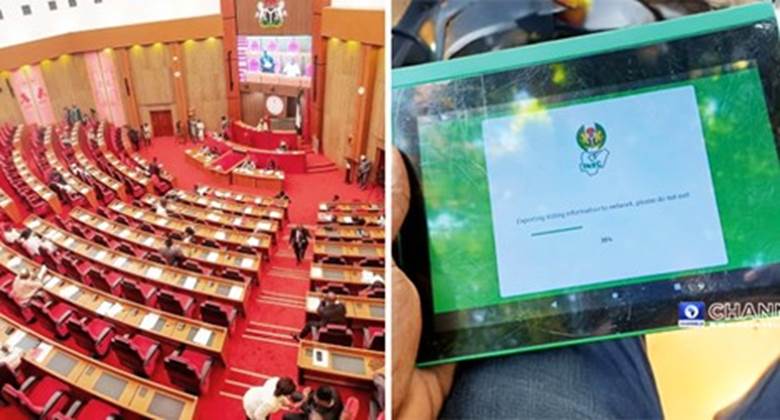
Central to the Senate’s reversal on electronic transmission of election results is a long-standing concern: Nigeria’s uneven internet coverage, particularly in rural, riverine, and conflict-affected areas. Lawmakers argue that without reliable connectivity nationwide, mandatory real-time transmission could disenfranchise voters or invalidate results from poorly connected polling units.
However, election technology experts and civil society groups insist that the internet challenge, while real, is not insurmountable and does not justify weakening the electronic transmission framework. Rather, they argue, the problem demands smart system design, legal clarity, and operational safeguards, not legislative retreat.
Across Nigeria and other emerging democracies, several practical solutions already exist:
- Store-and-Forward Model: Results can be captured electronically at polling units even without network coverage. Once counted, results are entered into the BVAS device and securely stored offline, uploading automatically once a stable connection is detected. This was partially applied in 2023, where delayed uploads often matched physical result sheets. Countries like India and Indonesia also use this model successfully.
- Multi-Network Devices: BVAS devices can be equipped with multiple SIM or eSIM profiles to switch automatically to the available network, reducing failed uploads without new infrastructure.
- Satellite-Backed Internet for Remote Areas: For hard-to-reach polling units, satellite internet can serve as a backup. This is targeted for riverine communities in Bayelsa, parts of the Niger Delta, and remote settlements in Borno and Taraba.
- Time-Bound Upload Windows: Instead of demanding instant “real-time” transmission, the law could specify a window of six to twelve hours post-polling. Failures would be documented, time-stamped, and independently verifiable.
- Connectivity Mapping & Redundant Upload Points: Pre-election identification of polling units by network strength, combined with ward or local government upload hubs, ensures results are securely transmitted even from offline zones.
- Strict Legal Penalties & Transparency: Deliberate interference with electronic transmission should attract penalties. INEC should publish logs post-election, including upload times, delays, and recovery timelines.
Election observers and governance experts warn that continued reliance on Form EC8A undermines reform. While intended as a safeguard, manual result sheets remain vulnerable to allegations of manipulation, placing the burden on INEC to prove any transmission failure is genuine.
The political sensitivity was evident in the Senate chamber itself. During deliberations, Senator Enyinnaya Abaribe challenged the process, demanding individual voting rather than a voice vote. Proceedings briefly descended into disorder before calm was restored.
Political reactions remain sharply divided. The PDP dismissed the amendment as a “clever-by-half” move preserving loopholes, while the ADC welcomed the reversal as proof of citizen influence. Human rights activists continue to demand compulsory real-time transmission, and Senator Natasha Akpoti-Uduaghan argued it is achievable with satellite solutions.
INEC Chairman Prof. Joash Amupitan sought to calm public fears, highlighting the BVAS system’s capabilities, including quick voter accreditation and automatic upload once connectivity is restored. However, experts stress that Nigeria’s digital infrastructure remains a challenge, with 301 of 774 LGAs lacking reliable internet and overall internet penetration at roughly 36 per cent.
To accelerate harmonisation, the Senate expanded its conference committee to 12 members, matching the House. Presidential assent is expected within February.
The Senate’s U-turn is a significant, if imperfect, step toward electoral modernisation. But legislation alone is not enough. INEC must demonstrate technical capacity, institutional integrity, and transparency. Failure risks public mistrust, post-election litigation, and eroded confidence in 2027 polls.
For Nigerians, the debate underscores a central truth: electoral reform is no longer just about law. It is about trust in institutions, technology, and the political will to protect the vote. In this test, the burden now rests firmly on INEC.