
Abuja
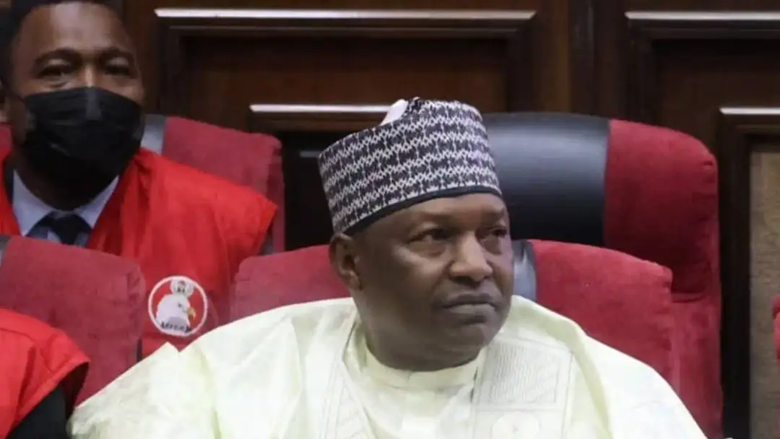
Former Attorney-General of the Federation and Minister of Justice, Abubakar Malami (SAN), has asked the Federal High Court in Abuja to set aside an interim forfeiture order placed on three of his properties by the Economic and Financial Crimes Commission (EFCC), insisting that his wealth was acquired from legitimate sources, including salaries, business income, and personal gifts.
Malami requested a fresh motion filed before the Abuja Division of the court, challenging an interim forfeiture order granted on January 6, 2025, by Justice Emeka Nwite, which temporarily forfeited 57 properties allegedly linked to unlawful activities and traced to him.
The former justice minister is contesting the forfeiture of three specific properties, arguing that they were lawfully acquired, properly declared, and not connected to any criminal conduct.
In the application, Malami challenged the forfeiture of properties listed as numbers 9, 18, and 48 in the EFCC’s ex parte motion.
They include:
- A property located at Plot 157, Lamido Crescent, Nasarawa GRA, Kano;
- A duplex with boys’ quarters at No. 12, Yalinga Street, off Adetokunbo Ademola Crescent, Wuse II, Abuja, reportedly purchased for N150 million in October 2018; and
- The ADC Kadi Malami Foundation Building, acquired for N56 million.
These properties form part of a larger pool of multibillion-naira assets spread across Abuja, Kano, Kebbi and Kaduna states, which the EFCC claims are proceeds of unlawful activities.
Justice Nwite, sitting as a vacation judge, granted the interim forfeiture order following an ex parte application filed by EFCC counsel, Ekele Iheanacho (SAN).
The judge also directed the anti-graft agency to publish the forfeiture order in a national newspaper and invited interested parties to show cause within 14 days why the properties should not be permanently forfeited to the Federal Government.
The order was part of ongoing asset-tracing efforts by the EFCC against the former Attorney-General, who served from 2015 to 2023.
In response, Malami, through his legal team led by Joseph Daudu (SAN), accused the EFCC of obtaining the interim order through suppression of material facts and misrepresentation.
In the motion on notice, dated January 26 and filed on January 27, Malami urged the court to vacate the forfeiture order on the three properties, arguing that it violated his constitutional rights to property, presumption of innocence, and peaceful enjoyment of family life.
He also asked the court to restrain the EFCC from interfering with his ownership, possession, and control of the properties while the matter remains unresolved.
A key plank of Malami’s argument is that the disputed properties were fully declared in his asset declaration forms submitted to the Code of Conduct Bureau (CCB) during his tenure as a public officer.
According to the application, Malami declared the assets in both his 2019 and 2023 asset declaration forms, which his lawyers argue constitutes prima facie proof of lawful acquisition.
He further stated that one of the properties is held in trust for the estate of his late father, Khadi Malami Nassarawa, and therefore cannot lawfully be forfeited.
In a 14-ground argument, Daudu told the court that the EFCC failed to link the properties to any specific criminal offence or provide prima facie evidence of unlawful activity.
The senior advocate outlined Malami’s declared sources of income to include:
- Over N374 million from salaries, estacodes, and severance allowances;
- Sitting allowances from service on various judicial and presidential committees;
- N574 million from the disposal of assets;
- Over N10 billion in business turnover;
- N2.52 billion in loans advanced to businesses;
- N958 million received as traditional gifts from personal friends.
He also disclosed that Malami earned over N509 million from the launch and public presentation of his book titled “Contemporary Issues on Nigerian Law and Practice, Thorny Terrains in Traversing the Nigerian Justice Sector: My Travails and Triumphs.”
According to Daudu, these income streams, alongside profits from business activities, sufficiently demonstrate that the properties were acquired through lawful means and declared in compliance with the Fifth Schedule of the 1999 Constitution.
Malami’s legal team also faulted the EFCC for allegedly relying on exaggerated and inflated valuations of the assets to mislead the court into granting the interim forfeiture order.
They argued that no credible valuation evidence or prima facie proof was presented to justify the forfeiture, describing the order as premature and unjustified.
The case, earlier adjourned to January 27 for a report on compliance with the publication order, could not proceed after it was discovered that the matter was not listed on the court’s cause list, having been heard during the court’s vacation.
As a result, Justice Nwite returned the case file to the Chief Judge of the Federal High Court for reassignment to another judge.
The court is expected to fix a new hearing date once the reassignment is completed.
Beyond the forfeiture proceedings, Malami is currently facing money laundering charges filed against him by the EFCC.
He is also reportedly being held at a State Security Service (SSS) facility over a separate allegation bordering on terrorism financing, a development that has further intensified public scrutiny around his legal battles.
With the interim forfeiture order now under challenge and the case awaiting reassignment, the legal confrontation between Malami and the EFCC is far from over.
Legal observers say the outcome could test the balance between asset-recovery powers of anti-corruption agencies and the constitutional protections available to individuals, particularly former public office holders.
As the court prepares to take the matter afresh, attention will remain firmly on how the judiciary navigates the competing claims of accountability, due process, and the presumption of innocence.