
Niamey, Niger
Panic swept across parts of Niger’s capital, Niamey, late Wednesday night after heavy gunfire and loud explosions were reported near the country’s main international airport, raising fresh concerns about security in the Sahel nation already battling political instability and insurgency.
Residents living close to Diori Hamani International Airport said the disturbance began shortly after midnight and continued for nearly two hours, with repeated gunshots and blasts echoing across neighbourhoods surrounding the airport.
Many described the sounds as different from normal military drills, saying the intensity and duration of the explosions triggered fear and confusion, with families staying indoors and streets quickly emptying as the situation unfolded.
Videos circulated on social media appeared to show bright streaks of light across the sky, leading to speculation that air defence systems may have been activated. However, authorities have not confirmed this, and the videos could not be independently verified at the time of reporting.
Hours after the incident, an official of Niger’s Ministry of Foreign Affairs told Anadolu News Agency that the situation was “under control” and urged residents to remain calm. No official explanation was given for the cause of the gunfire and explosions, and there was no immediate confirmation of casualties or damage.
By early Thursday morning, calm had largely returned to the affected areas, although the heavy military presence around the airport remained visible.
The lack of detailed information has fuelled speculation among residents, many of whom are already on edge due to months of political tension and persistent security threats.
The location of the incident has drawn particular concern.
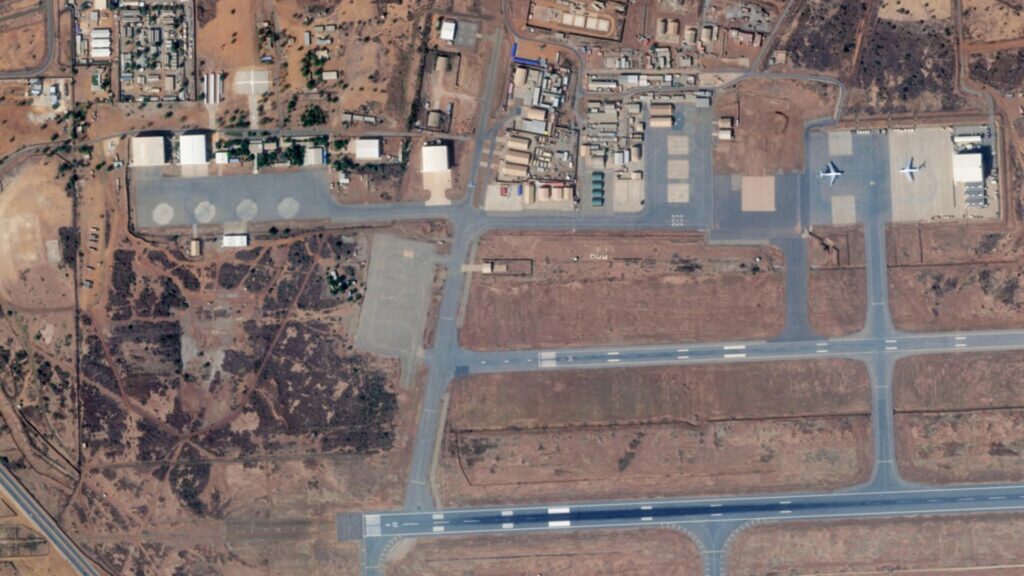
Diori Hamani International Airport, situated about 10 kilometres from the presidential palace, is not only Niger’s main civilian airport but also a major military hub. It houses a Nigerien Air Force base, a drone facility, and serves as a coordination point for the joint military force created by Niger, Mali, and Burkina Faso to fight jihadist groups across the Sahel.
Residents reported seeing fire engines speeding towards the airport at the height of the incident, while open-source flight tracking data showed that a commercial flight from Algiers was diverted to Burkina Faso, suggesting that authorities considered the situation serious enough to disrupt air traffic.
Images shared online, though unverified, appeared to show flames rising several metres high and what looked like burnt vehicles near the airport’s perimeter fence.
In a further twist, a foreign ministry official disclosed that investigators were looking into whether the incident could be linked to a large uranium shipment currently stranded at the airport.
Niger is one of the world’s major uranium producers, supplying nuclear fuel to several countries. However, exports have been disrupted since the military government nationalised uranium mines following the 2023 coup, triggering disputes with foreign partners, particularly France.
The uranium consignment is reported to have been stuck at the airport for weeks, adding to the country’s economic pressure and raising questions about security around strategic resources.
While officials have not confirmed any connection between the gunfire and the uranium shipment, the revelation has added another layer of complexity to the incident.
As the gunfire faded around 2am, new tensions emerged online.
Supporters of the military government began circulating messages calling on residents to “defend the country.” One pro-junta activist, Ibrahim Bana, posted a video urging people to take to the streets, a move that raised fears of possible unrest or clashes.
Security analysts say such calls reflect the highly charged atmosphere in Niamey, where political loyalties remain divided and fear of external interference runs high.
Niger has been under military rule since July 2023, when General Abdourahamane Tiani overthrew the democratically elected government of President Mohamed Bazoum. Since then, the country has faced diplomatic isolation, economic pressure, and worsening security conditions.
Like neighbouring Mali and Burkina Faso, Niger continues to battle jihadist groups linked to Al-Qaeda and Islamic State, particularly in border regions. According to the conflict monitoring group ACLED, nearly 2,000 people were killed in jihadist-related violence in Niger in 2025 alone.
Following the coup, the three military-led countries expelled French and US forces and later formed the Alliance of Sahel States (AES), announcing plans for a 5,000-strong joint force to fight insurgents. Despite these measures, attacks on civilians, military bases, and infrastructure have continued.
As of press time, Niger’s military authorities had not issued a detailed statement explaining what caused the gunfire and explosions near the airport, leaving residents and observers waiting for clarity.
What is clear is that the incident has once again highlighted the fragile security situation in Niger, where political uncertainty, regional conflict, and economic strain continue to intersect.
For now, calm has returned to Niamey — but the unanswered questions surrounding the night of gunfire and explosions serve as a reminder that stability in the Sahel remains fragile, and peace uncertain.