
Paris
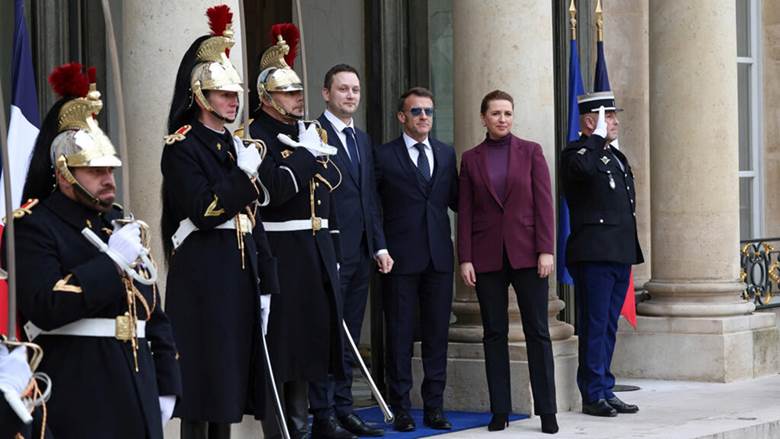
Europe’s reliance on the United States for military protection has come under fresh scrutiny after the recent Greenland controversy, French President Emmanuel Macron said on Wednesday, calling it a “strategic wake-up call” for the continent. The warning came as Macron hosted Denmark’s Prime Minister Mette Frederiksen and Greenland’s Premier Jens-Frederik Nielsen in Paris to discuss security, autonomy, and transatlantic relations.
The diplomatic meeting underscores Europe’s growing concern about its ability to assert strategic independence in a world of shifting alliances, rising military tensions, and economic vulnerabilities.
Speaking at the Élysée Palace ahead of the summit, President Macron stressed that Europe must reduce its overreliance on the United States for defence. “Europe cannot indefinitely rely on others for its security,” Macron said. “The Greenland episode is a wake-up call that reminds us to strengthen our capabilities and assert our strategic autonomy.”
The French leader’s remarks reflect broader unease following former US President Donald Trump’s 2019 suggestion to purchase Greenland, a Danish autonomous territory. While Washington has since downplayed the incident, it revived fears in European capitals that transatlantic ties, while historically strong, may not always guarantee Europe’s security.
Prime Minister Frederiksen of Denmark echoed Macron’s concerns, stressing the need for immediate action. Speaking at Sciences Po University in Paris, she said:
“When you look at intelligence, nuclear weapons, and so on, we depend on the US. But Europe is capable of doing much more than we publicly acknowledge. Rearming ourselves now is crucial.”
Frederiksen also criticized the long-term NATO spending targets, noting that the 2035 deadlines would come too late to address current threats.
Greenland’s Premier, Jens-Frederik Nielsen, added that while Greenland maintains strong ties with both Denmark and the United States, its people expect autonomy and protection from undue geopolitical pressures.
Europe’s reliance on the United States extends beyond military matters. Valdis Dombrovskis, European Commissioner for Economic Affairs, highlighted the continent’s dependence on US-dominated payment systems, such as Visa and Mastercard, during the European Banking Summit.
“Today, our payments landscape is highly dominated by non-European providers. This makes us dependent on foreign-owned companies in an increasingly polarised and fragmented world,” Dombrovskis said.
Efforts to create a digital euro have been underway since 2020 to mitigate such risks, but progress has been slow due to political disagreements and pushback from banks, illustrating the broader challenge of economic sovereignty alongside military autonomy.
Security analysts see Greenland as emblematic of wider transatlantic challenges. Ian Lesser, Senior Director for Foreign and Security Policy at the German Marshall Fund, explained:
“The US provides things Europe cannot easily replace for many years, even if it invests more in defence or assumes a more active role. The Greenland episode is less about a single territory and more about reminding Europe to plan for the long term.”
European capitals now face a complex geopolitical environment: balancing transatlantic alliances, deterring potential adversaries, and ensuring that continental security and economic systems are robust enough to withstand shocks.
Even cultural figures have weighed in. Canadian-American musician Neil Young offered Greenlanders free access to his music catalogue as a symbolic gesture of solidarity, aiming to “ease some of the unwanted stress and threats” residents face.
While symbolic, the gesture underscores that Greenland’s strategic importance resonates beyond military or economic concerns—it has become a touchstone for discussions about sovereignty, autonomy, and Europe’s role in global geopolitics.
The Paris talks signal a shared recognition among European and Danish leaders that Europe must act decisively to bolster its defences and assert economic and strategic independence.
As Macron put it:
“We must not wait for external shocks to remind us of our responsibilities. Europe’s future security and autonomy depend on the decisions we make today.”
For now, the Greenland standoff serves as both a warning and an opportunity for Europe to rethink its strategic priorities, balance transatlantic reliance, and prepare for a rapidly changing geopolitical landscape.