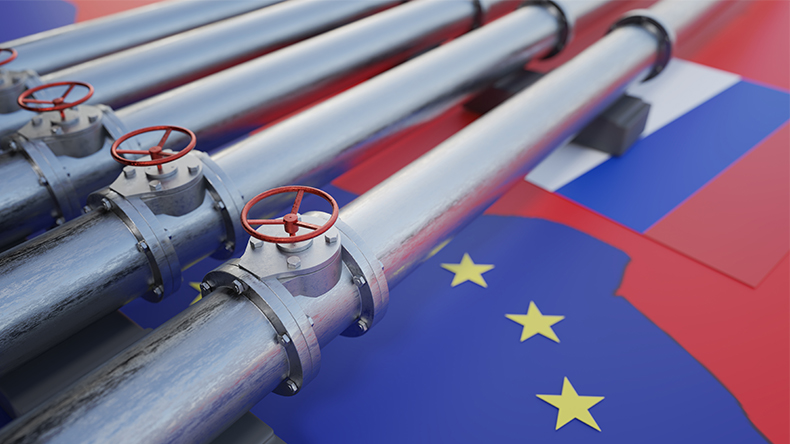
The European Union has formally approved a phased ban on Russian gas imports, setting a deadline of 2027 to end the bloc’s reliance on Moscow for energy and cementing one of its most consequential policy shifts since Russia’s full-scale invasion of Ukraine in 2022.The new law will halt imports of Russian liquefied natural gas (LNG) by the end of 2026, followed by a complete stop to pipeline gas no later than September 30, 2027. Member states may request a narrow extension until November 1, 2027 if they are unable to secure adequate storage levels for winter.Before the Ukraine war, Russia supplied over 40% of Europe’s natural gas — a strategic dependence that shaped decades of economic policy. That share had already declined to an estimated 13% by 2025, as European governments scrambled to secure alternative suppliers, expand LNG terminals, and accelerate investment in renewables.The final vote passed despite divisions within the bloc. Hungary and Slovakia opposed the measure, while Bulgaria abstained. Hungarian officials indicated that Budapest may challenge the law in the European Court of Justice, arguing that it threatens national energy security. The European Commission maintains the policy falls within EU competence on shared energy and sanctions.The ban forms part of a broader European strategy to reduce Russia’s wartime revenues, reshape the continent’s energy system, and strengthen collective security through diversification. Since 2022, EU member states have increased imports from Norway, the United States, Qatar and North African suppliers, while expanding LNG capacity in Spain, Germany, and the Netherlands.Analysts say the policy signals a long-term break with a decades-old economic relationship that once linked European industry to Russian hydrocarbons through pipelines built during the Cold War. Some governments view the shift as irreversible; others worry about supply volatility and price pressures as the transition unfolds.Energy experts note that the ban will test Europe’s ability to balance decarbonisation, inflation management, and strategic autonomy at the same time. The EU has also set parallel targets to boost wind and renewable capacity, expand electricity grid interconnections, and encourage industrial electrification to reduce fossil fuel demand.Russia has criticised the policy and is expected to seek alternative markets for the remaining volumes, though global infrastructure constraints limit rapid re-direction.The EU’s energy transition is now entering a new phase: cutting dependency is no longer a crisis response but a structural strategy. The challenge will be how the bloc navigates the political, economic and market consequences of turning that strategy into reality.