
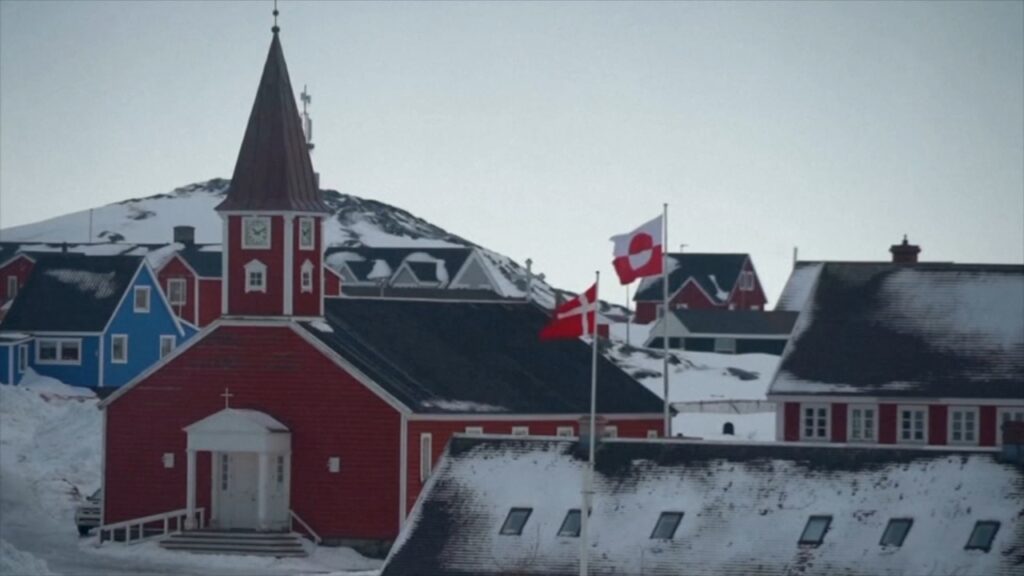
President Donald Trump’s determination to bring Greenland under U.S. control has triggered a sharp diplomatic confrontation with Denmark and the Greenlandic government, raising fears of a serious rupture in transatlantic relations.
Speaking on Friday, Trump reiterated that the United States “needs” Greenland for strategic and security reasons and said he was considering the use of tariffs against countries that resist Washington’s objective. The remarks mark the most explicit economic threat yet in a campaign that has unsettled European allies and NATO partners.
The president argues that Greenland’s location at the gateway to the Arctic makes it indispensable to American national security, particularly as competition with Russia and China intensifies in the polar region. “We cannot allow others to dominate that space,” Trump told reporters, without providing details on how annexation would be pursued.
European Outrage and Nordic Resistance
Copenhagen reacted swiftly, describing Trump’s comments as unacceptable and contrary to international law. Danish officials emphasized that Greenland, while enjoying broad autonomy, remains part of the Kingdom of Denmark and that its future cannot be decided through coercion.
Greenland’s leadership has been equally firm. The government in Nuuk stated again this week that the island is not for sale and that any discussion about its status must respect the principle of self-determination. Local politicians warned that Trump’s rhetoric ignores Greenlandic aspirations and risks destabilizing the Arctic at a time when cooperation is essential.
Across Europe, the reaction has been one of alarm. French and German diplomats cautioned that any attempt by Washington to force the issue could damage trade relations and undermine NATO unity. Analysts note that the dispute touches a sensitive nerve, reviving memories of great-power competition over smaller territories.
Talks End in Stalemate
Efforts to calm the crisis through diplomacy have so far produced little progress. Meetings in Washington between U.S., Danish and Greenlandic representatives, including discussions led by Vice President J.D. Vance, ended with what officials described as “fundamental disagreement” over sovereignty and security arrangements.
While the United States insists it seeks a negotiated solution, Danish negotiators reported no movement on the core demand that Greenland remain under Danish authority. Observers say trust between the allies has been badly shaken.
Domestic Skepticism in the U.S.
At home, Trump’s Greenland push appears unpopular. A new national poll shows roughly three-quarters of Americans oppose the idea of annexing the territory, with many respondents saying the administration is focused on the wrong priorities during its first year back in power.
The controversy unfolded as Trump also addressed domestic security issues, saying he had no immediate plans to invoke the Insurrection Act to deploy troops to Minnesota despite earlier threats. “There’s no reason right now,” he said, adding that he would act if circumstances changed.
Strategic Stakes
Greenland, the world’s largest island, hosts a major U.S. air base and sits atop significant mineral resources and emerging Arctic shipping routes. Experts say control over the territory would offer substantial military and economic advantages, but warn that unilateral action could shatter decades of Western cooperation.
For now, the standoff leaves relations between Washington and its European allies at one of their lowest points in recent memory. Whether diplomacy can bridge the widening Arctic divide remains uncertain, but the episode has already redrawn the contours of global debate over sovereignty, security and the future of the far North.