
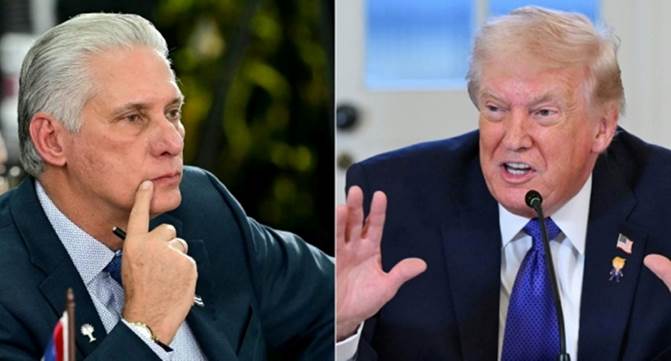
U.S. President Donald Trump has issued a stark warning to Cuba, urging the Caribbean island nation to “make a deal” with the United States before it is “too late,” amid escalating regional tensions following the U.S. seizure of Venezuelan leader Nicolás Maduro. The message, delivered via Trump’s Truth Social platform on January 11, 2026, signals a sharp escalation in U.S. pressure on Havana and marks a significant shift in Washington’s posture toward its long-standing geopolitical rival.
President Trump wrote: “THERE WILL BE NO MORE OIL OR MONEY GOING TO CUBA — ZERO! I strongly suggest they make a deal, BEFORE IT IS TOO LATE,” without laying out specific terms or consequences if Cuba refuses to negotiate.
The warning comes in the wake of U.S. forces’ Operation Absolute Resolve — a military operation earlier this month that culminated in the capture of Venezuelan President Nicolás Maduro and his wife on drug trafficking and related charges. In the aftermath, the United States has seized Venezuelan oil tankers and exerted control over the country’s oil supply, which historically provided Cuba with crucial energy resources.
Cuba has long depended on preferential oil shipments from Venezuela, a relationship rooted in decades of political and economic cooperation. With those shipments cut off under U.S. pressure, Cuban authorities are confronting an already fragile energy situation and widening economic strain.
Cuban government officials swiftly condemned Trump’s ultimatum, framing it as an attack on national sovereignty. Cuban President Miguel Díaz‑Canel declared that “no one dictates what we do,” rejecting external interference in Cuba’s affairs. The island’s economy, already grappling with shortages of basic goods and persistent power blackouts, now faces additional stress without Venezuelan oil.
Cuban Foreign Minister Bruno Rodríguez similarly reiterated on social media that Havana retains the sovereign right to import fuel “from any willing exporter… without interference or subordination to the unilateral coercive measures of the United States.”
Relations between Havana and Washington have deteriorated sharply since early January, when Cuban authorities reported the death of 32 members of its armed forces and intelligence services during the U.S. operation in Venezuela. Cuba said the personnel were in Caracas under an agreement with Venezuelan authorities. Washington has defended the operation as part of its broader strategy to combat narcoterrorism and criminal networks.
The deaths of Cuban personnel have heightened tensions and are likely to influence Cuba’s diplomatic posture in the weeks ahead as Havana balances internal criticism with external pressure.
Trump’s ultimatum must also be understood against the backdrop of decades of U.S.–Cuba antagonism. Since Cuba’s 1959 revolution and the subsequent imposition of a U.S. trade embargo, relations between the two countries have been marked by ideological confrontation, intermittent diplomatic thawing, and entrenched mistrust. Cuba’s reliance on Venezuelan oil under agreements dating back to the early 2000s helped sustain its economy through some of its harshest sanctions and shortages — until now.
The loss of Venezuelan energy support compounds the economic dilemmas facing Havana, which has increasingly looked to alternative suppliers such as Mexico, though these have yet to fully compensate for the shortfall.
Trump’s hard line towards Cuba is part of a broader realignment of U.S. policy in Latin America following the ouster of Maduro, a key ideological ally of Havana. U.S. pressuring Cuba to negotiate reflects Washington’s intent to diminish the influence of communist‑aligned governments in the region and reshape geopolitical relationships previously anchored by Caracas — even as Cuba rejects what it calls unilateral coercive measures.
Analysts warn that cutting Cuba off from Venezuelan oil could trigger deeper economic instability and social unrest on the island, challenging Havana’s capacity to govern effectively amid shortages and infrastructural strain.
As Cuba weighs Trump’s ultimatum, observers say the situation will have significant diplomatic and economic ramifications. Washington’s next steps — including any formal proposal outlining the terms of a deal with Cuba — remain unclear, but the current rhetoric underscores a potentially transformative period in U.S.–Cuba relations.
For now, the international community watches closely as Cuba confronts a tightening squeeze on energy supplies, constrained economic growth, and intensifying diplomatic pressure from Washington. The coming weeks will likely shape both Cuba’s internal policy responses and the broader geopolitical landscape in the Western Hemisphere.