
Nigeria’s long-running struggle with insecurity has entered a more diplomatically sensitive phase, as renewed domestic assurances of military empowerment coincide with unusually direct warnings from the United States. In Abuja on Friday, the Federal Government reaffirmed its resolve to strengthen the Armed Forces amid persistent violence—just as remarks by U.S. President Donald Trump sharpened debate around sovereignty, counterterrorism cooperation, and the international framing of Nigeria’s security crisis.
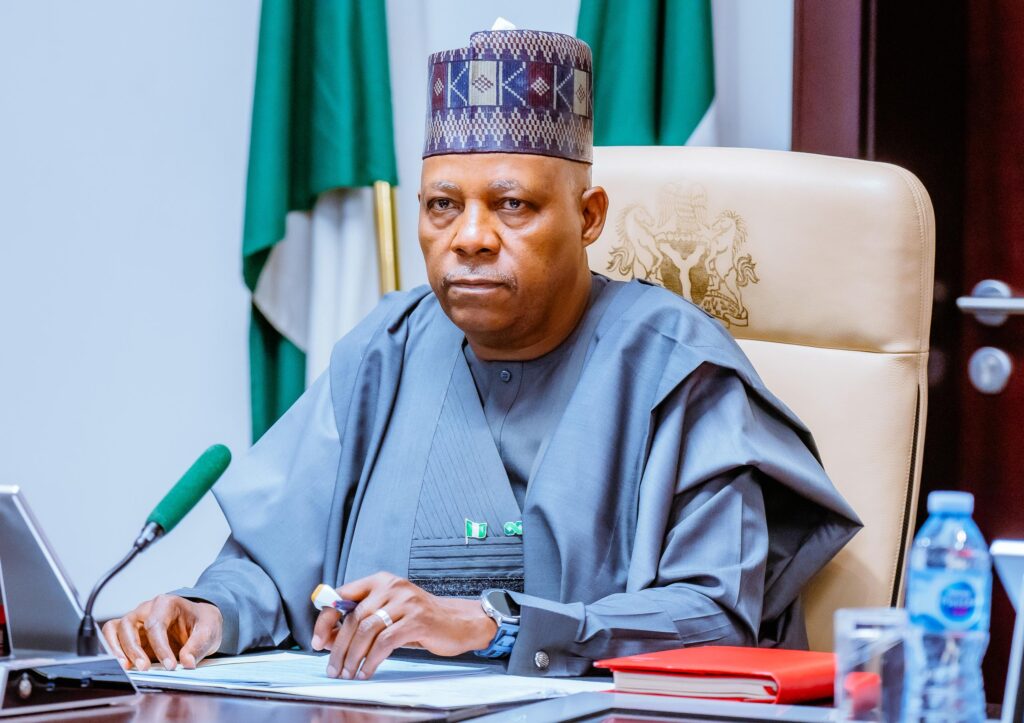
The Federal Government’s position was conveyed by Vice President Kashim Shettima during a special Jumma’a Prayer at the National Mosque in Abuja, held ahead of the 2026 Armed Forces Celebration and Remembrance Day. Observed annually on January 15, the event honours serving personnel and commemorates fallen soldiers who have died in defence of the nation.
Addressing worshippers, Shettima reiterated President Bola Tinubu’s commitment to equipping and empowering the Nigerian Armed Forces to confront insurgency, banditry, kidnapping, and other violent threats. He paid tribute to military personnel who “paid the supreme price” for Nigeria’s territorial integrity and acknowledged the sacrifices of their families.
The message was both symbolic and strategic. With insecurity continuing to affect multiple regions—from insurgency in the northeast to banditry and mass abductions in the northwest and north-central areas—the government sought to project confidence, continuity, and renewed determination.
Nigeria’s renewed security messaging follows comments by U.S. President Donald Trump in a January 8 interview with The New York Times, in which he warned that the United States could carry out further airstrikes in Nigeria if killings of Christians continue. He referenced a U.S. airstrike conducted on Christmas Day in northwestern Nigeria.
The U.S. military stated that the operation targeted Islamic State militants and was conducted at the request of the Nigerian government. Nigerian authorities similarly described the action as a joint counterterrorism operation against designated terrorist groups, stressing that it was not linked to religion.
President Trump, however, framed the issue in religious terms, saying additional strikes could follow if attacks persisted. While acknowledging that Muslims have also been killed by extremist groups, he maintained that Christians were disproportionately targeted.
Nigerian officials have consistently rejected claims of systematic religious persecution, arguing that the country’s security crisis is rooted in a complex mix of insurgency, organized crime, governance gaps, and socioeconomic pressures.
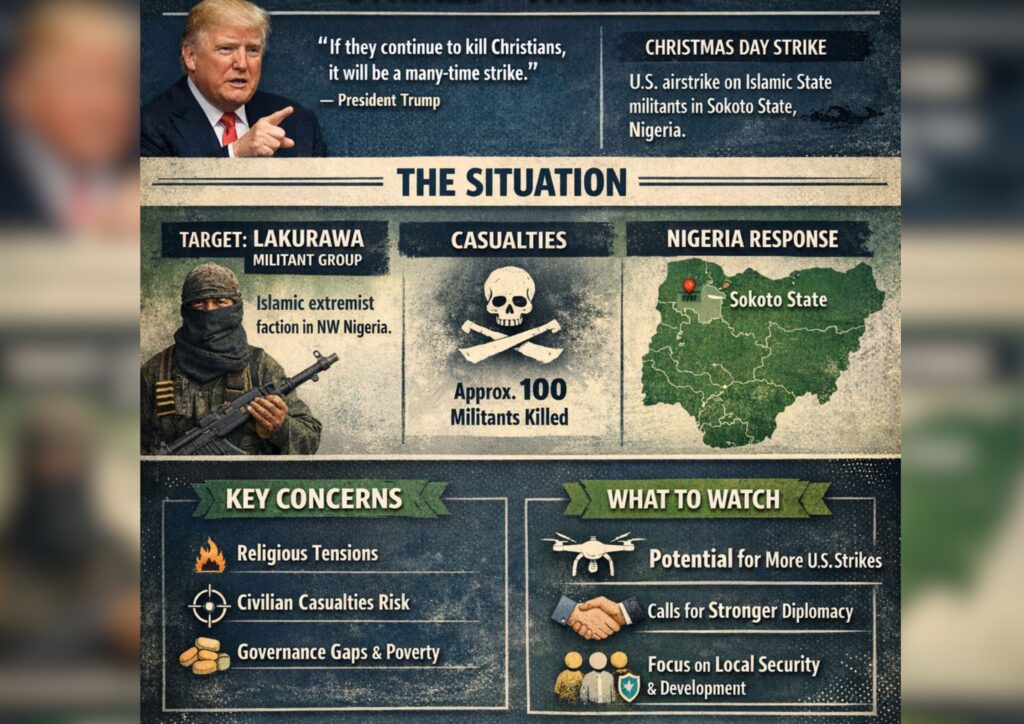
With a population of over 230 million, Nigeria is almost evenly divided between Christians and Muslims. Security agencies and independent analysts note that extremist violence has affected both communities, warning that framing the crisis primarily along religious lines risks oversimplifying the conflict and deepening internal tensions.
While Abuja remains open to cooperation with Washington on counterterrorism, it has also emphasized the need to protect national sovereignty and resist narratives that could further polarize society.
The convergence of domestic military commitments and external pressure highlights the balancing act facing the Tinubu administration. International cooperation remains vital for intelligence sharing and capacity-building, but overt threats of unilateral action risk straining diplomatic relations and complicating internal security efforts.
Reaffirming confidence in the Armed Forces serves multiple goals: reassuring citizens, signaling resolve to partners, and asserting Nigeria’s responsibility for its own security.
In the weeks ahead, attention will focus on:
- Concrete military reforms in equipment, welfare, and intelligence coordination;
- The tone of U.S.–Nigeria engagement, particularly whether cooperation broadens beyond religious framing;
- Transparency around joint operations to sustain public trust; and
- Nigeria’s ability to manage internal narratives without inflaming religious or ethnic divisions.
Nigeria’s security challenge will not be solved by airstrikes alone. The coming period will test whether strengthened military capacity, supported by governance reforms and careful diplomacy, can steer the countrytoward greater stability while preserving its sovereignty.